
Wheel Load vs Outrigger Load on Indoor Aerial Lifts What Buyers Should Check
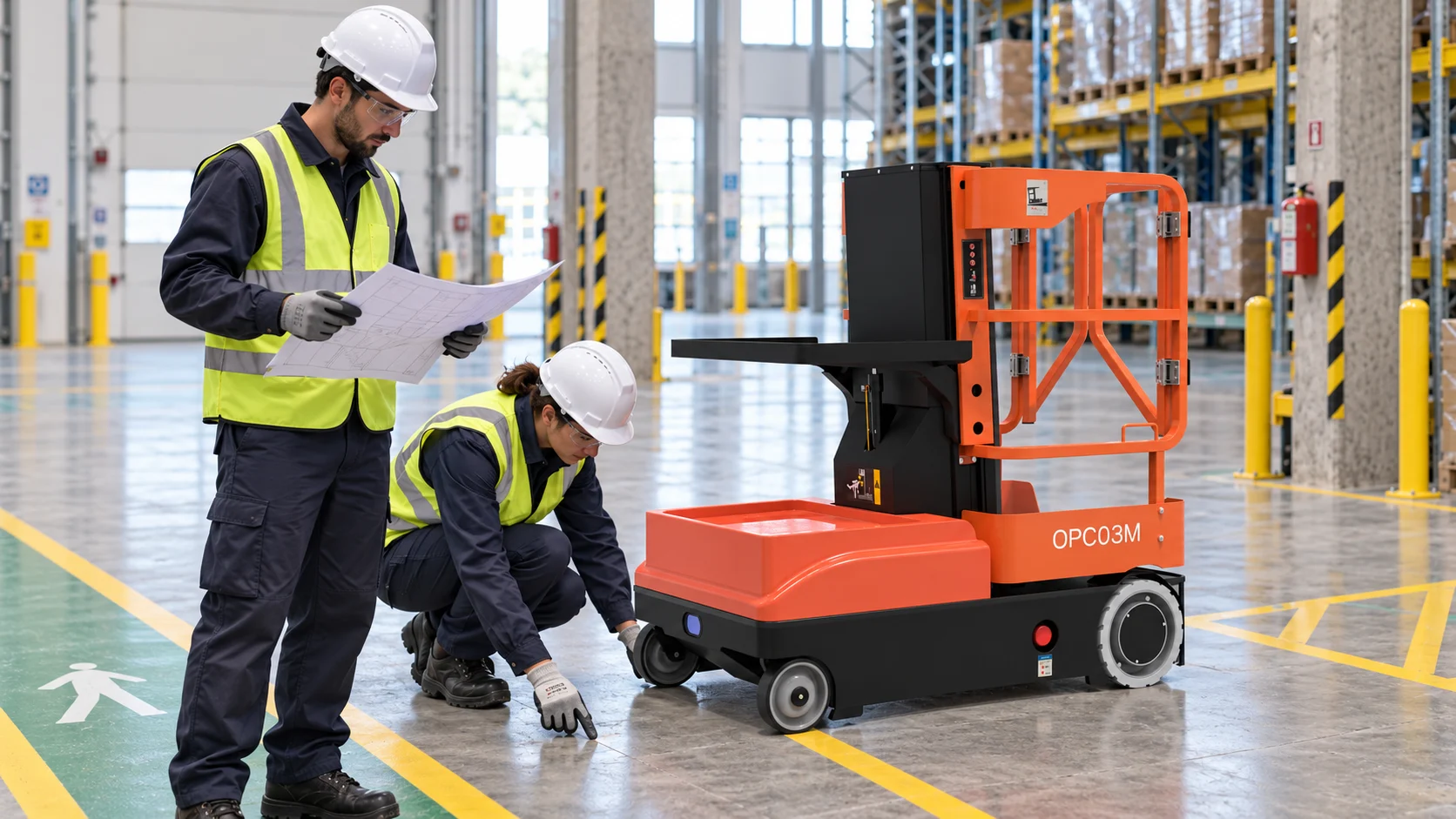
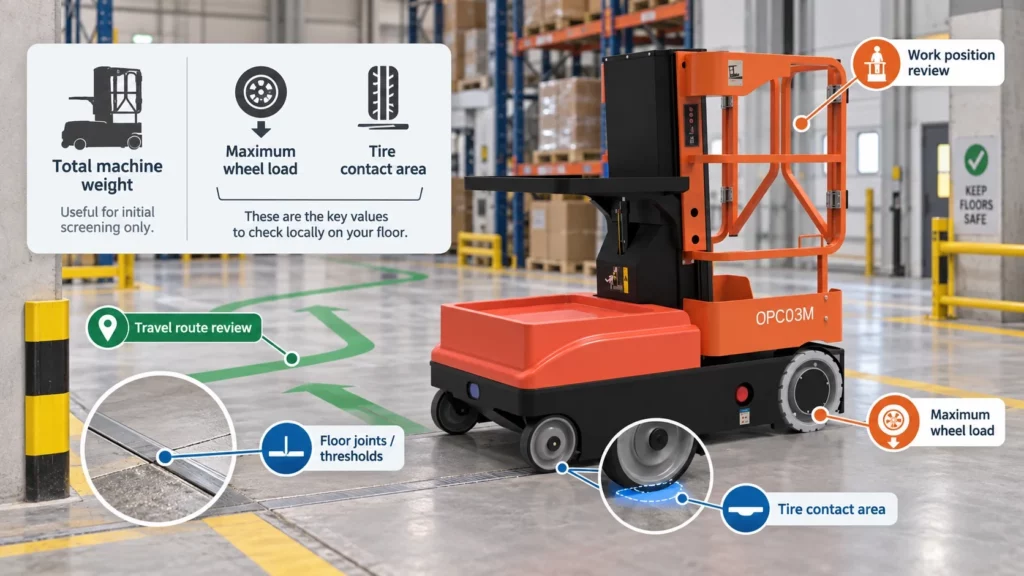
Wheel load and outrigger load describe different operating states of an indoor aerial lift. Wheel load is the reaction carried by one tire while the machine is supported on its wheels. Outrigger load is the reaction at one stabilizer foot after the supports are deployed. Buyers may need both values for the same job: wheel loads govern the access route, while outrigger reactions govern the work position.
Neither value can be replaced by total machine weight divided equally among the contact points. The controlling reaction depends on the machine configuration, platform load, center of gravity, steering or setup condition, and the manufacturer’s defined load case. Procurement teams should therefore request maximum reactions and contact dimensions, then have the facility owner or qualified structural reviewer compare them with the actual floor system.
Wheel Load and Outrigger Load Are Not Interchangeable
| Check | Wheel-supported condition | Outrigger-supported condition |
|---|---|---|
| Support point | Individual tire contact patch | Individual outrigger foot or approved pad |
| Typical phase | Travel, steering, braking, parking, and wheel-supported work | Stationary setup and elevated work after deployment |
| Primary request | Maximum wheel load and tire contact information | Maximum outrigger reaction and foot or pad dimensions |
| Common concern | Rolling load, joints, thresholds, panels, finishes, and local framing | High concentrated reaction, setup footprint, bearing, and load spreading |
| Approval basis | Exact route and operating condition | Exact work point and deployed configuration |
When Maximum Wheel Load Controls
Maximum wheel load matters anywhere the lift travels or remains supported by its tires. A route review should cover unloading, ramps, elevators, raised access panels, mezzanine decking, grating, joints, thresholds, turns, braking zones, and the final parking position. A wheel crossing a panel edge or narrow deck element is a local event; an acceptable average floor pressure does not prove that the concentrated or rolling load is acceptable.
Do not estimate each wheel reaction as one-quarter of a four-wheel machine’s loaded weight. Batteries, drive components, steering geometry, platform extension, payload location, and grade can shift the load distribution. Ask for the manufacturer’s maximum wheel load for the planned configuration and clarify whether it applies during travel, elevated operation, or another stated condition. Job planning should also follow OSHA’s Working Safely with Scissor Lifts guidance and the instructions for the exact model.
When Maximum Outrigger Reaction Controls
Outrigger load becomes relevant when a lift must deploy stabilizers before elevation or for a defined working configuration. The supports change the load path by creating discrete bearing points outside or near the chassis. One foot may carry more than an equal share because of machine geometry, payload position, leveling, or the manufacturer’s design case. Outriggers improve stability when used as specified, but they do not automatically reduce the structural demand on the floor.
Buyers should request the maximum reaction at any one outrigger, the standard foot dimensions, any approved pad requirements, the full deployed footprint, allowable slope, and confirmation of whether the tires remain loaded after setup. JQLIFT’s guide to vertical mast lift outrigger footprint explains why setup clearance must be checked separately from stowed machine width. The floor review must still address each concentrated support reaction.
Why One Indoor Job May Require Both Checks
A lift can pass the work-position review and still be unable to reach that position. For example, an approved outrigger reaction at the work point does not verify a raised-floor route, an elevator sill, or a mezzanine joint. The reverse can also occur: the wheels may be acceptable along the route, while a small outrigger foot creates an excessive local reaction at setup. Treat travel and elevated work as separate load cases connected by one documented route.
Do not add maximum wheel load and maximum outrigger reaction together unless the manufacturer identifies a simultaneous load case. Some machines may unload the wheels substantially when stabilized; others may retain a defined wheel reaction. The correct combination must come from the product manual or manufacturer, not from an assumed support pattern.
Buyer Floor-Load Data Checklist
1. Identify the exact model and options. Record battery or power package, tires, attachments, platform extension, and any stabilizer configuration.
2. Define the loaded operating case. State occupants, tools, materials, and the maximum planned platform load rather than submitting an empty-machine request.
3. Request maximum reactions. Obtain maximum individual wheel load and maximum individual outrigger reaction, with units and the operating condition for each value.
4. Request contact information. Confirm tire type and contact assumptions, outrigger foot dimensions, approved pads, and any manufacturer restrictions on mats or supports.
5. Map the complete route. Include docks, ramps, elevators, doors, turns, thresholds, floor joints, access panels, openings, edges, and damaged areas.
6. Define every work position. Mark the deployed footprint, required clearances, platform orientation, emergency lowering area, and nearby floor discontinuities.
7. Match each value to the correct rating. Uniform live load, concentrated load, rolling load, contact pressure, wheel load, and outrigger reaction are not interchangeable.
8. Record approval and controls. Document permitted routes, setup points, payload limits, surface protection, load-spreading design, inspections, and operating restrictions.
Evaluate Contact Area and Load Spreading Carefully
A simple pressure screen divides a support reaction by an assumed contact area. That calculation can help compare alternatives, but it is not a complete structural check. Pneumatic and solid tires deform differently, an outrigger foot may not bear uniformly, and a mat does not distribute load evenly across its full visible area unless its stiffness and support conditions allow it. Raised panels, deck plates, concrete slabs, joists, and connections can respond differently to the same reaction.
Plywood or steel plates may protect a finish or spread a load when they are properly designed, but they do not create capacity in an inadequate floor. A qualified reviewer should confirm material, thickness, dimensions, orientation, joint bridging, edge distance, traction, and the effective area used in the calculation. Keep screening calculations clearly labeled and obtain approval for the final arrangement.
Choosing an Indoor Lift and Preparing the RFQ
Equipment selection should start with the route, work height, platform load, floor limits, and setup space. A compact model from the JQLIFT scissor lift range may suit a task needing a larger platform, while a model from the vertical mast lift range may suit a narrower access path. Product type alone does not settle the floor question; compare model-specific reactions, dimensions, turning needs, platform capacity, and working configuration.
A useful RFQ includes floor drawings and ratings, the travel route, required working height, payload, door and elevator dimensions, maximum allowed machine weight, required wheel-load and outrigger-reaction data, setup footprint, quantity, and photographs of transitions or damage. JQLIFT can use those inputs to identify candidate equipment and provide model-specific data. Final acceptance of the floor and any load-spreading arrangement remains with the party responsible for the structure.
Conclusion
Wheel load governs the machine while it is carried by its tires; outrigger load governs the supported setup defined by the manufacturer. Indoor buyers should obtain both maximum reactions when both states occur, verify their contact dimensions and load cases, and compare them with the route and work-position ratings separately. For model data and application screening, request a floor-load fit check from JQLIFT with the planned configuration, payload, floor information, drawings, route, and required working height.
FAQs
Is wheel load the same as total aerial lift weight?
No. Total weight is the complete machine load under a stated configuration. Wheel load is the reaction at one tire, and the maximum individual reaction may be greater than an equal division of total weight.
Do outriggers reduce the load on an indoor floor?
They change where the load enters the floor and provide the stability defined by the manufacturer. A small foot can create a high concentrated reaction, so the supported condition still requires a floor check.
Should wheel load and outrigger load be added together?
Not unless the manufacturer specifies that they act simultaneously in the load case being reviewed. Confirm whether the wheels retain load after the outriggers are deployed and use the stated reactions.
Can an outrigger pad make any floor acceptable?
No. A suitable pad or engineered mat may spread a reaction or protect a surface, but it cannot create structural capacity. Its effective distribution depends on stiffness, size, support conditions, and the floor system.


