
Data Center Aerial Lift Selection Checklist Width, Weight, Turning Radius, Height and Load
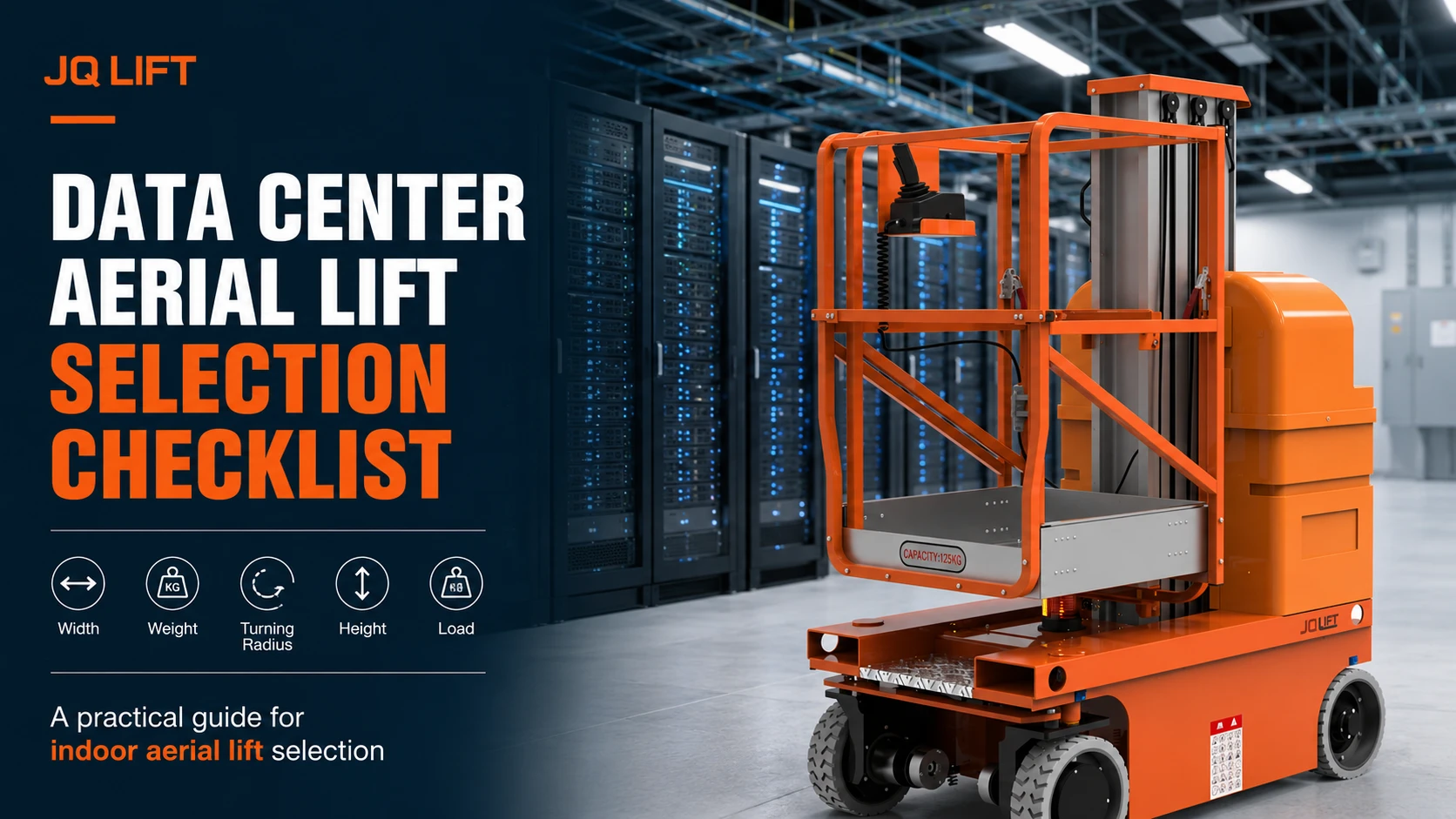
Choosing an aerial lift for data center work starts with the building, not the product catalog. A machine may reach the required height but still fail to pass through a doorway, turn inside an aisle, or match the floor and platform-load limits.
This data center aerial lift selection checklist helps facilities engineers, maintenance teams, contractors, and purchasing staff compare width, weight, turning radius, height, and load before requesting a quotation.
Why One Dimension Can Disqualify an Aerial Lift
Data center maintenance projects often involve cable trays, overhead lighting, electrical systems, and other installations above occupied equipment areas. The available route can be more restrictive than the work height.
The Access Route Can Matter More Than Maximum Height
Start with the narrowest doorway, aisle, threshold, and turning point. Measure clear opening width rather than relying on architectural drawings alone. Door hardware, cable protection, barriers, and temporary construction materials can reduce the usable space.
The lift’s overall width and length should be checked against the route together with its turning radius. A machine may pass through a straight aisle but lack enough space to make a 90-degree turn or reposition near a rack row. Ask the supplier for an external dimension drawing and turning-radius data for the exact model being quoted.
This check is especially important when evaluating a narrow aisle aerial lift or a lift for overhead cable tray installation.
Machine Weight and Platform Load Are Different Checks
Machine weight affects floor loading, transport, and the ability to move across thresholds. Platform load capacity covers the people, tools, and materials carried at height. These values should not be treated as interchangeable.
For example, the procurement calculation may need to include two workers, hand tools, cable-tray components, lighting equipment, and temporary mounting hardware. The final total must be compared with the rated platform load for the selected configuration.
Floor construction, raised-floor systems, thresholds, and surface protection should be reviewed by the responsible site team. The suitable limit depends on the application and should be verified against the product specification and site requirements.
Measure the Work Area Before Requesting a Quote
A supplier can only recommend a suitable indoor aerial lift when the site information is complete. A short measurement sheet often prevents a long replacement process later.
Record Doorways, Aisles, and Turning Points
Record the smallest doorway, the narrowest aisle, the tightest turning area, and any point where the lift must reverse or rotate. Include door frames, fire doors, rack protection, columns, temporary barriers, and cable covers.
For replacement projects, record the existing machine’s overall width, length, working height, platform height, and load rating. These figures provide a useful starting point, but the new machine should still be checked against current conditions. A changed rack layout or newly installed containment system can make an old route unsuitable.
A route drawing or marked floor plan is more useful than a general statement such as “the lift will be used indoors.”
Check Working Height and Overhead Clearance
Platform height and working height describe different points. The platform must reach a usable position while allowing the operator to work comfortably with tools and materials. Overhead clearance must also account for cable trays, light fixtures, pipes, containment, and sprinkler systems.
A higher platform is not automatically the correct choice. Excess height can create clearance conflicts, increase machine size, or reduce access to areas with low overhead obstructions. The required height should be based on the actual installation point, not only the highest available model.
Apply the Five-Point Aerial Lift Selection Checklist
Width, Length, and Turning Radius
Compare the machine’s total width with the narrowest clear route. Then check total length and turning radius at the locations where the machine must change direction.
The correct question is not simply, “Will it fit through the door?” It is, “Can it enter, turn, stop, and position safely at the work point?” A lift that fits through a doorway but cannot align with the cable tray may create more handling work and increase installation risk.
Platform Height and Working Height
Confirm which height is listed on the specification sheet. Ask whether the quoted value is platform height, working height, or maximum elevation. Also confirm whether the measurement changes with guardrails, platform extensions, or a particular configuration.
The selected height should cover the installation task while preserving overhead clearance. A short site survey with the actual cable-tray or lighting elevation can prevent an unsuitable height decision.
Platform Load for People, Tools, and Materials
Calculate the expected working load before comparing models. Include every person on the platform, hand tools, test equipment, cable, fixtures, and installation materials.
Do not rely on a general category description such as “small scissor lift.” Load ratings may vary by model or configuration. The quotation should identify the exact model, rated platform load, platform dimensions, and any restrictions on occupants or materials.
Choose the Lift Type for Indoor Data Center Work
Vertical mast lifts and small scissor lifts can both support indoor maintenance, but their practical advantages differ.
| Requirement | Vertical Mast Lift | Small Scissor Lift |
|---|---|---|
| Narrow route | Often suitable when width and turning space are limited | Depends strongly on overall width and platform size |
| Platform arrangement | Useful for compact, mainly vertical tasks | Useful when a larger standing area is needed |
| Typical work pattern | Single-operator inspection or maintenance | Two-person electrical, lighting, or installation work |
| Main checks | Width, turning radius, height, and load | Width, platform size, height, and model-specific load |
| Procurement risk | Selecting height without checking route dimensions | Selecting platform size without checking access limits |
When a Vertical Mast Lift Fits Narrow Indoor Routes
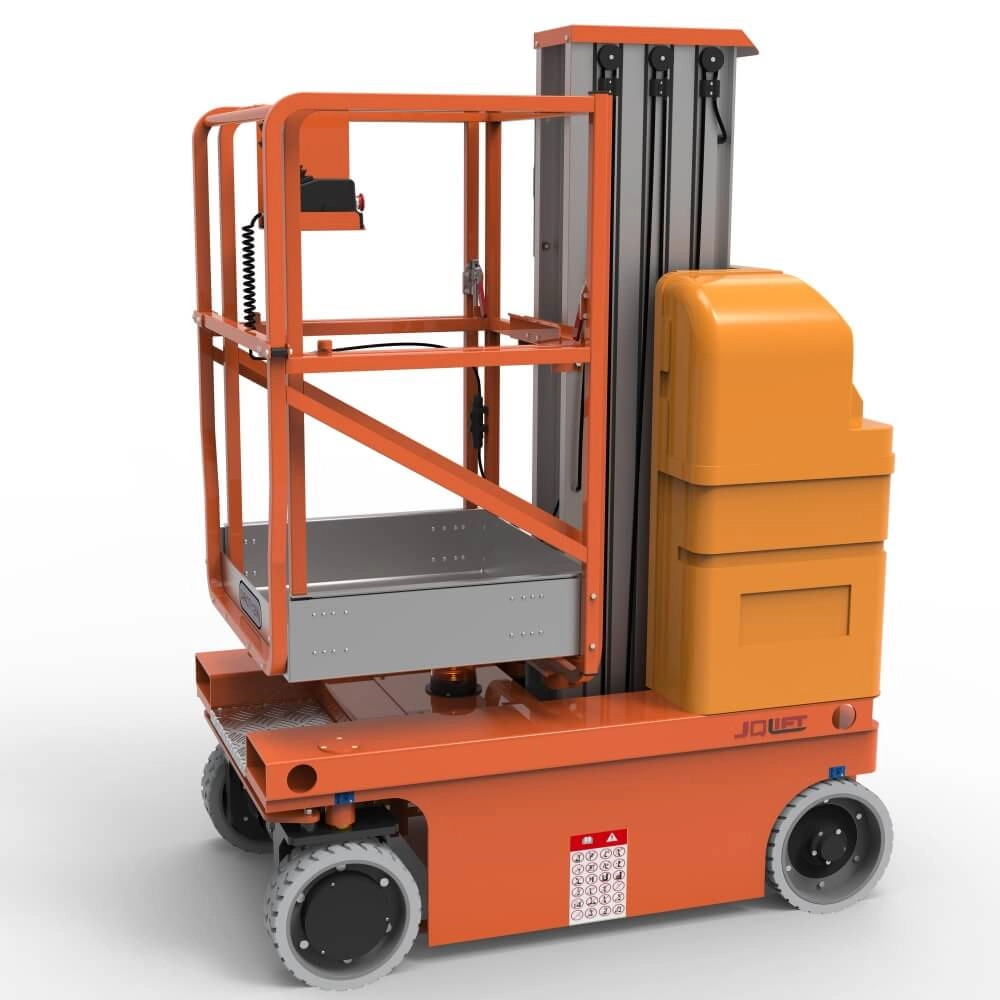
A vertical mast lift can be considered when the work requires vertical access in a confined indoor route. It may suit inspection, lighting maintenance, and overhead installation where horizontal reach is limited.
The decision still depends on the route, floor, platform load, and working height. Before purchasing, compare the exact machine width, length, turning radius, and load rating with the site measurements.
Jiequ’s AL all-electric aluminum alloy vertical mast lift page publishes a 820 mm overall width, 1,400 mm overall length, and 1,600 mm turning radius, along with 6.0 m and 7.5 m platform-height options and a 125 kg rated load. These figures can support an initial shortlist, but data center suitability should be verified against the actual application.
When a Small Scissor Lift Is More Practical
A small scissor lift may be more practical when the task requires a larger standing platform or two workers to handle tools and installation materials. It can be useful for some lighting, electrical, and overhead maintenance activities.
Jiequ’s SF semi-electric small scissor lift page lists a 760 mm overall width, a 4.8 m maximum working height, and model-dependent loads of 200 kg or 300 kg. The platform is listed at 1,155 mm long and 600 mm wide, with capacity for two workers.
The exact model, floor conditions, platform load, and route should be confirmed before specifying it for a data center.
Do Not Confuse Personnel Lifts With Server Handling Lifts
A personnel aerial lift raises workers and their tools. A server or rack lift handles equipment movement. These are different product categories with different operating requirements.
The RFQ should state whether the task involves people working at height, moving equipment, or both. Combining both requirements under “data center lift” can lead to an unsuitable recommendation.
Prevent Common Selection Errors
Do Not Select From a Generic Catalog Alone
Generic dimensions provide a starting point, not a final decision. A product page may show maximum height and rated load without explaining how the machine behaves in a specific aisle or on a specific floor.
Request an exact technical drawing, configuration details, and model-specific load information. For replacements, compare the proposed machine with the old equipment’s route, work height, platform size, and operating method.
Confirm Floor, Threshold, Wheel, and Power Conditions
Before approving an indoor aerial lift, confirm floor type, thresholds, gradients, surface protection, wheel material, charging access, and operating restrictions. Requirements may vary by material, size, load, operating environment, or configuration.
These details should be confirmed by the site team and supplier rather than assumed from general industry practice.
Build a Data Center Aerial Lift RFQ
A useful RFQ should contain the narrowest route width, turning points, required platform and working height, overhead clearance, machine-weight limit, platform load, floor information, power conditions, target quantity, drawings, and application description.
A qualified supplier should be able to return a model-specific specification sheet, external dimensions, load information, available configuration options, and any limitations relevant to the application. Sample orders or drawing-based production may also be useful when the route or platform requirements are unusual.
Jiequ’s vertical mast lift range can be reviewed when comparing different lift configurations. The Jiequ lift manufacturer website can provide a broader view of the company’s product categories and published application information.
Conclusion
The right data center aerial lift is the one that fits the route, floor, work height, platform load, and operating method at the same time. Width, machine weight, turning radius, height, and load should be confirmed before comparing prices or selecting a model.
For a technical review, provide the proposed model, site dimensions, floor conditions, working height, personnel count, tool weight, drawings, sample requirements, target quantity, and application details through request a technical quotation.
FAQs
What width should an aerial lift have for a data center aisle?
The lift should be narrower than the smallest clear route with enough operating space for positioning and turning. Door width alone is not sufficient.
How do I calculate aerial lift platform load?
Add all workers, tools, equipment, and materials that will be carried on the platform. Compare the total with the rated load of the exact model and configuration.
Is a vertical mast lift or scissor lift better for data center work?
A vertical mast lift may suit narrow, mainly vertical tasks. A small scissor lift may be more practical when two workers need a larger standing platform. Site dimensions and load requirements determine the choice.
What should be included in a data center aerial lift RFQ?
Include route width, turning points, working height, platform height, overhead clearance, machine-weight limits, platform load, floor conditions, power requirements, drawings, quantity, and application details.


