
How to Choose a Low-Level Access Lift for Data Center Construction and Maintenance
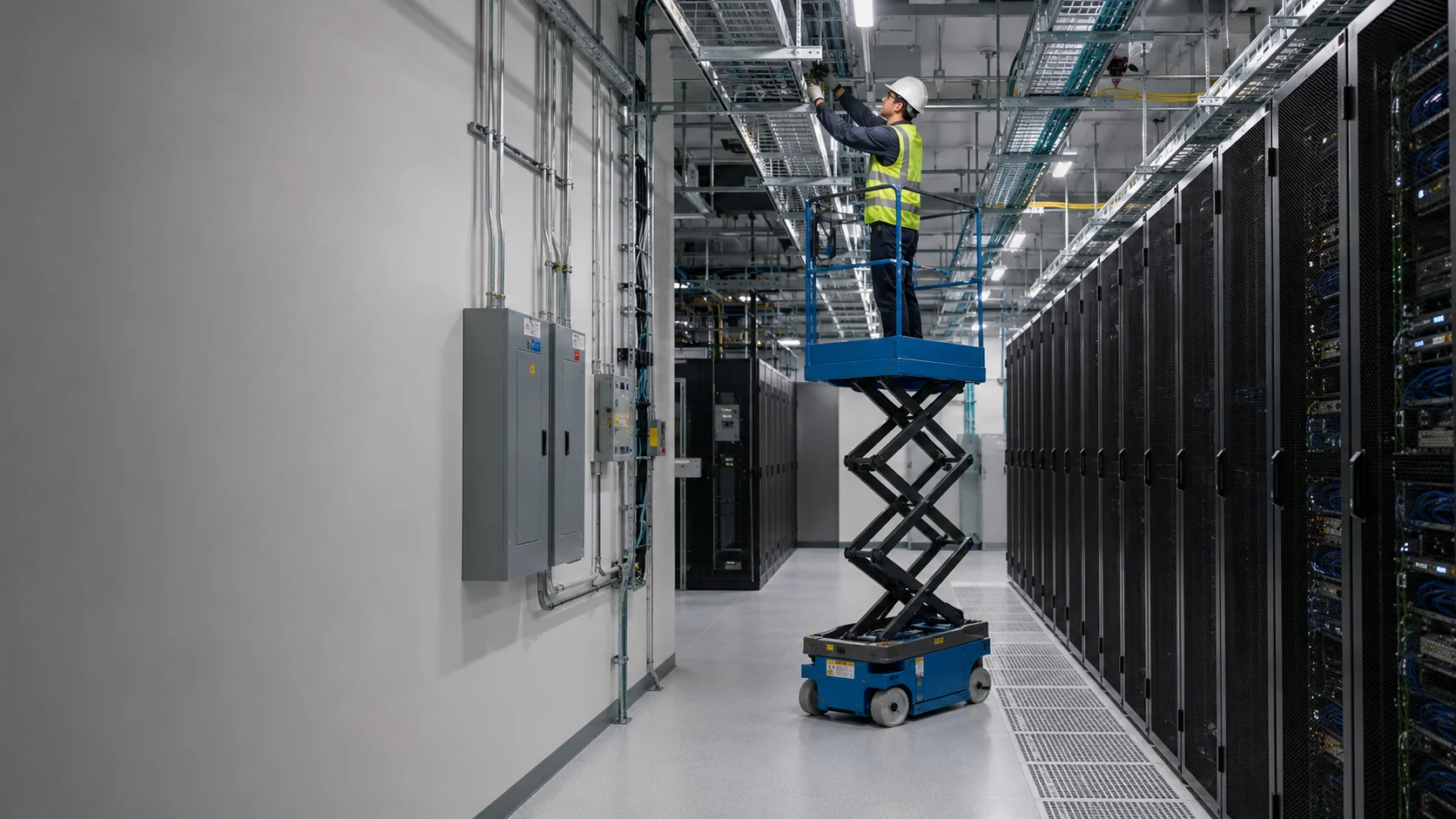
Choosing a low-level access lift for data center construction and maintenance requires more than comparing maximum platform heights. Contractors and facility teams must consider narrow access routes, overhead cable trays, finished floors, operator payload, wheel loads, charging conditions, and whether work will occur during construction or inside an operating data hall.
The right choice may be a low-level platform, a mini scissor lift, or a compact vertical mast lift. The decision should begin with the task and site conditions, followed by equipment specifications and supplier documentation.
What Does “Data Center Access Lift” Mean?
A data center access lift raises personnel so they can install, inspect, or maintain overhead systems. Common tasks include cable tray installation, lighting work, fire detection maintenance, security sensor inspection, and access to HVAC or other mechanical and electrical equipment.
This equipment should not be confused with a server rack lift. A server lift handles cabinets, servers, batteries, or other equipment; it does not raise personnel. Buyers searching for a data center personnel lift should clearly describe whether the load is a person, a server cabinet, or construction material. This distinction prevents an unsuitable product recommendation and keeps the RFQ focused on the correct equipment category.
Match the Lift to the Work Phase
Data center construction and operating-facility maintenance create different access requirements. A machine suitable for installation work on an unfinished site may not be appropriate for routine maintenance in a live data hall.
Construction and MEP Fit-Out
During construction and mechanical, electrical, and plumbing fit-out, lifts may be used repeatedly for cable trays, conduit, fire protection systems, lighting, and ceiling services. These tasks can require two operators, additional tools, or small quantities of installation material.
A mini scissor lift can be practical when platform space and payload are more important than having the smallest possible machine. Before selecting one, confirm the floor condition, required platform extension, work frequency, and whether the lift must travel between work positions while carrying tools.
Construction conditions may also change as the project progresses. Access routes that are open during early construction can become restricted after racks, partitions, doors, and mechanical equipment are installed.
Live Data Hall Maintenance
An operating data hall usually places greater emphasis on compact dimensions, controlled movement, floor protection, battery operation, and access through established routes. Noise, charging location, tire material, and emergency lowering may also become part of the approval process.
A compact electric access platform may be more suitable than a larger construction lift when work involves one technician performing inspections or minor repairs. However, “electric” and “indoor use” do not automatically mean that a machine is approved for raised floors or sensitive operating environments. Those conditions must be checked against the product specification and facility requirements.
Calculate Height and Payload Before Selecting a Model
Platform height and working height are not the same. Platform height measures the maximum platform elevation, while working height normally includes the operator’s reach. Buyers should identify the highest actual work point and confirm how far the operator can safely reach without leaning outside the platform.
Payload calculations should include the operator, tools, test equipment, and any materials carried onto the platform. A single-person vertical mast lift may be adequate for inspection work but unsuitable for two technicians installing cable trays. Selecting excessive height can also increase machine weight, dimensions, or stabilizer requirements without improving productivity.
Low-Level Platform vs Mini Scissor Lift vs Vertical Mast Lift
There is no single lift type for every data center task. The most useful comparison considers height, platform size, route restrictions, floor conditions, and how many people must work from the platform.
| Lift type | More suitable for | Main points to verify |
|---|---|---|
| Low-level access platform | Frequent low-height work and short maintenance tasks | Limited height, payload, platform space, manual or powered movement |
| Mini or micro scissor lift | Two-person work, tools, and a larger work area | Machine weight, wheel load, turning space, floor condition |
| Vertical mast lift | Higher single-person access and narrow routes | Platform capacity, overall height, stabilizer footprint, tire specification |
When a Mini Scissor Lift Is More Practical
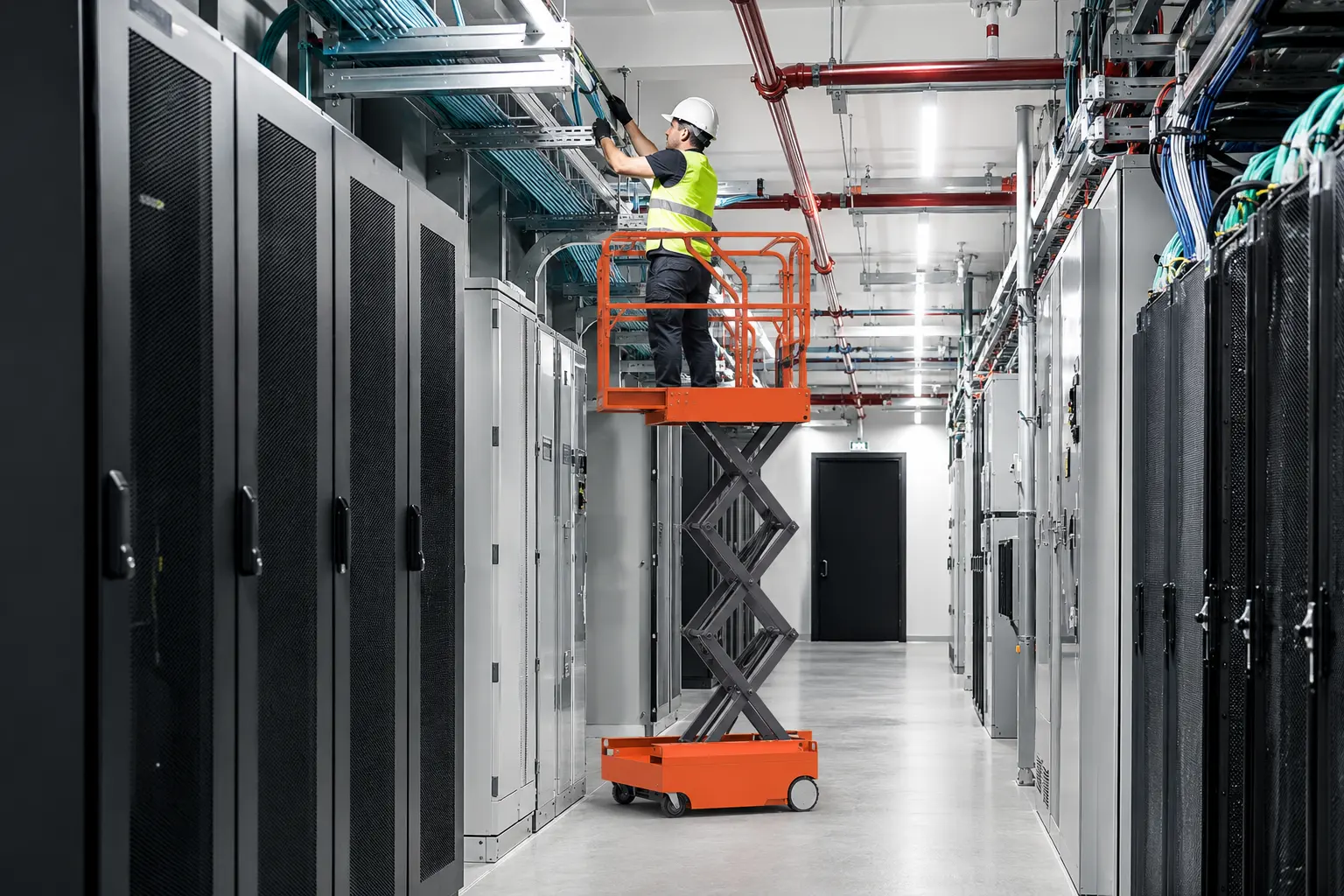
A mini scissor lift is usually the stronger candidate when technicians need a stable work area, an extension deck, or enough capacity for two people and their tools. It can support repetitive installation work where the platform must move between several overhead work points.
The Scissor Lifts category provides a useful starting point for comparing this equipment type. Buyers should check overall width, platform height, turning radius, machine weight, extension-deck capacity, and the type of surface on which the lift may operate.
The ASF Small Scissors model, for example, has published platform-height options from 1.8 to 4.8 meters, a 760 mm overall width, a 1,300 mm overall length, a 300 kg maximum load, and a 550 mm extension platform. The published specification also states that it is intended for paved surfaces. Its suitability for a particular data center still depends on floor capacity, route dimensions, tire requirements, and site approval.
When a Vertical Mast Lift Is More Suitable
A vertical mast lift may be preferable when one technician needs to reach higher services through narrow corridors or restricted equipment areas. Its narrow chassis can simplify route planning, but buyers must still review the turning radius, machine height, platform capacity, and any required stabilizer footprint.
The Vertical Mastlifts category includes equipment for different platform heights and operating configurations. This type is particularly relevant when comparing a vertical mast lift versus a mini scissor lift for data center maintenance. The mast lift often offers higher single-person access, while the scissor lift generally provides more platform space and payload.
A mast lift should not be selected only because it reaches higher. If the machine requires outriggers or has insufficient capacity for tools and materials, it may be less practical than a compact scissor lift.
Check the Access Route and Floor Before Ordering
A lift can meet the height requirement and still fail on site because it cannot pass through a doorway, turn into an aisle, enter an elevator, or operate on the specified floor.
Doorways, Corridors, Elevators, and Turning Space
The access survey should record the narrowest door, lowest overhead clearance, tightest corner, corridor width, elevator door dimensions, elevator car size, and elevator capacity. These measurements must be compared with the lift’s transport dimensions, not only its working dimensions.
Buyers asking what size lift fits through a data center doorway should also consider machine length and turning radius. A lift may pass through a door in a straight line but be unable to make the following turn. Stabilizers, removable guardrails, entry steps, and platform extensions can create additional clearance requirements.
A route drawing with measurements is more useful to a supplier than a general request for a “compact lift.”
Raised Floors, Wheel Loads, and Surface Protection
The question “Can a scissor lift be used on a data center raised floor?” cannot be answered from total machine weight alone. The facility engineer must consider maximum wheel load, contact area, point loading, floor-panel capacity, supporting structure, and the route across the floor.
The supplier should be asked for maximum wheel load or equivalent load-distribution information for the selected configuration. Tire material should also be confirmed. Non-marking tires and ESD-rated tires are different requirements, and neither characteristic should be assumed without product documentation.
Where the floor capacity is uncertain, approval should be obtained before the equipment enters the area. A temporary load-distribution method may be considered by the responsible site engineer, but it must be based on the facility’s engineering requirements rather than a general recommendation.
Battery, Noise, and Operating Conditions
Indoor access equipment is commonly selected with battery-powered travel and lifting, but charging voltage, battery capacity, operating time, charger location, and emergency lowering still require review. These factors may vary by model and configuration.
The AL All-Electric Aluminum Alloy lift has published 6-meter and 7.5-meter platform-height options, an 820 mm overall width, a 125 kg rated load, and electric drive and lifting. These figures can help determine whether the machine fits the required height and route. Floor loading, tire characteristics, noise, operating environment, and applicable documentation should be confirmed before treating it as a data center solution.
Prevent Common Selection and Procurement Errors
One common error is purchasing according to maximum height while ignoring the normal task. A taller machine may introduce unnecessary weight, dimensions, or stabilizer requirements. The selected platform height should match the highest regular work point, with occasional exceptional work handled separately when appropriate.
Another error is requesting a price before collecting site information. Quotes based only on height often require revision after the supplier learns about doorways, elevators, payload, raised floors, or tire requirements. A basic pass-or-fail matrix should be completed before comparing prices.
Generic claims also require careful interpretation. “Indoor,” “compact,” or “maintenance lift” does not confirm suitability for a live data hall. Product-level specifications, operating instructions, relevant certificates, and maintenance information should be reviewed against the site’s safety procedures and applicable requirements.
Prepare a Data Center Access Lift RFQ
A complete data center lift RFQ allows the supplier to recommend a configuration instead of guessing from a short product description. It should include:
- Required platform and working height
- Number of operators and total payload
- Tools or materials carried on the platform
- Door, corridor, elevator, and turning dimensions
- Floor type and allowable wheel or point load
- Tire, marking, or ESD requirements
- Battery and charging conditions
- Expected duty cycle
- Required documentation
- Quantity, delivery destination, and target schedule
How to Evaluate the Supplier
A qualified supplier should be able to provide model-specific dimensions, capacities, machine weight, operating conditions, and dimensional drawings. For sensitive floors, the supplier should also address wheel-load questions instead of relying only on total weight.
Jiequ Lift publishes specifications for compact scissor lifts and vertical mast equipment that can support an initial technical comparison. The company’s product information can be used to shortlist models, but data center-specific requirements should still be verified for the selected machine and configuration.
Supplier evaluation should also cover manuals, maintenance access, replacement parts, warranty scope, delivery terms, and technical support. These commercial details matter because a technically suitable lift can still create downtime if maintenance information or replacement components are difficult to obtain.
Conclusion
Selecting a low-level access lift for data center construction and maintenance starts with the task, not the product name. Buyers should define the work phase, height, payload, route, floor capacity, wheel-load limits, power conditions, and required documentation before comparing models.
Jiequ Lift’s published scissor and vertical mast specifications provide a basis for technical screening. To discuss a suitable shortlist, the Contact Jiequ Lift inquiry should include the application, required height, operator load, route dimensions, floor type, quantity, destination, and any available site drawings.
Frequently Asked Questions
What lift is suitable for data center cable tray installation?
A mini scissor lift may suit two-person installation work and heavier tool loads, while a vertical mast lift may suit higher single-person work in narrow routes. The decision depends on working height, platform capacity, floor loading, and access dimensions.
Can a scissor lift be used on a raised data center floor?
Possibly, but total machine weight is not enough to make the decision. Maximum wheel load, contact pressure, floor-panel capacity, supporting structure, and the travel route must be reviewed by the responsible facility or structural engineer.
How do I know which platform height is right for data center maintenance?
Measure the highest regular work point and compare it with the manufacturer’s platform-height and working-height definitions. Also consider operator reach, tool position, overhead obstructions, and whether the additional height changes the machine’s weight or dimensions.
Is a vertical mast lift better than a mini scissor lift?
A vertical mast lift is often more practical for higher single-person access and narrow routes. A mini scissor lift usually provides more platform space and payload. Neither is universally preferable; the site route, floor, height, and work method determine the better option.
What information should be sent to a data center access lift supplier?
Send the required height, payload, operator count, doorway and elevator dimensions, turning space, floor type, allowable wheel load, tire requirements, duty cycle, documentation requirements, quantity, and delivery destination.


