
How Much Outrigger Footprint Does a Vertical Mast Lift Need?
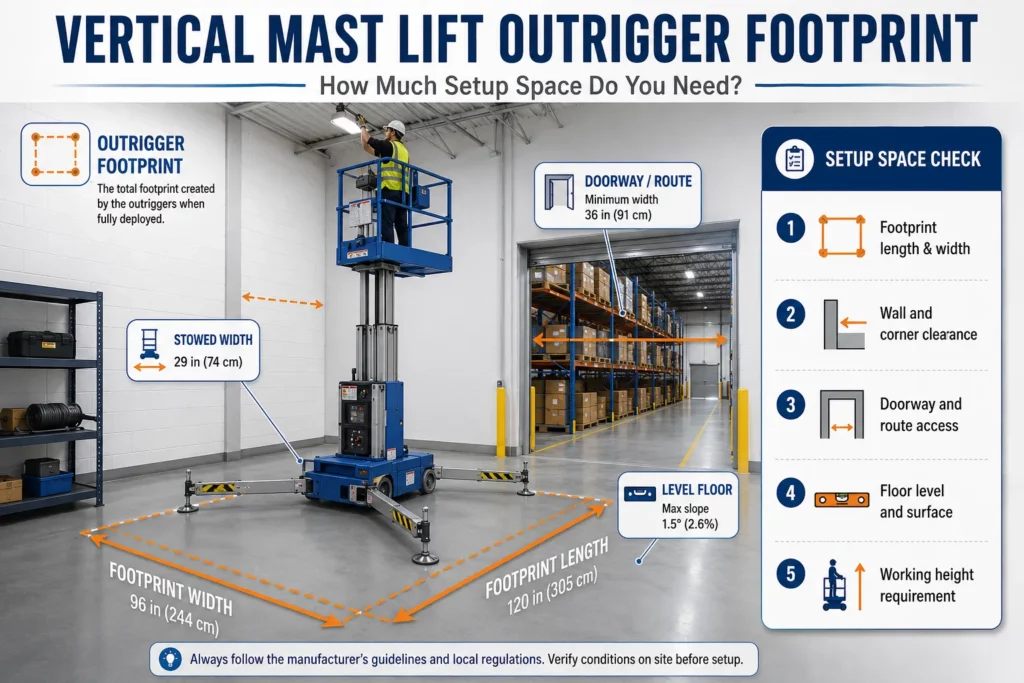
A vertical mast lift outrigger footprint is the floor area required after the support legs are fully deployed. This matters because a mast lift may pass through a doorway in its stowed position but still need much more setup space before it can raise. For buyers, maintenance teams, and facility managers, the key question is not only “How high does it reach?” but also “Can it be positioned, leveled, and supported safely at the work point?”
What Does Outrigger Footprint Mean on a Vertical Mast Lift?
Outrigger footprint refers to the working footprint of the machine, usually expressed as length × width after the support legs are deployed. It is different from machine width, stowed width, or transport size. A product specification may list the machine body as narrow enough for indoor movement, while the outrigger footprint may be much wider once the lift is ready for elevated work.
Outrigger Footprint Is the Working Footprint, Not the Stowed Machine Width
This distinction is important in warehouses, factories, hotels, shopping centers, and office buildings where the lift must pass through doors, corridors, elevators, and tight corners before setup. A narrow vertical mast lift can be easy to move, but the actual work area must allow all support feet to extend completely.
Buyers should compare three dimensions before purchase: stowed dimensions for transport, vertical mast lift setup space for operation, and available floor area around the work point. Public product specifications from major aerial work platform suppliers commonly list outrigger footprint separately from machine width, which shows that these are separate purchasing checks. Genie’s AWP specifications, for example, list “outrigger footprint (l/w)” as a specific measurement.
Why Outrigger Footprint Changes by Lift Type, Height, and Structure
The required outrigger footprint depends on lift structure, platform height, rated load, base design, and operating environment. Single mast lifts, double mast lifts, push-around mast lifts, and self-propelled vertical mast lifts may use different support layouts. A higher platform height or heavier work condition may require a larger support area, but the exact value should be verified against the product specification.
JQLIFT’s L single mast aluminum alloy lift lists a support foot expansion size of 1925 × 1750 mm, while the DL double mast aluminum alloy lift includes several support foot expansion sizes across its model range. These differences show why buyers should not assume one footprint applies to all mast lifts.
How Much Setup Space Does a Vertical Mast Lift Usually Need?
There is no single universal outrigger space for every vertical mast lift. The required floor area depends on the model. The practical rule is to treat the model’s outrigger footprint length and outrigger footprint width as the minimum clear floor area, then add extra clearance for people, walls, racks, columns, tools, and nearby traffic.
Use the Model’s Outrigger Footprint as the Minimum Clear Floor Area
When checking “how much space does a mast lift need,” start with the specification sheet. Look for terms such as outrigger footprint, support foot expansion size, setup footprint, or stabilizer width. This value is more useful than machine width when judging whether the lift can actually be used at the work location.
If the available floor space is smaller than the required footprint, the solution is not to force the machine into position. The buyer should choose a different setup point, select another model, or evaluate a different lift type. The required footprint may also vary by configuration, so platform size, power option, load requirement, and indoor or outdoor use should be confirmed before ordering.
Add Clearance for Walls, Racks, Columns, and Operator Access
A lift may technically fit within the measured footprint but still be impractical if it blocks a corridor, touches racking, interferes with a machine base, or prevents the operator from accessing controls. Wall access and corner access are especially important when the work point is near lights, pipes, signs, HVAC units, or warehouse shelves.
Before requesting a quote, measure the work point and the surrounding floor area. Record the distance to walls, rack posts, fixed equipment, floor drains, door swings, and pedestrian routes. If the lift will be used close to a wall or corner, ask the supplier to verify whether the platform can reach the target point without unsafe positioning.
How to Measure the Worksite Before Using or Buying a Mast Lift
A correct setup check should follow the full route from storage to operation. Many purchasing issues occur because the lift can enter the building but cannot be positioned at the actual work point.
Measure the Full Setup Area, Not Just the Work Point
The work target may be overhead, but the lift’s support legs occupy floor space in four directions. Measure the clear floor length and width where the lift will stand, then check whether the support feet can deploy without hitting racks, columns, desks, production equipment, or stock.
This is useful for indoor vertical mast lift applications such as lighting maintenance, ceiling inspection, warehouse goods retrieval, sign installation, and factory maintenance. It is less suitable as a rough estimate for outdoor uneven ground or applications with unknown floor strength, where the supplier and site safety team should review the conditions in detail.
Check Doorways, Elevators, Corridors, and Turning Routes Before Setup
A push-around vertical mast lift may have compact stowed dimensions, but the travel route still matters. Door width, door height, elevator size, corridor turning space, thresholds, ramps, and charging location should be measured before purchase or rental. A lift that reaches the required height may still be the wrong choice if it cannot reach the work area.
For RFQ preparation, send route photos, floor plans, and the narrowest access dimensions. Include the location of the work point, the route from unloading area to setup point, and any restrictions such as mezzanine access, sensitive flooring, or shared pedestrian areas.
Confirm Floor Level, Surface Strength, and Outrigger Pads
Outriggers are part of the stability system, so the floor condition matters. OSHA’s aerial lift guidance recommends setting outriggers on pads or on a level, solid surface when available, setting brakes when outriggers are used, and using wheel chocks on sloped surfaces when safe to do so.
For B2B procurement, confirm whether the lift will be used on concrete, epoxy flooring, tile, wood, carpet, mezzanine floors, or other surfaces. Sensitive floors may need protection, and uneven surfaces may require a different setup method or equipment choice. Product instructions and local safety requirements should be followed.
What Happens If the Outriggers Cannot Fully Deploy?
If the outriggers cannot fully deploy, the lift may not be able to raise. Some machines use sensors, interlocks, or level checks to prevent operation when support conditions are not met.
The Lift May Not Raise If Outrigger Interlocks Are Not Satisfied
JQLIFT’s DL double mast aluminum alloy lift describes four-sided outriggers equipped with infrared sensors, designed so the equipment can operate properly only after all four outriggers are fully extended. This type of feature makes the footprint check a purchasing requirement, not just a safety note.
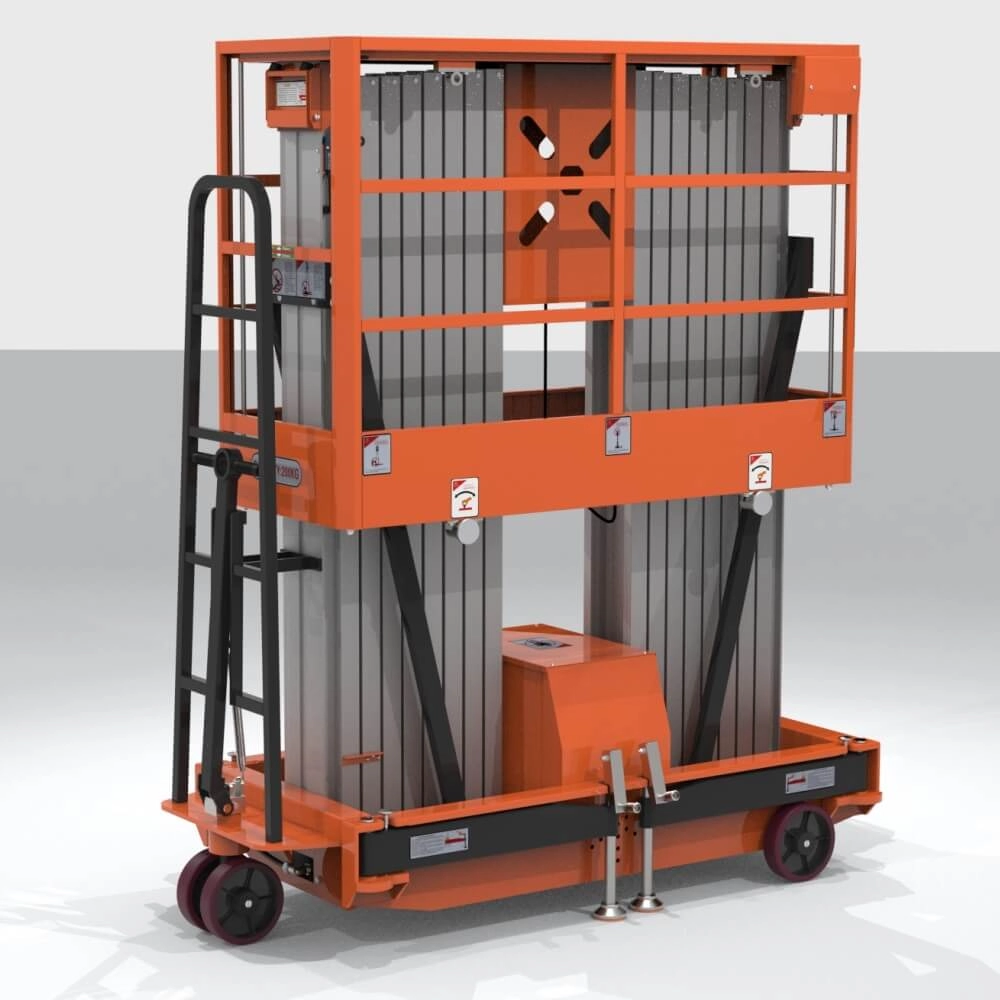
Before selecting a model, buyers should ask how the support-leg interlock works, whether indicator lights are provided, what alarms appear when the setup is incomplete, and what ground conditions are required. This helps avoid delivery-stage surprises when the lift reaches the site but cannot operate in the intended area.
Partial Deployment Should Not Be Treated as a Space-Saving Method
If the worksite cannot accept the specified outrigger footprint, partial deployment should not be used as a workaround. The practical choices are to change the setup location, use a lift with a smaller footprint, select a model with better wall access, or evaluate a self-propelled vertical mast lift if travel efficiency and compact turning are more important than outrigger-based setup.
The supplier should verify fit before shipment, especially when the application involves corridors, rack aisles, machine rooms, elevators, retail floors, or other confined indoor spaces.
Which Vertical Mast Lift Type Fits Your Available Space?
The right type depends on working height, load, available footprint, route clearance, floor surface, and movement frequency. Buyers comparing vertical mastlifts can review single mast, double mast, and all-electric options before confirming the application details.
| Lift Type | Suitable Scenario | Key Space Check |
| Single mast lift | Compact indoor access and light-duty maintenance | Support foot expansion size and doorway route |
| Double mast lift | Higher indoor access and heavier work needs | Larger support footprint and platform load |
| Self-propelled vertical mast lift | Frequent movement between work points | Turning radius, overall width, and floor condition |
Single mast lifts are often considered for one-person maintenance, lighting work, and compact indoor access. Double mast lifts may suit higher indoor access needs, warehouse goods retrieval, factory maintenance, and office building cleaning or maintenance. The final choice should be based on the product specification rather than the category name alone.
For buyers comparing suppliers, a qualified vertical mast lift supplier should help verify setup space, not only provide a price. JQLIFT lists L single mast aluminum alloy lift, DL double mast aluminum alloy lift, and AL all-electric aluminum alloy products under its vertical mast lift category.
What to Send to a Supplier Before Requesting a Quote
A useful vertical mast lift RFQ should include: required working height, platform height, available floor length × width, maximum allowable support foot expansion size, wall distance, corner access, doorway and elevator dimensions, floor type, load requirement, indoor or outdoor use, and photos or layout drawings.
The buyer should ask the supplier to verify whether the selected model can reach the work point, fully deploy its outriggers, pass through the route, protect the floor surface, and meet the expected work cycle. About JQLIFT describes Hangzhou Jiequ Machinery Manufacturing Co., Ltd. as a manufacturer rooted in Hangzhou with pre-sales consultation and tailored aerial work solutions. This makes application data useful when discussing model fit and configuration.
Conclusion
A vertical mast lift should be selected by working footprint, not just platform height or machine width. The outrigger footprint determines whether the lift can be set up safely at the actual work point, while route clearance determines whether it can reach that point at all.
Before requesting a quote, prepare the available floor area, required working height, wall distance, floor condition, route dimensions, load details, and site photos. For model confirmation or application review, buyers can contact JQLIFT with the measured data and project requirements.
FAQs
Q1: How much outrigger space does a vertical mast lift need?
A: It depends on the model. Check the outrigger footprint length and width, then compare them with the clear floor area at the worksite. Extra clearance may be needed for walls, operators, tools, and surrounding equipment.
Q2: Is outrigger footprint the same as machine width?
A: No. Machine width is usually the stowed or body width. Outrigger footprint is the working footprint after the support legs are deployed. A lift may be narrow in transport but much wider during operation.
Q3: Can a vertical mast lift be used without outriggers?
A: It depends on the lift design. If the model requires outriggers, they should be used according to the product instructions. Some equipment may not raise unless outrigger sensors or interlocks are satisfied.
Q4: How close can a mast lift work to a wall?
A: Wall access depends on platform design, outrigger layout, and the exact model. Measure the wall distance and ask the supplier to confirm whether the platform can reach the work point without unsafe setup.
Q5: What should I measure before buying a vertical mast lift?
Measure working height, available setup area, support foot expansion limit, doorway and elevator size, route clearance, wall distance, floor condition, load requirement, and work frequency.


