
Scissor Lift Non-Marking Tires: What Buyers Should Check for Indoor Floors
For a lift working over a finished indoor floor, a black tire mark can be a more immediate complaint than the machine’s travel speed. Yet ordering “non-marking tires” leaves several buying questions unanswered. What is the floor coating? The amount of turning and the approved wheel assembly belong in the discussion too.
A request for scissor lift non-marking tires is a useful starting point for the quotation. Finishing the specification takes a closer look at where the wheels will go and what the floor must carry.
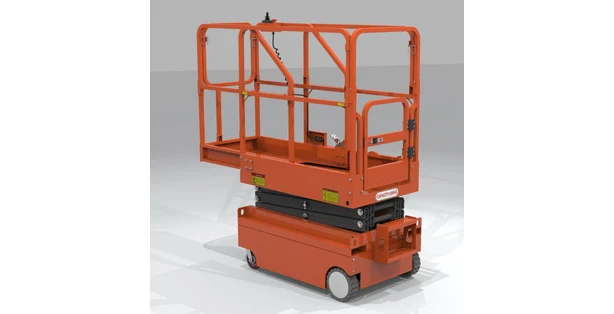
What the non-marking label tells a buyer
The non-marking description concerns visible marking from the compound. A purchasing specification has to cover rather more than that.
Grit picked up on an ordinary travel route can reach a clean area on the tire. The same route may bring oil onto the wheels. Then there is turning: repeated steering in a confined space can scrub the surface in a way that straight travel does not. None of those questions disappears because a wheel has a non-marking description.
For procurement, the useful request is a named tire specification for a named lift configuration, checked against the intended floor. “Suitable for indoor use” is too broad when the facility has a particular finish to protect.
Solid, foam-filled and non-marking are different descriptions
A solid tire describes construction. Foam-filled describes a pneumatic casing with filling inside. Non-marking concerns the compound’s marking characteristics. For that reason, “solid” and “non-marking” can both belong in a description without being interchangeable.
Polyurethane can appear in a foam-filling description. That says something about the material inside the casing, not necessarily the tread touching the floor. A request for polyurethane wheels would need a more precise answer than a foam-filled specification.
Surface suitability belongs to the machine specification as well. Non-marking options exist on different kinds of equipment, so the description cannot establish where a particular lift may travel or work.
The floor specification belongs with the enquiry
Name the finish: sealed concrete, an epoxy coating, tile or polished flooring. Include the facility’s written restrictions where available. A request that quotes those restrictions gives the equipment supplier something to assess; “do not damage the floor” leaves the acceptance requirement open.
Then describe the job. One job may involve parking the lift for a maintenance task; another may involve crossing the building repeatedly. Those routes should not receive the same description. Mark the corners where steering space is limited, particularly if the wheels will scrub sideways during a turn.
A trial on one surface offers limited reassurance about a different coating or work pattern. Keep the proposed floor and configuration named throughout the discussion.
JQLIFT lists the ASF small scissor lift range for paved surfaces. For a finished indoor area, include the coating, turning points and travel frequency in the enquiry alongside platform height and load. The tire assembly for that proposal should be confirmed with JQLIFT; a specification from another product family is not a substitute.
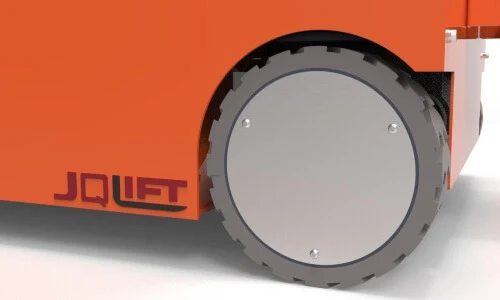
A clean-looking floor can still have a load problem
Visible marks and structural loading are separate issues. A wheel can leave no residue while the machine is too heavy for a restricted floor area.
Total machine weight is only the starting point. For a floor with a concentrated-load or contact-pressure restriction, obtain the loading data for the selected configuration. A simple weight-per-wheel calculation assumes a distribution that may not represent the working machine; the facilities review needs the manufacturer’s figures.
Any other contact points matter as well. If the proposed equipment uses supports during work, their loads and contact areas belong in the review. A tire selection alone cannot settle those questions.
When a site trial is worth arranging
For a sensitive finish, an agreed trial can be more informative than another general claim about non-marking performance. The facility owner should approve the test area first. It need not be a valuable finished section that would be costly to repair.
Agree the trial details in advance: the machine configuration, carried load, route and turns. Stay within the operating instructions throughout. The flooring team can then examine the test area against the facility’s acceptance requirements, with a record of what was actually tried. Any cleaning should follow its approved method.
Without an approved test area, involve the flooring contractor in the specification review. That discussion may rule out an unsuitable combination. It should not be recorded as a successful floor trial.
Ordering a replacement assembly
Replacing the wheels to deal with floor marks introduces a second buying decision. A change in tire construction or assembly weight can affect stability, even when the new wheel fits mechanically. Manufacturer approval has to cover that substitution.
Give JQLIFT the exact model and configuration when requesting the replacement reference. Include the floor requirement again, rather than ordering a wheel by diameter and hoping that its other characteristics match.
Condition matters after delivery too. Damage such as cuts, missing sections and separation at the rim requires assessment in accordance with the machine instructions. JQLIFT’s scissor lift pre-use checklist covers the broader inspection. Replacement approval remains a separate matter.
A brief the supplier can use
The shortest useful brief combines the floor requirement with the job:
- Floor finish and any written protection restrictions
- Travel route, tight turns and movement frequency
- Intended working load and platform height
- Floor-load limits, where applicable
- Proposed tire specification and approved replacement reference
- Availability of an agreed test area
Finally, decide how the wheels will be checked before entry to the sensitive area. Otherwise the chosen tire may carry in the very grit or residue the facility is trying to keep out.
Contact JQLIFT about the floor and tire requirements with those details. That gives the model discussion something concrete to work from and keeps a non-marking request tied to the actual floor.


