
Electric Order Picker Platform Dimensions: How to Match Operator Space, Load Size, and Aisle Fit
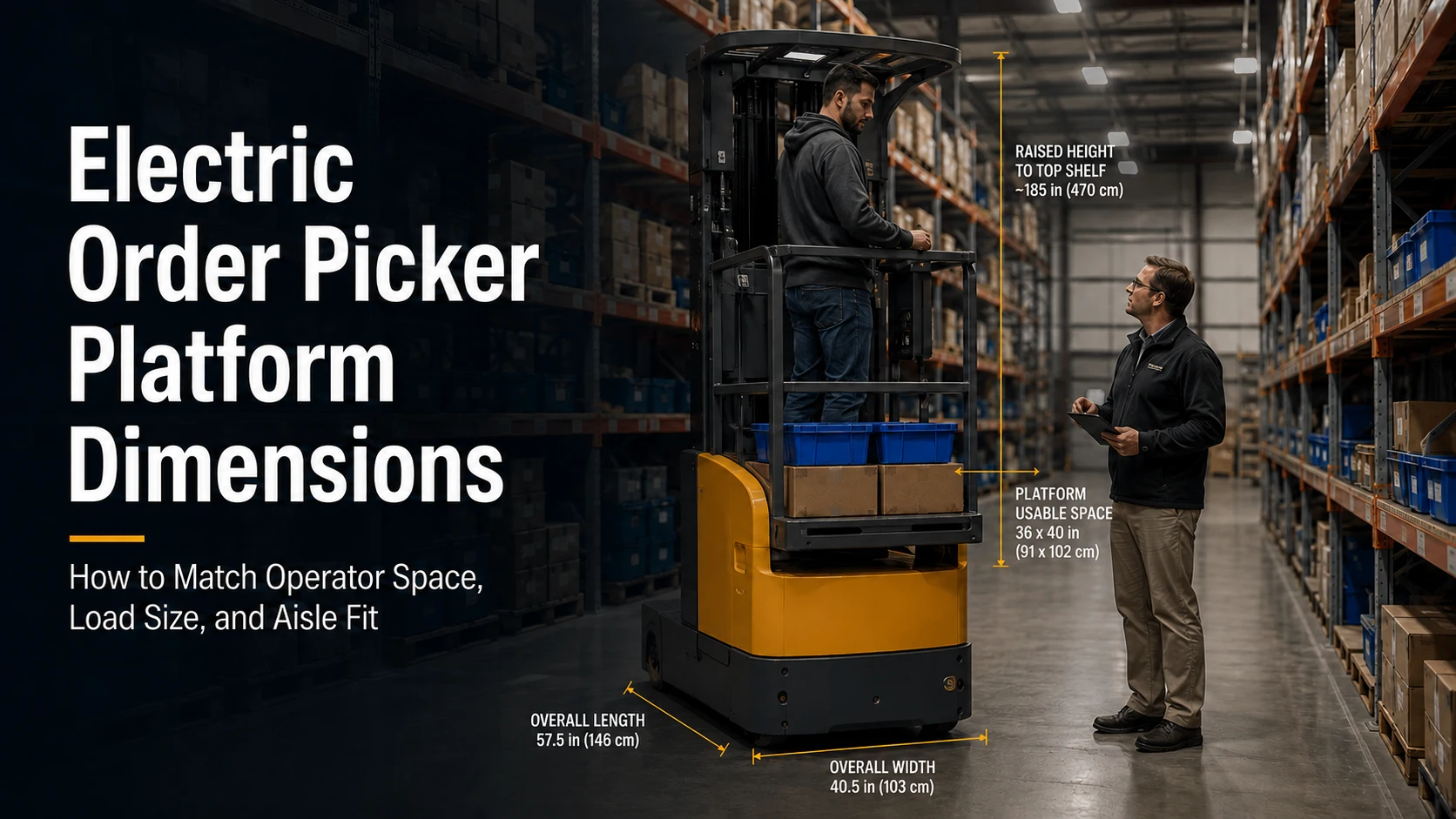
Choosing the right order picker platform dimensions requires more than checking whether an operator can stand inside the guardrails. The platform must accommodate the operator, picked goods, bins, scanners, and tools without creating an equipment footprint that is too large for doorways, aisles, elevators, or turning areas. A platform that is too small can restrict movement and load placement, while an unnecessarily large platform may reduce maneuverability. The correct choice depends on the full picking process, not one dimension on a specification sheet.
What Do Order Picker Platform Dimensions Actually Mean?
Product specifications may use terms such as platform length, platform width, standing platform, cargo platform, load tray, or usable platform. These terms are not automatically interchangeable. Before comparing models, buyers should determine which physical area each measurement describes and whether the published number is an external dimension or the usable space inside the guardrails.
Operator Standing Platform vs. Cargo Platform or Load Tray
The operator platform is the area where the worker stands and uses the controls. A cargo platform or load tray is intended for cartons, bins, tools, or picked materials. Some machines combine these functions within one guarded area, while others provide a separate load section.
This distinction matters when asking, “What size platform do I need on an electric order picker?” A platform may appear large on paper but provide limited standing room after the control console, gate, structural members, or cargo area are considered.
Ask the supplier to identify:
- The usable standing length and width inside the guardrails
- The dimensions of any separate cargo platform or tray
- Whether operator weight, goods, bins, and tools share the same rated capacity
- The position of the controls, access gate, and load area
- The clear space available when the equipment is ready for operation
A dimensioned top-view drawing is more useful than a single “platform size” figure.
Platform Dimensions vs. Platform Height and Overall Machine Size
Platform length and width describe horizontal space. Platform height describes how high the platform can rise. Overall width describes the widest part of the complete machine, which may include the chassis, wheels, guardrails, or other structures.
Platform width is therefore not the same as overall machine width. A machine with a suitable standing area may still be too wide for a doorway or too difficult to turn inside a cross aisle. Likewise, a compact platform does not automatically mean the complete machine has a compact working footprint.
Buyers should request platform dimensions, overall machine dimensions, turning radius, and any deployed support-leg dimensions as separate specifications.
How to Size the Platform for the Operator and Picking Process
A suitable order picker standing platform size should support the actual movements required during a picking cycle. The operator may need to enter through a gate, face the controls, turn toward shelving, scan products, reposition containers, and handle goods without standing on stored items or blocking the access point.
Measure Usable Standing Space, Control Access, and Carried Items
Start with the space inside the platform rather than the outside frame. Measure the area remaining after accounting for controls, gates, steps, structural posts, tool holders, and cargo sections.
The evaluation should reflect the real work process:
- Does the operator remain facing one direction or need to turn?
- Are goods picked from one rack face or both sides of the aisle?
- Will a scanner, tablet, tool bag, or small parts container be carried?
- Does the operator need space to open cartons or reposition a bin?
- Will workers of different body sizes use the same equipment?
No universal platform width is suitable for every operator or application. When the required movement is unclear, a floor template made to the published dimensions can provide a simple preliminary check. Final suitability should still be verified against the latest product drawing.
After the required standing and load areas are defined, buyers can compare aerial order picker models rather than selecting a machine from lift height or rated capacity alone. The JQLIFT category page lists several semi-electric and fully electric aerial order picker configurations for comparison.
When a Wider Platform Helps—and When It Does Not
A wider platform can be useful when the operator handles larger containers, carries tools, needs additional turning room, or manages several small orders during one picking cycle. It may also suit applications where goods must be temporarily positioned beside the operator before being transferred.
A wider platform is not automatically the better choice. For small-item picking in narrow stockrooms, additional platform space may provide little practical benefit while increasing overall width, turning requirements, transport dimensions, or equipment weight.
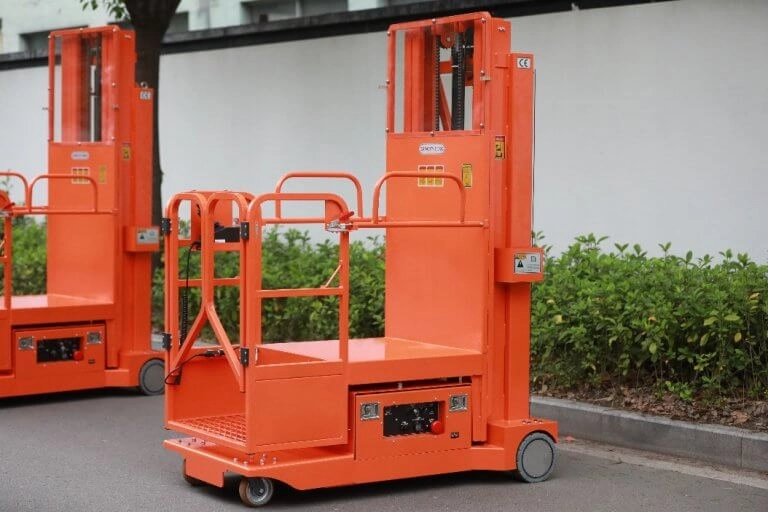
The decision should compare the extra usable space with the narrowest aisle, doorway, elevator, and maneuvering point in the facility. Where a wider platform is required, the DAT fully electric order picker with a wider platform provides a published platform size of 707 × 807 mm and an overall width of 1,015 mm. These figures illustrate why platform space and complete machine width must be reviewed together.
How to Match Platform Size to Goods, Bins, and Load Placement
A platform should be selected around the largest regularly handled item or container, not only the average product. Weight capacity alone does not show whether a long carton, wide tote, or group of bins can be placed correctly.
Measure the Largest Bin, Carton, and Picking Container
Record the length, width, height, and weight of the largest recurring item. Include handles, lids, protective packaging, and any part that extends beyond the main container. When several bins are carried together, measure their combined arrangement.
Also consider how the goods are handled. A carton may physically fit but leave no room for scanning, opening, labeling, or repositioning. A container may block the gate or controls even though its dimensions are smaller than the platform.
Useful application information includes:
- Maximum and typical product dimensions
- Bin, tray, or carton dimensions
- Number of containers carried per cycle
- Required scanning or inspection space
- Product orientation during travel and lifting
- Photographs or drawings of unusual goods
This information helps the supplier judge whether the standard cargo area is suitable or an alternative model should be considered.
Check Overhang, Load Position, and Rated Capacity Together
A larger platform does not create a higher rated load capacity. Two items with the same weight may affect the application differently if one is compact and centered while the other is long, offset, or overhanging.
Buyers should confirm whether goods may extend beyond the platform, where the load should be positioned, and whether the published capacity includes the operator, tools, and containers. Unusual load shapes should be reviewed by the supplier rather than accepted through a general weight comparison.
The practical question is not only, “Does the product weigh less than the rated capacity?” It is also, “Can the complete load be positioned within the intended area without obstructing the operator or changing the operating footprint?”
Check Aisle Fit and the Full Operating Footprint
Order picker platform width is only one part of warehouse fit. The machine must pass through access points, reach the required shelf location, turn where necessary, and operate with any stabilizing structures correctly positioned.
Platform Width vs. Overall Machine Width and Turning Space
Measure the narrowest clear doorway, aisle, elevator entrance, and cross-aisle turning area. Use clear dimensions after accounting for rack protectors, columns, doors, stored pallets, and other fixed obstructions.
Straight-line clearance and turning clearance are different. A machine may pass through an aisle but lack sufficient room to turn into it. Goods that extend beyond the platform can also become the widest point during operation.
Do not choose equipment by comparing platform width directly with aisle width. Request the full machine width, overall length, minimum turning radius, and any application-specific clearance recommendation.
Stowed Dimensions vs. Working Footprint
Some machines occupy more space during lifting than they do while stored or transported. Support legs, outriggers, opened gates, extended trays, or the load itself may increase the working footprint.
For example, the JQLIFT T3 publishes a platform size of 630 × 645 mm and an overall width of 840 mm. Certain configurations also list a support-foot expansion size of 1,230 × 1,310 mm, demonstrating why buyers must distinguish between platform dimensions, machine dimensions, and deployed operating space.
Where clearances are limited, mark the complete operating footprint on the warehouse floor or request a layout review before ordering.
Compare Published JQLIFT Platform Dimensions
Published specifications can help identify whether a compact or wider model deserves further review. They should not be treated as confirmation of usable internal space or final application suitability.
| Model | Published Platform Size | Overall Width | Preliminary Selection Direction |
|---|---|---|---|
| T3 Semi-electric Reclaimer | 630 × 645 mm | 840 mm | Compact platform; check deployed support-foot space |
| AT Fully Electric Reclaimer | 630 × 690 mm | 760 mm | Compact fully electric configuration where overall width matters |
| DAT Fully Electric Reclaimer | 707 × 807 mm | 1,015 mm | Wider standing and loading area for applications needing more platform space |
The T3 and AT dimensions are published on their respective product pages, while the DAT page specifically describes an enlarged standing area and wider loading platform.
These measurements are comparison points. Buyers should request the current drawing and confirm usable internal space, control position, gate clearance, load placement, and warehouse fit.
When Should a Buyer Request Custom Platform Dimensions?
Customization may be appropriate when standard platforms cannot accommodate the operator, required containers, tools, or unusual goods. It should not be requested simply because a larger platform appears more flexible.
Standard Platform or Custom Configuration?
First determine whether the application can be handled by another standard model. A wider existing model may be easier to document, purchase, transport, and support than a modified platform.
Customization may deserve review when:
- A fixed container must fit in a specific orientation
- Tools or equipment must remain on the platform
- The standard gate or railing arrangement obstructs the task
- Unusual goods cannot be positioned within a standard load area
- The operator requires a different working arrangement
JQLIFT’s T3 page states that non-standard options can include external enclosure modifications for platform sections, but it does not publish a platform length or width customization range. Any dimensional change must therefore be confirmed for the selected model.
What Must Be Rechecked After Changing Platform Dimensions?
A platform modification may affect more than usable area. The supplier should review rated capacity, load distribution, overall width, turning space, guardrails, gate position, controls, machine weight, transport dimensions, and applicable documentation.
Before approving a non-standard design, request:
- An updated dimensioned drawing
- Revised platform and overall machine dimensions
- Written load and operating limitations
- Confirmation of control and gate positions
- Packaging and transport dimensions
- Price, quantity requirements, lead time, and warranty terms
Do not assume that a wider or longer platform preserves every standard-model specification.
How to Compare Suppliers and Prepare an Order Picker RFQ
A qualified supplier should separate published specifications from application-dependent recommendations. The proposal should clearly identify the platform, standing area, cargo area, overall dimensions, working footprint, and rated load rather than relying on descriptions such as “large platform.”
The JQLIFT product range publishes model-level platform and machine dimensions that buyers can use as a starting point. The company’s About page also states that it provides presales consultation and tailored aerial work solutions. Buyers can learn more about JQLIFT before deciding which drawings and application details to request.
An effective RFQ should include:
- Operator height and weight range
- Maximum item dimensions and weight
- Bin, carton, tray, scanner, and tool dimensions
- Number of containers carried per cycle
- Required platform and working height
- Narrowest aisle, doorway, and elevator dimensions
- Turning and cross-aisle space
- Shelf depth and expected load position
- Daily picking frequency
- Standard or custom platform preference
- Target quantity, destination, photographs, and layout drawings
Using the same information for each supplier makes platform dimensions, machine fit, and proposed modifications easier to compare.
Conclusion
Correct order picker platform dimensions must fit three things at the same time: the operator, the load, and the warehouse. A larger platform may provide useful working space, but it should not be selected without checking overall width, turning clearance, load placement, and operating footprint.
For model or configuration review, buyers can request an order picker platform review and submit operator information, maximum goods dimensions, bin sizes, aisle and doorway measurements, target quantity, and application drawings. This allows the proposed platform and complete machine dimensions to be checked against the actual picking task.
Frequently Asked Questions
What Size Platform Do I Need on an Electric Order Picker?
The required size depends on the operator’s working movement, the largest goods or containers carried, tools used on the platform, and available warehouse clearance. Ask for usable internal dimensions rather than relying only on external platform length and width.
Is a Larger Order Picker Platform Always Better?
No. A larger platform can provide more standing or cargo space, but it may also increase the complete machine footprint or maneuvering requirements. Compare the added space with aisle, doorway, elevator, and turning restrictions.
Is Platform Width the Same as Overall Machine Width?
No. Overall width may include the chassis, wheels, guardrails, or other structures. Request both values, along with turning radius and any deployed support dimensions.
Does Platform Size Change the Order Picker’s Load Capacity?
Platform area alone does not determine rated capacity. The model specification, operator weight, goods, tools, load position, and any non-standard modification should be reviewed together.
Can Electric Order Picker Platform Dimensions Be Customized?
Customization depends on the model and application. Any proposed change should be supported by an updated drawing and written confirmation of capacity, overall dimensions, guardrail arrangement, operating limitations, price, lead time, and warranty.


