
How to Calculate the Minimum Aisle Width for an Order Picker
Selecting an order picker by machine width alone can create an expensive warehouse layout problem. The minimum aisle width for an order picker must also account for side clearance, machine length, turning space, projecting loads, rack guards, and support feet used during lifting. The calculation should begin with actual site measurements rather than nominal rack spacing.
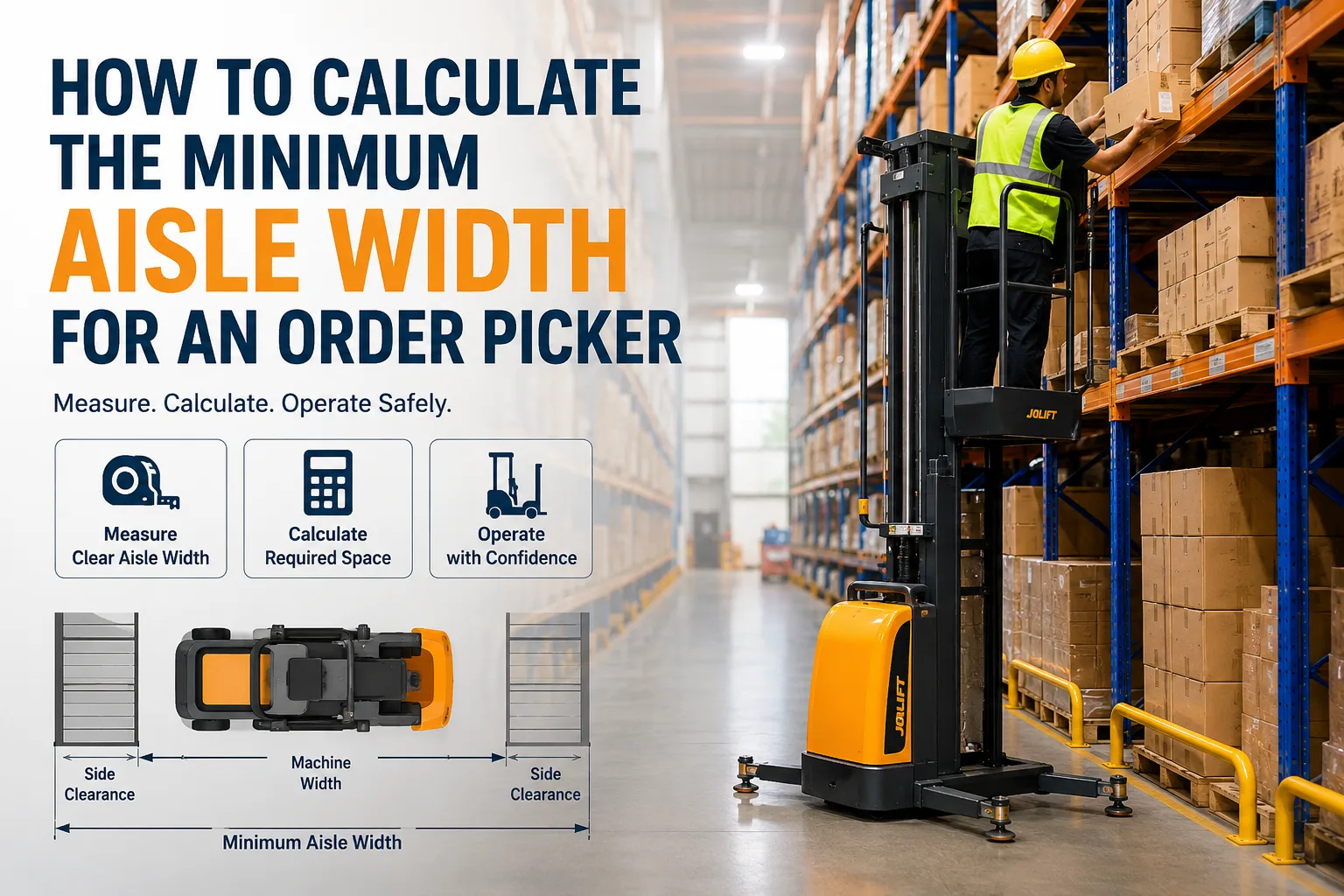
How Wide Does an Order Picker Aisle Need to Be?
The required order picker aisle width is the largest space needed for straight travel, aisle entry, turning, and elevated operation. A compact order picker may pass between two racks but still lack room to turn. A semi-electric unit may enter an aisle while stowed yet need considerably more space when its support feet are deployed.
This difference is particularly important in small warehouses, supermarket stockrooms, spare-parts facilities, and fulfillment centers where storage density leaves little room for error.
Measure the Clear Warehouse Aisle Width
Use the Narrowest Real Measurement
Measure the distance between the closest fixed or projecting obstacles. Rack plans may show more room than operators can actually use. Pallet overhang, cartons, rack protectors, columns, doorframes, pipes, and damaged uprights can all reduce the clear warehouse aisle width.
Measurements should be taken at several positions and heights. The smallest figure should be used for equipment planning. Otherwise, an order picker may enter the aisle successfully but become blocked by an obstruction farther inside.
Check the Full Order Picker Dimensions
Overall Width Is Only the Starting Point
A basic straight-travel calculation is:
Straight-travel width = machine overall width + left-side clearance + right-side clearance
The required side clearance should follow the manufacturer’s instructions, the facility risk assessment, and applicable local requirements. A single universal allowance should not be applied to every warehouse layout.
Overall length also matters. A longer compact order picker may travel through a narrow aisle but need more cross-aisle space to enter, leave, or reposition. Load trays, containers, attachments, and carried goods must also be included whenever they extend beyond the published order picker dimensions.
Check Turning Radius and Cross-Aisle Space
Turning Radius Does Not Equal Aisle Width
Minimum turning radius describes how tightly a self-propelled machine can turn under stated conditions. It does not provide a complete order picker aisle width calculation.
Machine length, approach angle, load position, nearby walls, packing stations, and rack-end protection can all affect the maneuver. A machine may have enough space for straight travel but still be unable to enter the aisle from the main warehouse route.
The cross aisle and open area at each aisle end should therefore be measured separately. These figures can then be compared with the manufacturer’s turning data. Where the available space is close to the calculated minimum, a controlled site test should be completed before placing a bulk order or changing the rack layout.
Include the Outrigger Operating Footprint
Stowed Width and Working Width May Differ
Some semi-electric order pickers require support feet or outriggers before lifting. For these machines, operating space can be assessed with the following calculation:
Operating width = deployed support-foot width + required side clearance
The support feet must remain clear of racks, stored goods, walls, and pedestrian routes. An order picker may reach the correct shelf position but still be unsuitable if its stabilizing footprint cannot open fully.
The final minimum aisle requirement should be the largest result from the straight-travel width, turning-space requirement, and deployed operating footprint.
Apply the Method to a Compact Order Picker
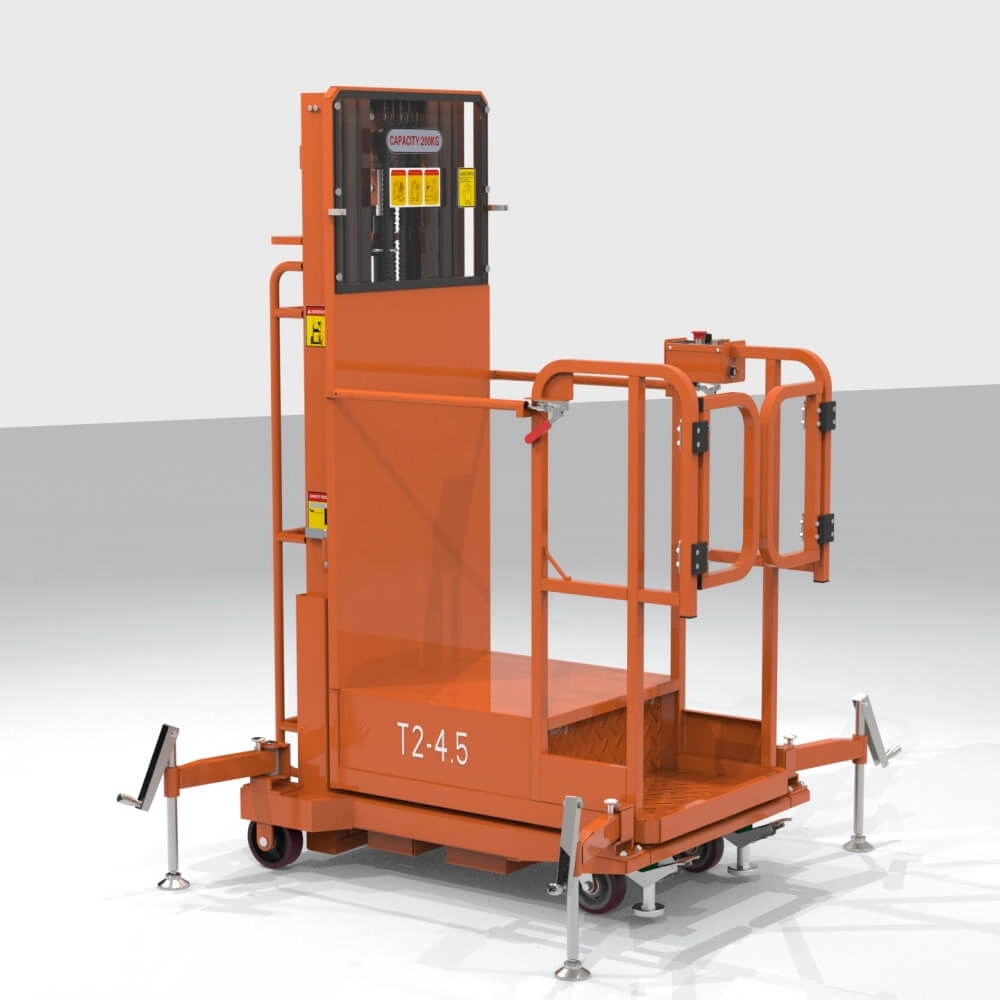
The T3 semi-electric order picker provides a practical example. Its published overall width is 840 mm, while its overall length is 1,300 mm. The series offers platform heights from 2.7 to 4.5 meters and has a rated load capacity of 200 kg.
For the listed configurations that use support feet, the published expansion size is 1,230 by 1,310 mm. This footprint is wider than the 840 mm machine body.
These specifications show why an 840 mm order picker cannot be matched to an aisle using body width alone. Buyers must verify straight travel, aisle-end maneuvering, and support-foot deployment as separate conditions. The largest of these requirements determines whether the machine can work in the proposed location.
Common Order Picker Aisle Planning Errors
Typical mistakes include measuring an empty aisle before stock is placed on the racks, using platform width instead of overall machine width, ignoring carton or pallet overhang, treating turning radius as the final aisle requirement, and overlooking the deployed support-foot footprint.
These errors can lead to rack contact, repeated repositioning, blocked pedestrian access, or equipment that cannot operate where it was intended. Taking complete measurements before requesting a quotation is far less costly than modifying racks or replacing unsuitable equipment later.
How JQLIFT Supports B2B Order Picker Selection
For buyers sourcing equipment for several facilities, distribution, or resale, supplier capability matters alongside machine specifications. A qualified manufacturer should provide model-specific dimensions, rated-load information, configuration details, and guidance based on the buyer’s actual warehouse measurements.
The JQLIFT aerial work platform manufacturer is operated by Hangzhou Jiequ Machinery Manufacturing Co., Ltd., which was established in 2015. Its official company profile describes a manufacturing base covering more than 30 acres, a team of more than ten R&D technicians, and over one hundred skilled workers. The company also reports software, utility-model, and invention patents, together with national high-tech enterprise recognition.
JQLIFT publishes dimensional information for its order picker models and supports non-standard T3 options, including machine-body colors, platform enclosure changes, and selected operational add-ons. These capabilities allow procurement teams to discuss warehouse restrictions before confirming the final product configuration.
Conclusion
The minimum aisle width for an order picker is not simply the number shown under “overall width” on a specification sheet. It must cover straight travel, cross-aisle turning, projected loads, and the machine’s complete operating footprint.
Accurate measurements reduce purchasing risk and help prevent costly warehouse changes. Procurement teams can request an order picker configuration from JQLIFT by providing the narrowest clear aisle, cross-aisle width, doorway dimensions, highest picking position, combined load, and available support-foot space.
FAQs
Q1: How do I calculate the minimum aisle width for an order picker?
A1: Add the required side clearance to the machine’s overall width. Then check the space needed for aisle entry, turning, projecting loads, and deployed support feet. The largest result should be used when selecting the equipment.
Q2: Is order picker width the same as required aisle width?
A2: No. Overall machine width does not include side clearance, turning movement, attachments, load overhang, rack protectors, or the space occupied by deployed support feet.
Q3: Does turning radius tell me how wide my warehouse aisle should be?
A3: Not by itself. Turning radius is one part of the calculation. Machine length, cross-aisle width, entry angle, load position, and nearby obstacles must also be considered.
Q4: Why does an order picker fit in the aisle but cannot lift there?
A4: The machine may fit while it is in the stowed travel position but lack enough space for its support feet. The full deployed operating footprint should be measured before elevated work begins.


