
Vertical Mast Lift Capacity vs Height: Why Taller Models May Carry Less
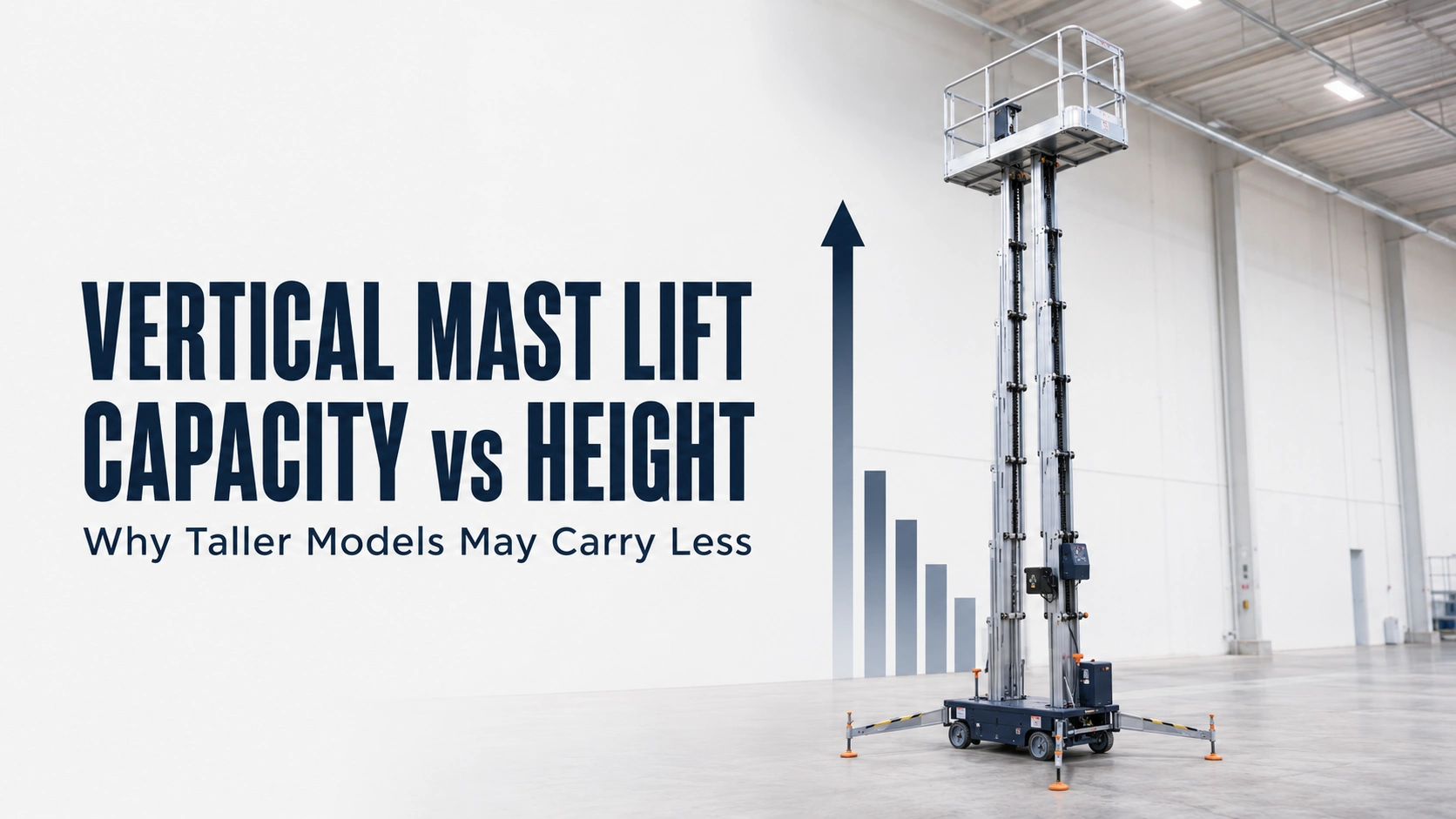
A taller vertical mast lift may have a lower load rating than a shorter model because increasing height places greater demands on stability, mast stiffness, base geometry, and supporting components. However, this does not mean that every vertical mast lift automatically loses capacity as its platform rises. In many cases, the difference appears when comparing separate models within the same product range.
For B2B buyers, the practical question is not simply, “How high can the lift go?” It is whether the vertical mast lift capacity at the required height can safely accommodate the operator, tools, materials, and job-specific equipment under the intended working conditions.
Why Can Vertical Mast Lift Capacity Decrease at Greater Heights?
Lift height and load capacity are closely connected because an elevated load creates greater leverage on the supporting structure. As platform height increases, relatively small changes in load position, floor level, or machine movement can have a larger effect on stability.
Manufacturers may address these demands by changing mast sections, widening the support footprint, increasing machine weight, limiting platform dimensions, or assigning a lower rated capacity to the tallest model. The resulting specification depends on the complete machine design rather than height alone.
Stability and the Higher Center of Gravity
Raising the platform moves the combined center of gravity of the machine, operator, tools, and materials upward. A higher center of gravity can make the equipment more sensitive to uneven floors, an incorrectly positioned load, incomplete outrigger deployment, or forces applied from the platform.
A taller model may therefore need a larger support footprint or a lower maximum platform load to remain within its intended stability limits. Buyers should review the machine dimensions in both transport and operating configurations, particularly where space around the work area is restricted.
This is especially important in factories, warehouses, hotels, and office buildings where the lift may need to pass through a narrow route before deploying outriggers near the task. A machine that fits through the access route may still require substantially more floor area when prepared for lifting.
Mast Loading, Deflection, and Structural Design
Mast sections carry compression and bending loads while guiding the platform vertically. Longer mast systems can experience more deflection than shorter structures under similar loads. The effect may vary with mast profile, section overlap, material, platform geometry, and the number of mast columns.
Reducing the rated load on a taller model may be one way to control structural stress and platform movement. Increasing component size or machine weight may be another, but that could make the lift more difficult to transport or unsuitable for floor-loading limits.
This is why buyers should not estimate a 14m vertical mast lift capacity from the rating of a 10m or 12m model. Each model’s specification should be checked individually.
Base Geometry, Outriggers, and Load Position
The support system must resist the overturning moment created by the elevated load. Outrigger layout, wheelbase, machine width, counterweight distribution, and platform position all contribute to this relationship.
Load position matters as well as total weight. An operator leaning outside the platform, heavy tools placed on one side, or materials extending beyond the guardrails may produce forces that are not represented by a simple weight calculation. Side loading from pulling cables, pushing equipment, or applying force to a structure can create additional risk.
A vertical mast lift should therefore be selected for the actual task, not used as a substitute for lifting suspended, oversized, or unstable materials unless the equipment specification explicitly permits that application.
Does Lift Capacity Always Decrease as Height Increases?
No. A rated vertical lift capacity may remain constant throughout a model’s permitted lifting range. Capacity differences often become visible when comparing models built for different maximum platform heights.
For example, the JQLIFT DL double mast aluminum alloy lift range lists the following model ratings:
| Model | Maximum Platform Height | Maximum Load |
|---|---|---|
| DL6-200 | 6,000 mm | 200 kg |
| DL8-200 | 8,000 mm | 200 kg |
| DL10-200 | 10,000 mm | 200 kg |
| DL12-200 | 12,000 mm | 200 kg |
| DL14-150 | 14,000 mm | 150 kg |
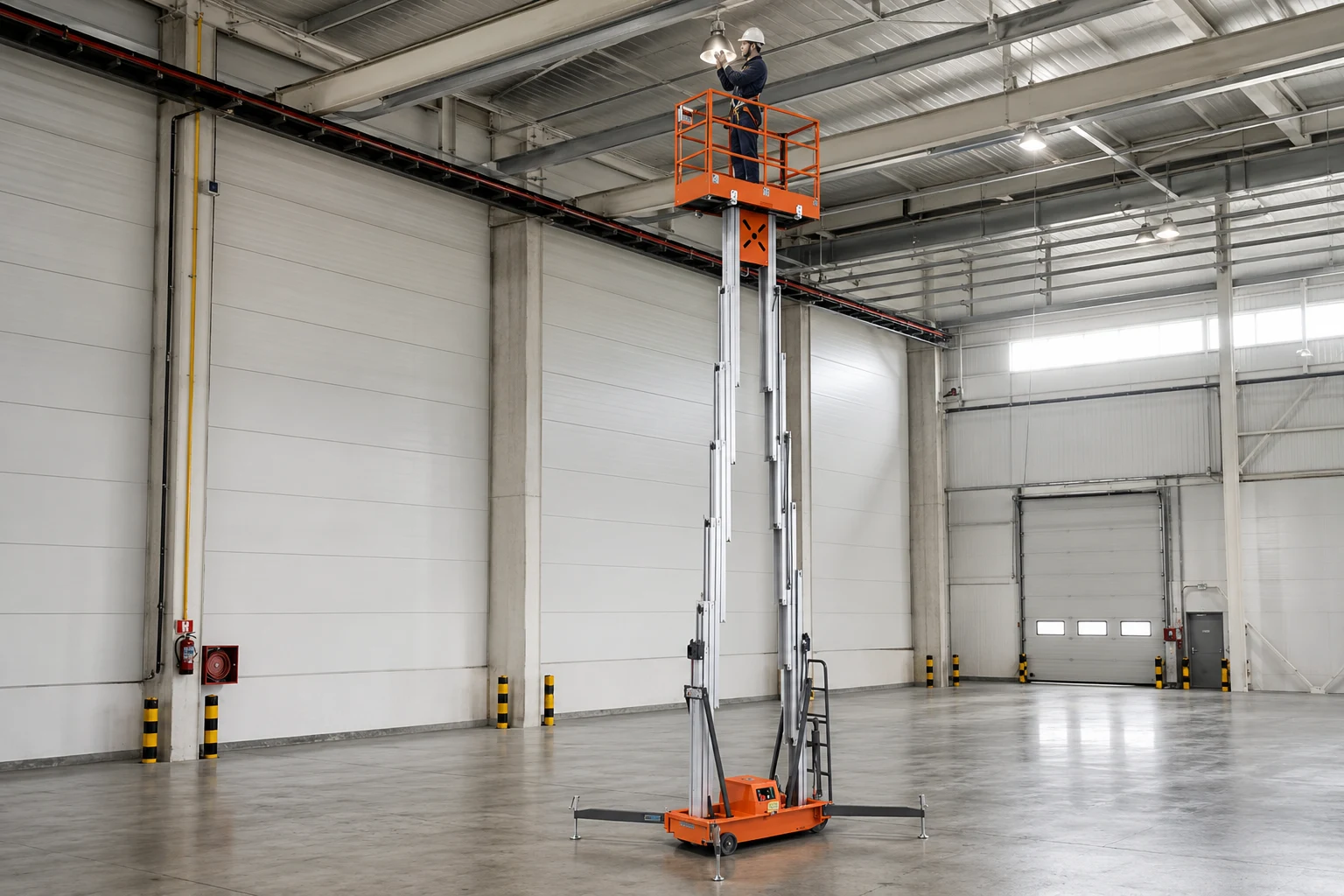
This comparison shows that capacity does not decline progressively from 6m to 12m. The reduction occurs on the 14m configuration. It should not be interpreted as meaning that a DL14-150 carries 200 kg at a lower elevation and 150 kg only at full height. The applicable rating must be taken from the product specification and operating instructions.
The same principle applies when comparing a single-mast and double-mast lift. Mast quantity can affect rigidity, platform dimensions, machine weight, and suitable applications, but the model’s published load rating remains the deciding reference.
How Much Vertical Mast Lift Capacity Is Required?
The required capacity should be calculated from the complete platform load rather than the operator’s weight alone. Depending on how the manufacturer defines rated load, the calculation may need to include:
- Operator or operators
- Hand tools and toolboxes
- Replacement components
- Cleaning equipment
- Installation materials
- Portable test instruments
- Attachments or platform modifications
- Other items carried during the task
For example, a nominal 150 kg mast lift may appear adequate for one operator. After adding tools, components, and job materials, the working load could approach or exceed the rating. Guessing individual weights or assuming that tools are insignificant creates avoidable procurement and operating risk.
Buyers should document the heaviest realistic load combination and verify how the manufacturer defines maximum load. Any required margin should follow the supplier’s instructions and the applicable workplace procedures; it should not be created by exceeding the stated rating.
Compare Platform Height, Working Height, and Required Reach
Platform height and working height are not interchangeable. Maximum platform height describes the elevated platform level, while working height is commonly an estimated reachable height above the platform. The exact definition should be confirmed in the supplier’s data.
Start with the physical position of the task: ceiling equipment, lighting, ductwork, storage level, signage, or service point. Then consider whether the operator needs to work above, beside, or below that point.
Selecting unnecessary height can increase machine size, weight, support-foot expansion, and purchase cost. Selecting too little height may encourage unsafe reaching or improvised methods. The appropriate model should provide sufficient access without relying on the operator to stretch outside the platform.
Check the Installation and Operating Environment
Capacity and height cannot be evaluated separately from the site. Before requesting a quotation, record:
- Door, corridor, and elevator dimensions
- Available outrigger deployment area
- Floor condition and allowable loading
- Indoor or outdoor use
- Slope, joints, drains, and surface irregularities
- Required AC or DC power arrangement
- Frequency of relocation
- Maximum platform load
- Required platform height
- Obstructions around the elevated work area
The DL range offers AC and DC configurations, but the appropriate power option depends on the application. Battery power may suit locations where access to a fixed supply is inconvenient, while AC power may be considered for stationary tasks near an appropriate supply. Configuration details should be confirmed against the selected model.
Common Capacity Selection Mistakes and How to Prevent Them
One frequent mistake is choosing by maximum height first and treating capacity as a secondary specification. The correct sequence is to define the task, calculate the total load, confirm the required platform height, and then screen models against site restrictions.
Another mistake is assuming that two lifts with the same nominal height have equivalent performance. Platform size, support footprint, machine dimensions, power supply, and rated load may differ. A specification comparison should use complete model data rather than a single headline figure.
Buyers should also avoid treating rated capacity as a target for routine loading without considering load variation. Tool inventories change, replacement parts vary in weight, and maintenance teams may carry unplanned materials. Establishing a job-specific loading checklist helps prevent gradual overloading.
After purchase, capacity markings and operating instructions should remain accessible. Operators should inspect the lift before use, deploy the supports as required, keep loads within the platform, and stop operation if the floor or support condition is unsuitable. Maintenance should follow the product instructions; unauthorized structural or platform changes may alter the conditions on which the original rating was based.
How to Compare 12m and 14m Vertical Mast Lifts
A 14m model is appropriate when the extra platform height is genuinely required and the expected working load remains within its rating. A 12m model may be the more practical choice when it reaches every service point while providing a higher stated capacity within the compared range.
For the DL models, the 12m unit is listed at 200 kg, while the 14m unit is listed at 150 kg. This makes the choice application-specific:
- Select by required reach if the 12m model cannot access the task.
- Select by total working load if the 14m rating is insufficient.
- Compare deployed dimensions when floor space is limited.
- Confirm transport dimensions where elevators or doorways are involved.
- Check power configuration and operating procedures before ordering.
If both required height and working load exceed the available model specification, the solution is not to overload the taller unit. Buyers should discuss another configuration or equipment category with the supplier.
What Should Buyers Check When Choosing a Vertical Mast Lift Supplier?
A supplier should be able to connect the application data to a specific model rather than recommend equipment from height alone. Useful quotation discussions should cover maximum platform load, required platform height, access dimensions, operating surface, power source, task frequency, and any requested attachments.
The JQLIFT vertical lifting equipment range includes vertical mast lifts and other lifting products for different access and material-handling requirements. Buyers should still assess each model according to the intended application rather than assume that one product type covers every elevated task.
Customization also requires careful review. The DL product information indicates support for changes such as color, standing-platform modifications, and attachment installation brackets. Any requested modification should be described before ordering so its technical feasibility and effect on the final specification can be assessed.
Information about JQLIFT manufacturing and service capabilities can help procurement teams complete an initial supplier review. Final approval should still be based on documented product specifications, commercial terms, service requirements, and the buyer’s own technical and safety criteria.
Conclusion
Vertical mast lift capacity may be lower on taller models because greater height changes the structural and stability demands placed on the machine. The reduction is not universal, nor should buyers assume that a machine automatically loses capacity as it rises. The correct rating is the value assigned to the selected model under its specified operating conditions.
A sound purchasing decision combines total platform load, required reach, deployed footprint, access route, floor condition, power configuration, and task type. For a model recommendation or quotation, buyers can contact JQLIFT for a vertical mast lift recommendation with the required height, operator and tool weight, site dimensions, operating environment, quantity, and application photos.
FAQs
Why do taller vertical mast lifts sometimes have lower capacity?
Greater platform height can increase overturning forces, mast deflection, and sensitivity to load position. Manufacturers may use a lower rated capacity on a taller model to address its particular structural and stability requirements.
Does a vertical mast lift lose capacity as the platform rises?
Not necessarily. Many models have one rated capacity throughout their permitted travel. If capacity changes by operating zone, that information should appear in the manufacturer’s load chart or instructions. Do not infer a staged capacity without documented specifications.
Is a 150 kg vertical mast lift enough for one person?
It depends on the combined load. The operator, tools, materials, equipment, and permitted attachments must remain within the stated rating. Buyers should also confirm how the manufacturer defines maximum platform load.
Should a buyer choose a 12m or 14m vertical mast lift?
Choose the 14m model when the additional reach is required and the total working load fits its rating. A 12m model may be preferable when it provides sufficient reach and offers a more suitable combination of capacity, size, and operating footprint.
What information should be sent when requesting a vertical mast lift quote?
Provide required platform height, maximum combined platform load, number of operators, tools and materials carried, doorway or elevator dimensions, available support area, floor conditions, power preference, application, quantity, and relevant site photos.


