
Order Picker Battery Checklist Before Buying: Runtime, Charging, Replacement, and Downtime

An order picker may meet the required lift height and load rating yet still disrupt operations if its battery system does not match the duty cycle. A practical order picker battery checklist therefore goes beyond voltage and amp-hour capacity. Buyers should verify runtime, charging time, facility power, battery access, replacement availability, and downtime cost. These checks matter most where one stopped machine delays picking or replenishment.
Why Battery Problems Cause Order Picker Downtime
Battery-related downtime often starts with a mismatch between the configuration and the work pattern.
Is the Battery Undersized, or Is the Duty Cycle Too Demanding?
A specification-sheet battery may deliver less runtime under frequent lifting, long travel, higher loads, little idle time, or demanding temperatures. Amp-hour capacity alone cannot answer, “How long does an order picker battery last?”
Document operating hours, shifts, lift frequency, travel distance, load, and reserve time. Intermittent stockroom use differs from continuous distribution-center work, so every runtime estimate should state its conditions.
Planned Charging Downtime vs. Unplanned Battery Downtime
Planned downtime is a charging period built into the schedule. Unplanned downtime occurs when the machine loses power early, charging takes longer than expected, a charger fails, or a replacement battery is unavailable.
Record charging windows and the longest acceptable peak-time interruption. Defining acceptable downtime makes it easier to compare standard charging, opportunity charging, a spare battery, or additional equipment.
How to Estimate Order Picker Battery Runtime Before Buying
Published voltage and capacity are starting points, not a promise that the machine will complete a specific shift. A useful runtime estimate must reflect the buyer’s workflow.
Turn the Warehouse Workflow Into a Battery Duty Cycle
Build an application profile covering shifts, lift cycles, travel, load, charging windows, environment, and reserve runtime.
A longer charging window may be enough for intermittent use, while continuous operation may need another battery strategy. Buyers can compare aerial order picker models after defining the duty cycle rather than selecting a machine first and adapting the schedule later.
Read Voltage, Capacity, Battery Type, and Charger as One System
Voltage, amp-hour capacity, battery type, motor demand, controls, and charger output should be reviewed together. A higher Ah figure does not automatically produce proportionally longer runtime. Changing battery capacity or chemistry without confirming compatibility may affect charging, weight, fit, connectors, and controls.
Specify voltage, capacity, dimensions, weight, connector, charger input and output, approved alternatives, and part number. Ask for similar-duty-cycle test data or a conditional estimate.
Choose a Charging Strategy That Fits the Operation
The right charging strategy depends on working hours, battery configuration, available breaks, and facility power. “How long does an order picker take to charge?” cannot be answered without the battery type, capacity, charger output, starting state of charge, and environment.
Overnight, Opportunity, or Faster Charging?
Overnight charging may suit a single-shift operation with a long inactive period. Opportunity charging may suit some operations with regular breaks, but only when the battery and charger are approved for that pattern. A faster charger may add cost without solving the actual duty-cycle problem.
For multi-shift work, compare between-shift charging, approved break-time charging, and spare-battery or extra-machine capacity.
Check Charger and Facility Compatibility Before Purchase
Confirm input voltage, frequency, plug type, charging location, charger format, cable routing, and outlet protection.
Battery charging and changing should be handled by trained personnel. OSHA guidance for powered industrial trucks addresses designated charging areas, vehicle positioning, ignition-source control, ventilation, and battery-handling hazards. Local rules and the manufacturer’s instructions should also be checked.
Check Battery Access and Replacement Time
Battery access, weight, tools, handling equipment, and service documents determine replacement downtime.
Inspect Access, Removal Direction, and Required Tools
“Easy battery access” may only mean a service panel opens quickly; it does not necessarily mean the battery can be removed quickly. Ask whether access is from the top, side, rear, or a pull-out tray. Confirm panel removal, connector location, battery weight, required personnel, and whether lifting equipment is needed.
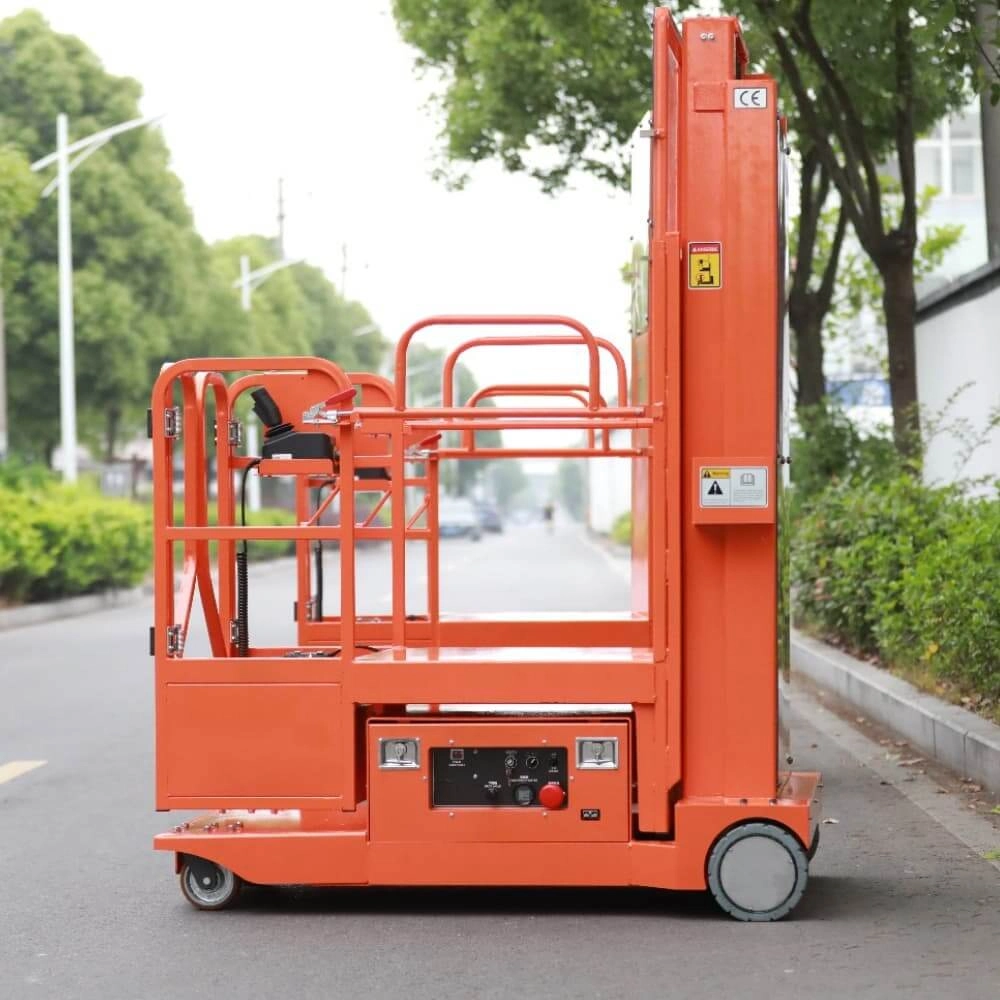
The fully electric order picker with drawer-style battery access is a relevant example. JQLIFT’s DAT page lists a drawer-style pull-out design, a 24V/105Ah battery, and a 24V/15A charger. Actual replacement time, tools, personnel, and compatibility should still be confirmed.
When Does a Spare Battery Make Business Sense?
A spare battery may be justified when equipment operates across multiple shifts, no dependable charging window exists, or replacement parts must travel a long distance. It may be unnecessary for occasional-use equipment that can charge during predictable idle periods.
Compare the added charger, storage, handling, maintenance, and training cost with lost picking time and parts lead time. Confirm part number, warranty, connector, storage requirements, and routine-removal suitability.
Prevent Battery-Related Downtime After Delivery
Without baseline records, it is difficult to tell whether shorter runtime comes from battery deterioration, incomplete charging, a changed workload, the charger, or another electrical issue.
Track Runtime, Charging Time, and Warning Signs
Record the shift, starting and ending charge indication, operating hours, charging times, shutdowns, warning codes, and workload changes. Compare later performance with the first weeks of normal operation.
A gradual runtime reduction should trigger inspection, not an immediate battery purchase. Check whether the work cycle changed, charging completes as expected, and connectors, cables, or the charger require qualified inspection. Set a reorder point using measured performance and replacement lead time.
Compare Total Cost and Choose the Right Supplier
Battery-related total cost includes the battery, charger, infrastructure, labor, spare parts, and stopped-machine cost. A lower purchase price may not be economical when parts are hard to obtain.
A qualified supplier should identify the proposed battery and charger, request relevant application data, provide model-level specifications, and clarify replacement parts and warranty terms. Published specifications should be separated from application-dependent estimates.
JQLIFT lists several aerial order picker configurations and publishes model-specific battery and charger data on relevant product pages. The DAT page also describes its pull-out maintenance design. These details provide a starting point, but runtime, charging duration, battery chemistry, replacement procedure, warranty, and parts lead time should be verified for the final model and destination.
Use the same RFQ questions for every supplier:
- What battery type, voltage, capacity, dimensions, weight, connector, and part number are supplied?
- What runtime has been tested, and under what duty cycle?
- What charging time and facility input power are required?
- Is the battery removable, and what tools, personnel, and handling equipment are needed?
- What are the battery and charger warranty terms?
- What are the replacement price, minimum order quantity, and lead time?
- Is a spare battery recommended for the stated shift pattern?
- Which manuals, photographs, or replacement videos are available?
Order Picker Battery Buying Decision Table
| Operating Scenario | Main Risk | Confirm Before Buying | Likely Action |
|---|---|---|---|
| Occasional single-shift picking | Unnecessary capacity cost | Runtime and storage charging instructions | Verify the standard configuration |
| Frequent single-shift picking | Battery cannot finish the shift | Duty-cycle runtime and charging window | Request an application review |
| Two or more shifts | Charging interrupts throughput | Approved charging method and spare-battery compatibility | Compare total cost options |
| Remote site | Long downtime after failure | Part number, warranty, and lead time | Consider a spare battery or charger |
| Limited maintenance resources | Slow inspection or replacement | Access design, tools, documents, and support | Request a replacement demonstration |
Conclusion
An effective order picker battery checklist connects the duty cycle to runtime, charging, battery access, replacement planning, and supplier support. Buyers should not select equipment from voltage and Ah alone or accept charging and runtime claims without stated conditions. The strongest decision combines application data, model-level specifications, a downtime plan, and written answers about replacement parts.
JQLIFT buyers can request an order picker battery configuration review by providing the required platform height, load, operating hours, shifts, lifting and travel frequency, charging window, facility voltage, destination market, and acceptable downtime. These details allow the proposed machine and battery system to be checked against the application.
Frequently Asked Questions
How long does an order picker battery last per charge?
There is no universal runtime. It depends on capacity and battery type, motor demand, lift and travel frequency, load, temperature, battery condition, and idle time. Ask for an estimate tied to a defined duty cycle.
How long does it take to charge an order picker?
Charging time depends on the battery system, capacity, charger output, starting state of charge, and conditions. Confirm the expected time in the product specification or supplier proposal.
Can an order picker battery be replaced?
A serviceable battery can generally be replaced, but access, tools, weight, personnel, and handling requirements vary by machine. Confirm the procedure and replacement part number before purchase.
Does a Multi-Shift Warehouse Need a Spare Battery?
Not in every case. The decision depends on charging windows, approved charging methods, required uptime, replacement time, and the cost of a stopped machine.
What Information Should Be Sent to an Order Picker Supplier?
Send the required height and load, operating hours, shifts, lifting and travel frequency, charging windows, facility power, environment, destination, and acceptable downtime.


