
What Is an Order Picker & When Should You Use One? | JQLIFT
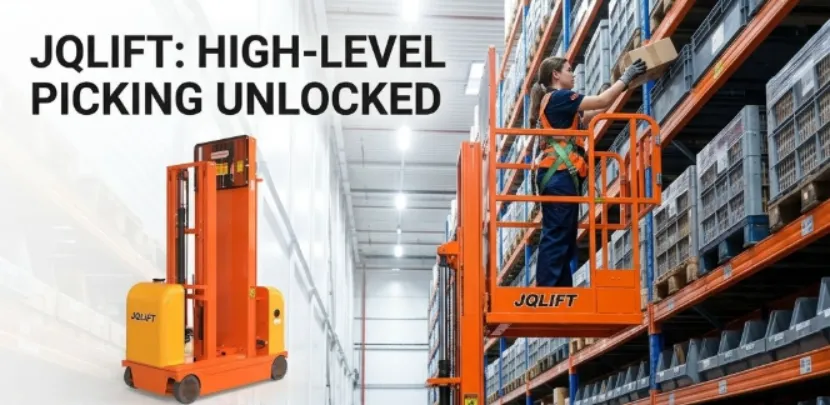
If you have ever looked up at a rack and thought, “There has to be a better way to grab that carton than a ladder and a lot of patience,” that is usually the moment this topic starts to matter. So, what is an order picker? It is a warehouse order picking machine that lifts you to the storage location so you can pick items directly from the shelf. That matters when your team handles piece picking in warehouse work, small batch orders, or fast daily replenishment.
In a busy order picker warehouse, speed is important, but safety usually becomes the real pain point first. Workers lose time walking back and forth, full pallets get moved just to reach a few boxes, and narrow aisles turn simple picks into awkward little traffic jams. Those are the situations where the right machine starts paying for itself.
What Is an Order Picker?
Before getting into features and use cases, it helps to keep the definition simple. This equipment is built for picking goods, not just moving bulk loads from one end of the building to the other. That distinction saves a lot of confusion when you compare it with other warehouse machines.
A Machine Built for Item-Level Picking
An order picker is a machine that raises both the operator and the platform to the shelf level. Instead of lifting only the load, it lifts you to the goods. That makes it useful when you need to pick cartons, parts, or individual items from upper racks.
This is why the phrase what is an order picker matters in real warehouse planning. It is not just another lift. It is meant for direct access to stock, especially when your orders are made of many SKUs rather than full pallets.
Why It Matters in Daily Warehouse Work
If your team spends most of the day pulling single items from different levels, an order picker warehouse setup often makes more sense than relying only on pallet handling equipment. You get closer access, better visibility, and less wasted motion. It also feels more natural for picking work. That sounds small, but over a long shift, small things stop being small.
How Does an Order Picker Work in a Warehouse?
The way it works is fairly straightforward, but the practical side matters more than the textbook definition. You step onto the platform, move through the aisle, raise the platform to the right level, and pick the goods directly. Simple enough. The value comes from how smoothly that happens in a tight warehouse.
Lift, Travel, and Direct Shelf Access
If you are asking how does an order picker work, the short answer is this: it combines controlled travel with vertical access. You move through the aisle, stop at the rack, rise to the product location, and retrieve the goods without dragging down a whole pallet first.
That is a big reason order pickers are common in fulfillment spaces, spare parts storage, and high-mix inventory areas. Piece picking in warehouse operations becomes faster because the operator works right at the pick face.
Why Narrow Aisles Change the Decision
A standard warehouse layout can hide a lot of inefficiency. Wide turns, blocked paths, and awkward shelf access all eat time. On the official homepage, JQLIFT presents its business around aerial order pickers and other lifting equipment, and the company says it has been manufacturing in Hangzhou since 2015 with a team that includes more than ten R&D technicians and more than one hundred skilled workers. That background matters because narrow aisle equipment tends to live or die on build quality and control feel, not just brochure numbers.
Order Picker vs Forklift: What’s the Difference?
This is where buyers often hesitate. The question is not which machine is “better” in general. The real question is which one fits the job you do most days.
When a Forklift Is the Better Fit
A forklift is usually the better choice when you mainly move full pallets, handle heavy inbound loads, or shift stock between zones. It is made for load transport. If that is your core task, there is no reason to force a picking machine into a bulk handling role.
When an Order Picker Makes More Sense
The order picker vs forklift choice becomes clearer when your staff picks individual items from upper shelves all day. That is when an order picker starts winning on access, precision, and workflow. You are not just moving stock. You are reaching it, seeing it, and taking exactly what the order calls for.
When to Use an Order Picker in a Warehouse?
This is really the heart of the article. Most buyers are not asking for definitions alone. They want to know when to use an order picker without making an expensive mistake.
When You Pick Items, Not Full Pallets
If your orders are carton based, piece based, or mixed SKU, an order picker usually fits better. Pulling down a full pallet to grab three boxes is slow and annoying. Everyone in warehousing has seen it. Nobody enjoys it.
When Your Aisles Are Tight
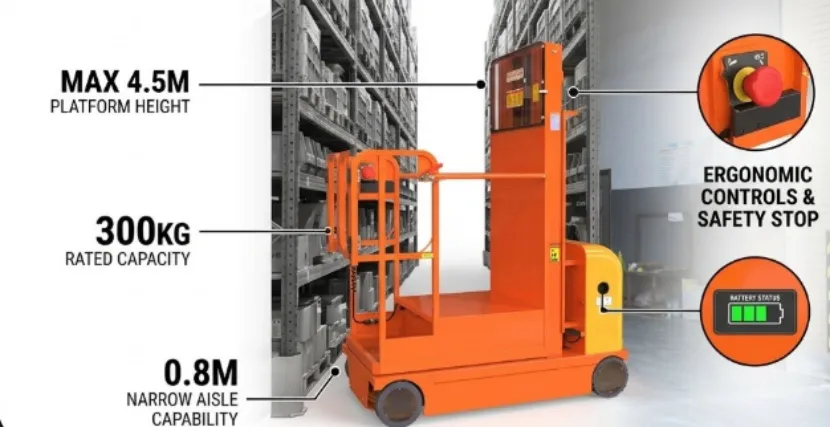
A narrow aisle order picker is often the right move when space is limited and vertical storage matters. On the official product page, the featured model is listed with up to 4.5 m platform height, 300 kg load capacity, 0.8 m narrow aisle capability, hydraulic steering, bidirectional travel, a red emergency stop button, battery status indication, and a minimum turning radius of 1600 mm. Those numbers speak directly to common warehouse worries: shelf access, turning room, safety, and day to day control.
When Safety and Accuracy Matter
If workers still use ladders for frequent upper-level picks, that is a sign you may already be late to the decision. Better order picker safety usually comes from controlled elevation, guardrails, clear controls, and stable movement. Accuracy improves too because you can work at eye level instead of reaching awkwardly from the ground.
How to Choose an Order Picker for Narrow Aisle Warehouses?
Once you know the machine type fits your work, the next step is picking the right spec. This is where many buyers either overspend or buy too small.
Check Lift Height and Load Capacity
Start with rack height and the real weight carried during a shift. That includes the operator, picked goods, and anything else on the platform. If the machine is undersized, the pain shows up fast.
Look at Steering, Turning, and Controls
If you need the best order picker for narrow aisles, focus on turning behavior, wheel design, control layout, and visibility. Fancy language is not the point. Can you move cleanly in a crowded aisle without feeling like you are wrestling the machine? That is the point.
A Quiet Note on JQLIFT
JQLIFT is worth a look if your work centers on high level picking in compact spaces. The company focuses on aerial order pickers and related lifting equipment, and its published specs show a practical approach: compact width, useful platform height, straightforward controls, and features that speak to real warehouse use rather than flashy wording. It reads less like showroom talk and more like equipment built for operators who have actual shelves to reach before lunch.
FAQ
Q1: What is an order picker used for?
A: It is used to pick cartons, cases, parts, or individual items from shelf locations, especially on upper racks.
Q2: How does an order picker work?
A: You stand on the platform, drive to the rack, raise the platform to the required level, and pick goods directly from the shelf.
Q3: When to use an order picker instead of a forklift?
A: Use an order picker when your work is item based rather than pallet based, especially in fulfillment, replenishment, or narrow aisle picking.
Q4: What should you check before buying a narrow aisle order picker?
A: Check lift height, load capacity, aisle width, turning radius, steering response, safety controls, and battery status display.
Q5: Is an order picker a good fit for warehouse space optimization?
A: Yes. It helps you use upper rack levels more effectively and supports tighter storage layouts without making picking slower.


