
Small Scissor Lift for Sale: 7 Features to Compare | JQLIFT
If you are looking for a small scissor lift for sale, price should not be your only filter. What really decides whether a machine works well for you is much simpler. Can it reach the height you need? Can it carry your tools without feeling cramped? Can it move through tight indoor space without turning every shift into a headache? Those are the questions that usually matter once the machine arrives on site.
Supplier background matters too, even if buyers do not always say it out loud. JQLIFT has been making aerial work equipment in Hangzhou since 2015. The company states that it has a manufacturing base of more than 30 acres, more than ten R&D technicians, more than one hundred skilled workers, and multiple patents. It also highlights pre sales consultation, tailored aerial work solutions, and quick after sales response. That mix matters because a good machine is only half the story. The other half is whether the supplier can actually support your job after delivery.
Why Does Platform Height Come First?
Before you compare anything else, check the height range against your actual job. A lot of buyers start broad, type in a phrase like mini scissor lift for sale, and then get stuck because several models look similar at first glance. The difference shows up when you match the numbers to the work.
Match Height to the Job
The ZSF series lists four max platform height options: 1800 mm, 3000 mm, 3900 mm, and 4800 mm. That gives you a clean way to choose based on what you really do, whether it is low ceiling repair, warehouse shelf work, or indoor maintenance in a narrow passage. Small scissor lift platform height is not a detail buried in the spec sheet. It is usually the first thing that decides if the machine will be useful every day or sit in the corner looking expensive.
How Much Load Do You Really Need?
Height gets attention first, but load is what affects daily use. A platform that lifts high but struggles with one operator and a few parts is not much help. This is where some listings look good until you read the fine print.
Check the Real Working Load
The published max load is 300 kg, and the extended platform load is 100 kg. That is a practical spec, not just a brochure number. Small scissor lift load capacity should cover the operator, tools, spare parts, and the kind of awkward little items that always come along on maintenance jobs. People forget about those until the first real shift. Then it becomes obvious fast.
Will the Machine Actually Fit Your Space?
This is the part many buyers skip, and then regret it. A machine can have the right height and load, but if it cannot move through your doorway, aisle, or work area cleanly, it stops being a solution. It becomes a workaround.
Look at Width, Length, and Turning Radius
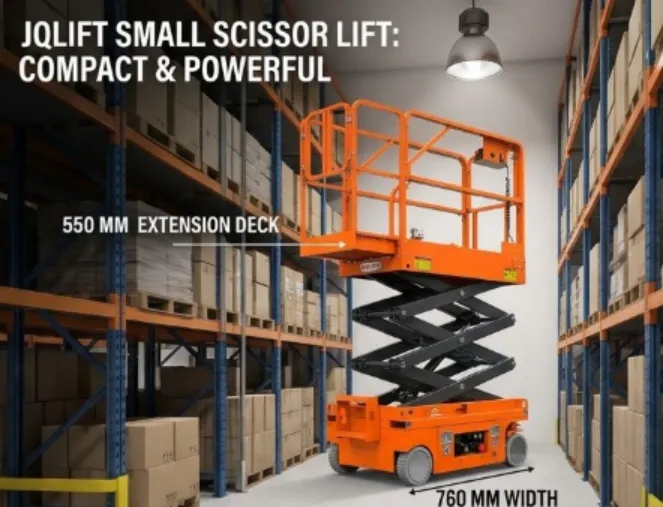
This unit has an overall width of 760 mm, an overall length of 1300 mm, and a minimum turning radius of 1600 mm. Those numbers are worth checking against your actual site, especially if you need a narrow scissor lift for warehouses, service corridors, or indoor maintenance routes. A compact scissor lift sounds nice in theory, but numbers tell the truth. If you want to compare similar models, the scissor lift category page gives a clearer picture of what sits in this size range.
Why Does an Extension Platform Save Time?
Some jobs do not need more height. They need a bit more reach. That sounds minor on paper, yet it changes the pace of work more than many buyers expect. Less repositioning means less wasted motion. On repetitive ceiling work, that adds up.
Reach a Bit Farther Without Repositioning
The inner platform extends outward by 550 mm. That extra deck space helps when you need to reach a light fixture, pipe run, or overhead fitting that sits just beyond normal standing position. Buyers often start by comparing a small electric scissor lift with other compact units, but the extension deck is one of those details that affects real productivity more than the power label alone.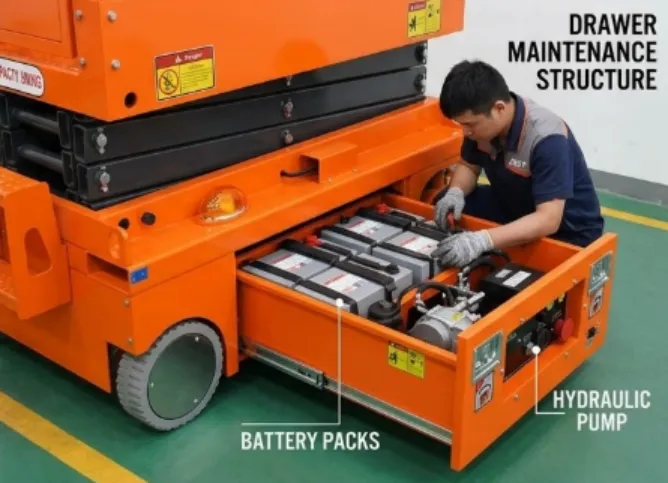
Which Safety Points Should You Check First?
Safety copy on product pages can sound similar, so it helps to look for specifics. You want to know what happens when the machine is not level and what protects the platform if a hose fails. Those are plain questions, and they matter.
Focus on the Safety System, Not Just the Price
The listed small scissor lift safety features include an electronic level that blocks lifting when front to back or left to right tilt goes past the safe limit. The machine also includes a hydraulic hose explosion proof valve to help prevent sudden drops caused by hose rupture, plus a platform mounted safety hook. That is the sort of detail buyers should compare line by line. Not all “safe” machines explain how they do the job.
What Makes Maintenance Easier After Delivery?
The sale is the easy part. Day to day upkeep is where ownership gets real. If routine checks take too long or service access is awkward, the machine costs you time even when nothing is broken.
Service Access Matters in Daily Use
This model uses a pull out drawer design for easier access during service, and it is fitted with 230 mm diameter wheels for rougher working conditions. Small scissor lift maintenance tends to be ignored during buying talks, but it should not be. You can also review the company’s service page for its stated approach to support, including requirement review and after sales care. That part is not flashy, but it matters more after month one than on day one.
Should You Ask About Customization and Supplier Support?
Yes, especially if your site is not standard. A machine may be close to what you need but not quite there. That gap is where supplier flexibility starts to matter more than a neat looking price list.
Buy for the Job You Have, Not the Brochure You Read
The product page states that this equipment supports function customization based on client needs. That makes custom small scissor lift requests a real option rather than a vague sales promise. If your project has unusual space limits, platform preferences, or operating habits, it makes sense to ask before ordering. A supplier that can talk through the job and respond clearly usually saves you trouble later. If that is where you are now, the contact page is the right next step.
Choosing a small scissor lift for sale gets easier when you compare the features that actually affect work: height, load, size, reach, safety, maintenance, and support. A small scissor lift should fit your floor plan and your routine, not just your budget. That is the part buyers remember a few weeks later. Usually very clearly.
FAQ
Q1: What is the most important spec to check when buying a small scissor lift?
A: Start with small scissor lift platform height, then check load, machine width, and safety details. Height gets the machine to the job, but width and load decide how usable it is in real work.
Q2: How much weight should a small scissor lift carry?
A: That depends on your operator, tools, and any parts carried on the platform. The published small scissor lift load capacity here is 300 kg, with 100 kg on the extended platform.
Q3: Is a narrow scissor lift better for indoor maintenance?
A: In many cases, yes. A narrow scissor lift is easier to move through aisles, corridors, and tighter work zones. This model lists a 760 mm overall width, which suits compact indoor space better than bulkier equipment.
Q4: Which small scissor lift safety features should you compare?
A: Focus on tilt protection, hose failure protection, and platform safety components. The listed small scissor lift safety features here include an electronic level, a hydraulic hose explosion proof valve, and a platform mounted safety hook.
Q5: When does a custom small scissor lift make sense?
A: A custom small scissor lift makes sense when your site, workflow, or platform needs do not match a standard unit. The product information states that function customization is available based on client requirements.


