
Self-Propelled vs. Push-Around: Top 8 Vertical Lifts for Every Budget
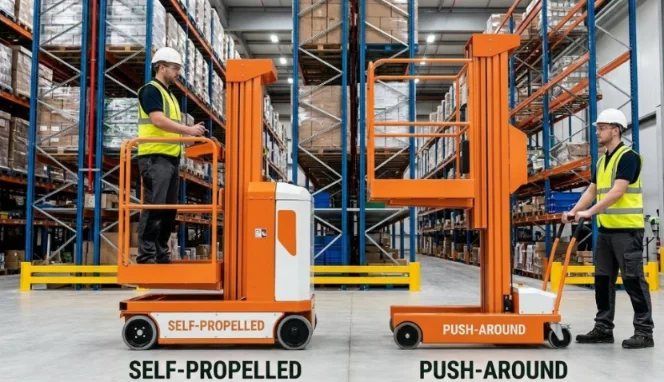
When you compare self-propelled vs push-around lifts, the real question is usually simple. Should you pay more now, or save money now and accept slower work later? That is where most buyers get stuck. A neat spec sheet does not settle it. A warehouse with long aisles has one answer. A mall maintenance team working in short bursts has another. This is also why affordable vertical mast lifts, cost-effective personnel lifts, and a solid mast lift price comparison matter more than a single sticker price. The right choice depends on how often you move, how far you move, and how much time those moves quietly eat every day.
What Is the Real Difference Between Self-Propelled and Push-Around Lifts?
The difference sounds obvious, but it affects almost every part of your budget. A push-around lift is cheaper and simpler. A self-propelled lift costs more, but it cuts walking, repositioning, and repeated setup. If your team only goes up a few times a day, that extra spend may not pay back quickly. If your operators stop at ten or twenty points in one shift, it often does.
Push-Around Lifts for Low-Cost Access
Push-around lifts fit low-frequency work. A semi-electric unit on the site can be pushed manually and lifted electrically, with platform heights from 2.7 m to 4.5 m, a 200 kg load, and unit weights from 320 kg to 450 kg depending on the model. That kind of setup makes sense for supermarkets, stock rooms, and occasional indoor maintenance where the machine does not need to travel much between jobs. It is the classic answer when buyers search for cost-effective personnel lifts without paying for drive motors they may barely use.
Self-Propelled Lifts for Faster Daily Work
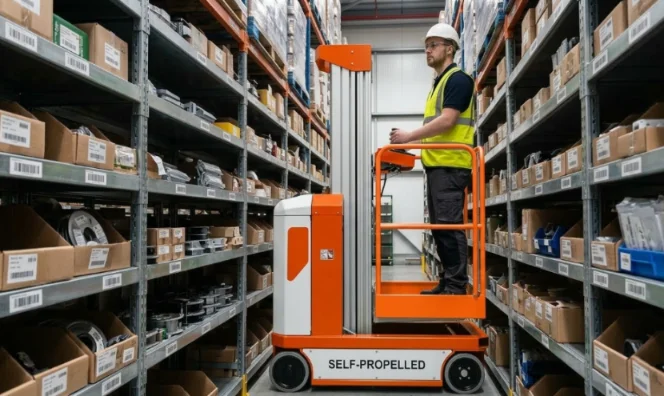
Self-propelled models make more sense when moving is part of the job, not a side task. One all-electric vertical mast model listed on the site offers electric mobility and lifting, 6 m or 7.5 m platform height options, a 125 kg load, and an 820 mm overall width. The page also notes 0.8 m narrow aisle capability and hydraulic steering for easier movement in tight warehouse lanes. That kind of machine is not just about lifting height. It is about shaving small delays off every stop. Those delays add up fast, even if people rarely write them into a purchase request.
Which Type Gives You Better Value?
Price matters, but value is about the whole job. That is the part many teams feel in practice and struggle to explain on paper.
When Push-Around Lifts Usually Win
A push-around unit is often the better pick when you have a tight budget, short indoor travel, and one operator doing short-duration tasks. The semi-electric picker line on the site is clearly built around that idea: practical lift heights, a 200 kg load, anti-slip platform, foot-operated braking, a transparent back panel for visibility, and outriggers on taller variants. For buyers doing shelf checks, light maintenance, or stock work a few times a week, this is the sensible side of the mast lift price comparison. You spend less up front, maintenance stays simple, and the machine is easier to store.
When Self-Propelled Lifts Usually Win
A self-propelled lift starts to look better when your team works across many positions in one shift. One all-electric mast model on the site has 305 mm wheels, emergency lowering, a centralized status interface, and a turning radius of 1600 mm. Another double mast model reaches up to 14 m and supports up to 200 kg, while using polyurethane tires that are described as floor-friendly and outfitted with infrared-monitored outriggers. Those details matter when you work in offices, hotels, factories, or warehouses where the floor condition and repeated repositioning both matter. The machine costs more, yes. But if it saves even a few minutes at each stop, the numbers start to move.
Which Vertical Lifts Fit Each Budget Best?
You do not need eight random products. You need eight sensible budget anchors. That is more useful.
Top 8 Vertical Lifts for Every Budget
For entry budget, look at T2-2.7 and T2-3.3. They keep cost low and still carry 200 kg. For small stores or back-room access, they are hard to argue with.
For lower mid budget, T2-4 and T2-4.5 give more height without jumping into full self-propelled pricing.
For buyers moving into affordable vertical mast lifts with electric travel, AL6-100 is a practical step.
If your aisles are tight and movement is frequent, AL7.5-100 is stronger for daily warehouse work.
For higher reach but still compact transport, L6-100 and L8-100 are worth attention. They offer 5.8 m and 7.8 m platform heights and a 125 kg load in a narrow 825 mm machine width.
For bigger indoor height needs, DL8-200 and DL12-200 are strong candidates. The double mast range reaches from 6 m to 14 m platform height, with 200 kg capacity on several variants before the tallest model drops to 150 kg. That is a useful spread for buyers doing a real mast lift price comparison by height class, not by headline alone.
Why Does JQLIFT Deserve a Look?
Before you decide, it helps to know whether the maker looks like a trading page or an actual manufacturing base. JQLIFT presents itself as a manufacturer founded in 2015 in Hangzhou, with a site of more than 30 acres, more than ten R&D technicians, more than one hundred skilled workers, and dozens of patents across software, utility, and invention categories. The company also says its products are sold globally and that it offers pre-sales consultation, tailored aerial work solutions, and after-sales response support. That mix matters. Buyers usually care less about slogans and more about whether the company can build, customize, and still answer the phone when a part is needed six months later. Fairly basic point, but people forget it when price pressure gets messy.
How Should You Choose?
The cleanest rule is this. If your work is low-frequency, mostly fixed-point, and budget-led, push-around lifts are often the right buy. If your work is daily, spread across many locations, and labor time matters, self-propelled lifts usually make better sense. That is the heart of self-propelled vs push-around lifts. It is not cheap versus expensive. It is low upfront spend versus lower daily friction. Once you frame it that way, the shortlist gets much shorter.
FAQ
Q1: Is a self-propelled lift always better than a push-around lift?
A: No. A self-propelled lift is better when you move often during the day. A push-around lift is often better for low-frequency indoor jobs with tight budgets.
Q2: What are the most affordable vertical mast lifts for indoor work?
A: Entry-level push-around or semi-electric models are usually the most affordable vertical mast lifts. The lower-height T2 models are a good example of that price class.
Q3: What should you check in a mast lift price comparison?
A: Check platform height, load, machine width, travel method, setup time, and safety features. Do not compare purchase price alone.
Q4: Are cost-effective personnel lifts always low-priced models?
A: Not always. A higher-priced self-propelled unit can be more cost-effective if it saves labor time every day.
Q5: Which lift type is better for narrow warehouse aisles?
A: A compact self-propelled mast lift is usually better when you need frequent movement in tight aisles. One listed all-electric model is described as suitable for 0.8 m aisles.


