
Best Indoor Aerial Lift for Hotel and Office Building Maintenance: How to Choose
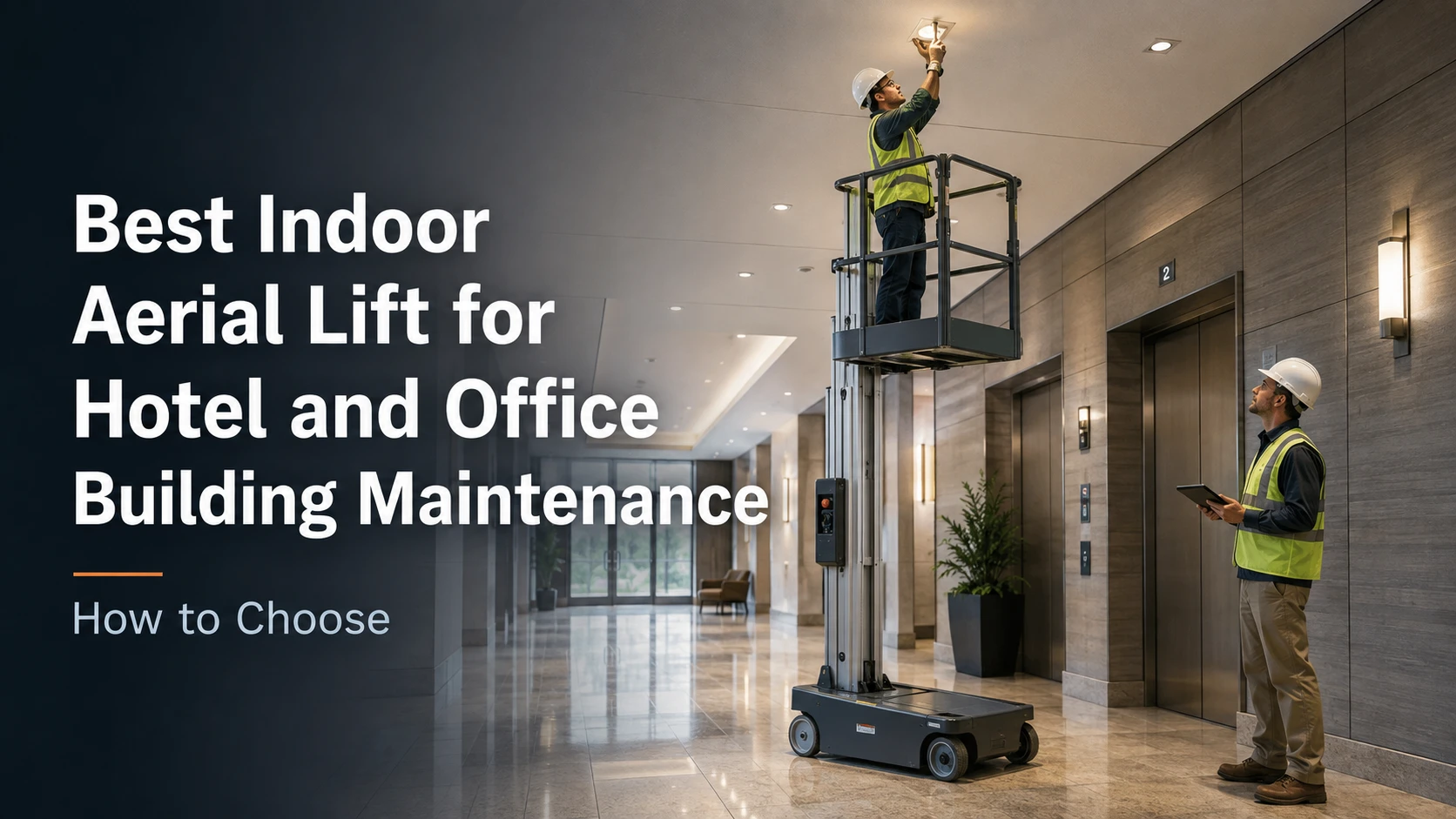
Choosing the best indoor aerial lift for hotel maintenance or office building maintenance is rarely a matter of comparing maximum height alone. A machine can reach the ceiling and still be unsuitable if it cannot pass through the entrance, turn in a service corridor, enter an elevator, carry the required tools, or operate within the available floor space.
For facility managers, maintenance contractors, procurement teams, and equipment distributors, the selection should start with the building and the task. Required height, access route, operator load, platform space, floor conditions, and frequency of movement should all be defined before a model is selected. A compact vertical mast lift may suit one-person work in restricted spaces, while a small scissor lift may make more sense when the job requires additional platform room or a higher working load.
What Makes an Aerial Lift Suitable for Hotel and Office Maintenance?
Hotels and office buildings create a different access problem from open warehouses or outdoor construction sites. Maintenance teams may need to work around finished interiors, occupied corridors, elevators, doors, reception areas, lighting systems, HVAC equipment, signage, and ceiling services without moving oversized equipment through the building.
The practical question is therefore not simply, “How high does the lift go?” It is, “Can this indoor aerial lift reach the work point through the route available and support the actual maintenance task?”
Building Access Can Matter More Than Maximum Lift Height
Before comparing platform height, map the complete travel route from the unloading point to the work area. Record the narrowest clear doorway, corridor width, ceiling clearance, elevator entrance, elevator car dimensions, turns, thresholds, ramps, and any fixed obstacles.
This is particularly important when selecting a compact aerial lift for a commercial building. A machine may fit through a straight doorway but still require more room to make a 90-degree turn. It may enter an elevator door but be too long for the elevator car. A lift with a narrow transport configuration may also require substantially more space once positioned for work.
For projects where doorway, corridor, and elevator access are the main constraint, these measurements should be checked against the supplier’s current transport and operating specifications before an order is placed.
Maintenance Frequency Changes the Right Power and Mobility Choice
A hotel that uses a lift occasionally for light replacement has a different requirement from a facility team that moves between multiple floors and maintenance points every day.
Push-around equipment may be practical when travel distances are short and the machine is repositioned infrequently. Where maintenance teams regularly move between ceiling fixtures, service areas, corridors, or rooms, powered travel may reduce manual repositioning and become a more relevant purchasing consideration.
The buyer should therefore describe how the machine will actually be used: how often it moves, how far it travels, whether elevator transport is required, where charging is available, and whether the equipment must repeatedly enter occupied areas. Power configuration should be selected from the verified specification for the exact model rather than assumed from a general product name.
Which Type of Indoor Aerial Lift Fits the Job?
There is no single lift type for every hotel or office building. The starting point should be the maintenance task and the physical restrictions around it.
| Work condition | Practical starting point |
|---|---|
| Restricted routes, one operator, light tools | Compact vertical mast lift |
| Higher indoor work with limited floor space | Double-mast vertical lift |
| Frequent movement between maintenance points | Powered vertical mast lift |
| More tools, materials, or platform space required | Compact scissor lift |
JQLIFT’s current product range includes single-mast, double-mast, and all-electric aluminum vertical lifts as well as several small scissor lift configurations, allowing buyers to compare these equipment types against different indoor applications.
Choose a Vertical Mast Lift for Compact One-Person Maintenance
A vertical mast lift is a useful starting point when one technician needs vertical access while the machine must remain relatively compact. Typical tasks can include lighting work, ceiling inspection, electrical service, signage work, and access to overhead building systems.
The main advantage is not simply height. It is the combination of vertical reach and a compact machine format. This can be important in hotels and office buildings where access may involve doors, corridors, elevators, furniture, or narrow service areas.
JQLIFT’s Vertical Mast Lifts range currently includes L single-mast, DL double-mast, and AL all-electric aluminum lift configurations. A buyer should still confirm the exact platform height, overall dimensions, machine weight, rated load, power configuration, and operating footprint for the proposed model.
A vertical mast lift may be less suitable when the job requires multiple operators, larger replacement parts, or substantial platform space. In those cases, capacity and working area can become more important than having the narrowest possible machine.
Choose a Compact Scissor Lift When Platform Space and Load Matter More
A compact scissor lift deserves consideration when the technician needs more standing area for tools, components, test equipment, or longer-duration work. The crossed lifting structure raises a larger platform vertically, which can provide more usable working space than many single-person mast configurations. OSHA also describes scissor lifts as mobile supported scaffold work platforms that move workers vertically in applications including retail and manufacturing.
This does not mean a scissor lift is automatically better for indoor maintenance. The larger platform and chassis may require a different access route, turning area, and floor space. Buyers should compare overall width, length, platform dimensions, rated load, turning requirements, machine weight, and travel configuration.
JQLIFT currently lists hydraulic, all-electric, and semi-electric models in its Scissor Lifts category.
When the choice remains unclear, the detailed guide Vertical Mast Lift vs Scissor Lift: Which Is Better for Indoor Maintenance? examines the decision in terms of access space, platform area, working load, operator number, floor conditions, and frequency of use.
How to Match Working Height, Load, and Platform Size to the Maintenance Task
Once the general equipment type is identified, three specifications need to be matched to the real job: height, load, and usable platform space.
Measure the Work Point Before Choosing Platform Height
Do not use ceiling height and platform height as interchangeable figures. The required platform position depends on the location of the work point and the operator’s working position. A maintenance team servicing ceiling lighting may require a different platform height from a team working on higher atrium fixtures, even inside the same building.
Buying significantly more height than the task requires can also change other characteristics of the machine, including dimensions, weight, setup requirements, and configuration. The RFQ should therefore state the actual work-point height and application rather than asking only for a generic “8 m lift” or “10 m lift.”
If a building contains several work areas, record the highest required point as well as the more common daily maintenance height. This gives the supplier enough context to decide whether one model can reasonably cover the work or whether another configuration should be reviewed.
Calculate the Operator, Tools, and Materials as One Working Load
Rated capacity should be compared with everything carried on the platform, not only the technician’s body weight. Tools, testing instruments, replacement lighting components, electrical parts, cleaning equipment, and other materials can materially change the required working load.
The purchasing team should estimate the normal load and the heaviest expected maintenance load, then verify both against the current model specification. Equipment should be operated within its rating and design limitations; OSHA similarly states that aerial equipment should be used within the applicable equipment ratings.
If a one-person platform leaves insufficient capacity or usable space once tools and parts are included, a different mast configuration or a compact scissor lift may be more appropriate.
Check the Building Before You Buy the Lift
One of the most expensive selection mistakes is confirming the work height but failing to confirm the access route. A site survey does not need to be complicated, but it should cover both transport and operation.
Verify Transport Dimensions and Operating Footprint Separately
Transport dimensions describe the machine while it is moving through the building. Operating dimensions describe the space it requires once positioned for elevated work. These figures can be very different.
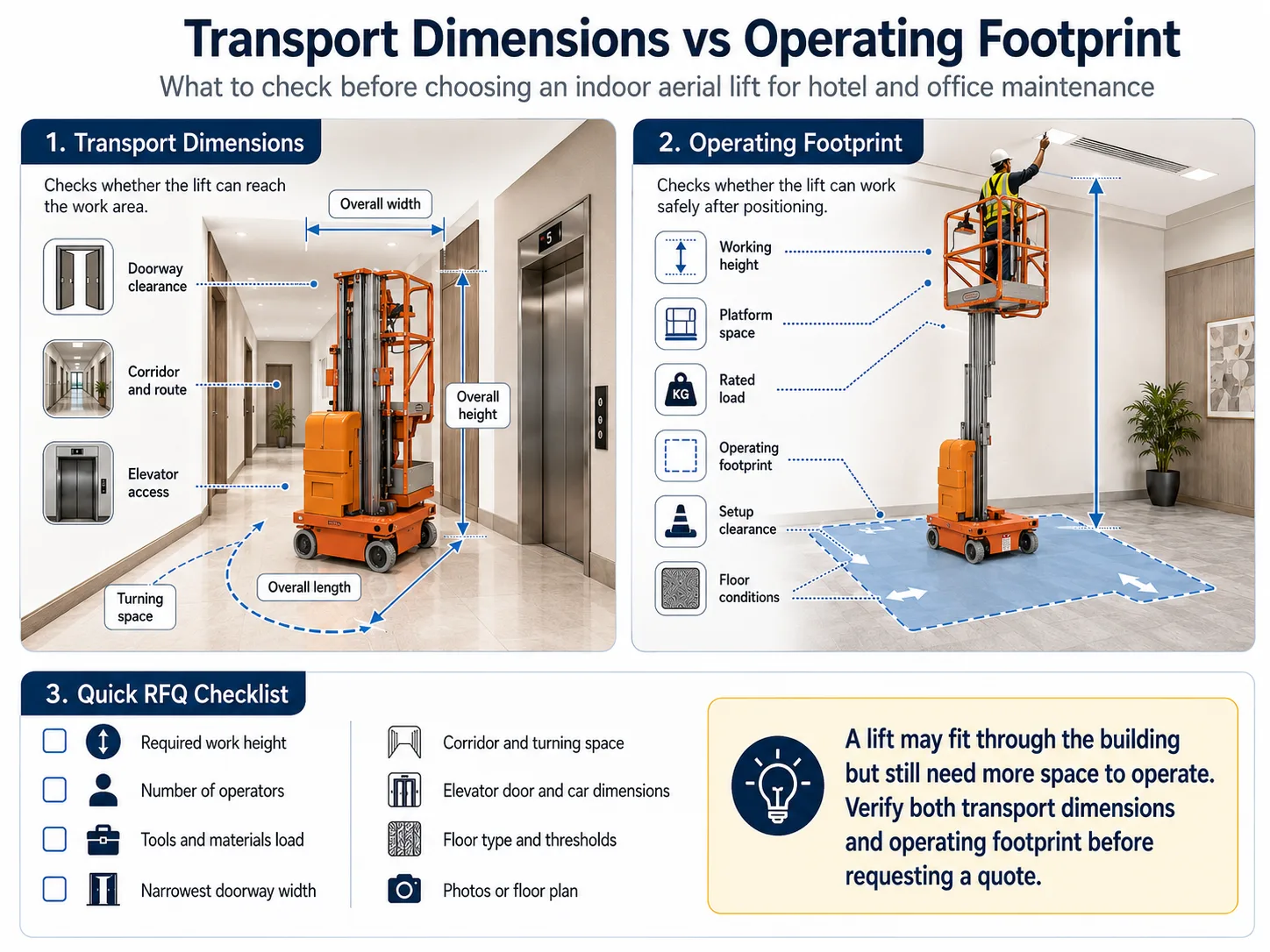
A narrow indoor maintenance lift may pass through a hotel doorway and still require additional clearance around the work point. Models that use outriggers or other support arrangements can need substantially more floor area during operation than their stowed width suggests. JQLIFT’s existing guidance likewise distinguishes stowed machine width from the floor area required after supports are deployed.
Before purchasing, request the exact stowed length, width, and height together with turning requirements and the complete operating or outrigger footprint where applicable.
Check Floor Conditions, Thresholds, and Sensitive Interior Surfaces
Finished buildings introduce another constraint: the machine has to travel over the actual floor.
Record whether the route includes polished tile, stone, wood, carpet transitions, ramps, raised thresholds, or other surfaces that may affect travel. Machine weight and concentrated wheel loads should also be reviewed against the building’s requirements rather than assuming that any product described as an “indoor lift” is suitable for every finished floor.
For unusual surfaces or load restrictions, provide photographs and floor information to the supplier and obtain confirmation for the proposed configuration. Avoid relying on general marketing descriptions such as “floor friendly” unless the relevant wheel, weight, and operating requirements have been verified.
How to Compare Indoor Aerial Lift Options Before Requesting a Quote
Price comparison is useful only after the technical requirement is consistent. If two suppliers are quoting different heights, capacities, power systems, or operating configurations, the prices are not directly comparable.
A site-based RFQ should normally specify:
- required work-point and platform height;
- narrowest doorway and corridor dimensions;
- elevator door and internal car dimensions where relevant;
- number of operators;
- combined operator, tool, and material load;
- required platform space;
- machine weight restrictions;
- floor type and thresholds;
- turning and setup space;
- power preference and charging conditions;
- daily movement frequency; and
photographs or drawings of difficult access points.
This information allows a supplier to recommend an exact configuration instead of quoting a generic indoor maintenance lift based only on maximum height.
How to Choose an Aerial Lift Supplier for Hotel and Office Projects
At the supplier-selection stage, the key question changes from “Which lift type looks suitable?” to “Can the supplier verify that the proposed machine actually matches the building?”
A qualified response should identify the exact model and provide current dimensions, rated load, platform information, machine weight, power configuration, and any operating-space requirements. Where the building has restricted elevators, sensitive flooring, unusual thresholds, or limited setup space, those conditions should be discussed before purchase rather than after delivery.
JQLIFT manufactures aerial work platforms and currently presents both vertical mast and compact scissor lift product lines for indoor and facility-maintenance applications. The company website also describes pre-sales product consultation and customized aerial-work solutions. Buyers can review the wider range through JQLIFT before narrowing the requirement to an exact configuration.
Technical documentation should be compared alongside purchase price. Specification sheets, operating instructions, configuration notes, customization details, and after-sales arrangements can affect whether a machine remains practical after it reaches the site. Any requested modification that could affect dimensions, load, stability, or access should be documented and verified for the final configuration.
RFQ Checklist for Hotel and Office Building Maintenance Lifts
Before requesting a quotation, prepare the highest work point, required platform height, operator count, total working load, doorway dimensions, corridor width, elevator dimensions and rated load, available setup space, floor type, thresholds, daily movement pattern, power requirements, and photographs or drawings of the route.
A complete RFQ reduces the risk of receiving a recommendation based only on height or product category and gives the supplier a clearer basis for checking whether the equipment fits the actual building.
Conclusion
Selecting an indoor aerial lift for hotel or office building maintenance starts with the jobsite rather than a catalog headline. The appropriate machine should match the required height, access route, operator and tool load, platform-space requirement, floor conditions, mobility pattern, and operating footprint.
Compact vertical mast lifts can be a practical starting point for restricted routes and one-person maintenance, while compact scissor lifts may suit jobs requiring more platform area or working load. Neither choice should be finalized until the exact model specifications are compared with actual site measurements.
For a model-specific review, provide the work height, doorway and elevator dimensions, operator and tool load, floor conditions, power preference, and site photographs through Contact JQLIFT. The proposed configuration can then be checked against the actual maintenance environment before a quotation is finalized.
FAQs
What is the best aerial lift for hotel maintenance?
The appropriate lift depends on the maintenance height, access route, operator load, tools, and available floor space. A compact vertical mast lift may suit one-person work in narrow hotel corridors, while a compact scissor lift may be more suitable when additional platform space or load capacity is required.
What type of aerial lift is suitable for office building maintenance?
Start by checking the work-point height, door and elevator access, turning space, floor conditions, operator number, and tool load. For narrow routes and light one-person work, a vertical mast lift may be appropriate. More open work areas with larger tool or platform requirements may favor a small scissor lift.
Can an indoor aerial lift fit in a passenger elevator?
Some configurations may fit, but this cannot be assumed from machine width alone. Compare the lift’s stowed width, height, length, machine weight, and turning requirements with the elevator door opening, internal car dimensions, rated load, and approach area.
Is a vertical mast lift or scissor lift better for indoor maintenance?
A vertical mast lift generally suits restricted access and compact one-person tasks, while a small scissor lift can provide more platform space for tools or longer work. The correct choice depends on the actual site and workload rather than the equipment category alone.
What information should be sent to an indoor aerial lift supplier before requesting a quote?
Provide the required work height, operator count, combined working load, doorway and corridor dimensions, elevator information, floor type, available operating space, power requirements, expected usage frequency, and site photographs or drawings.


