
Manual Picking Cart vs Self-Propelled Harvest Trolley: How to Choose Greenhouse Harvesting Equipment
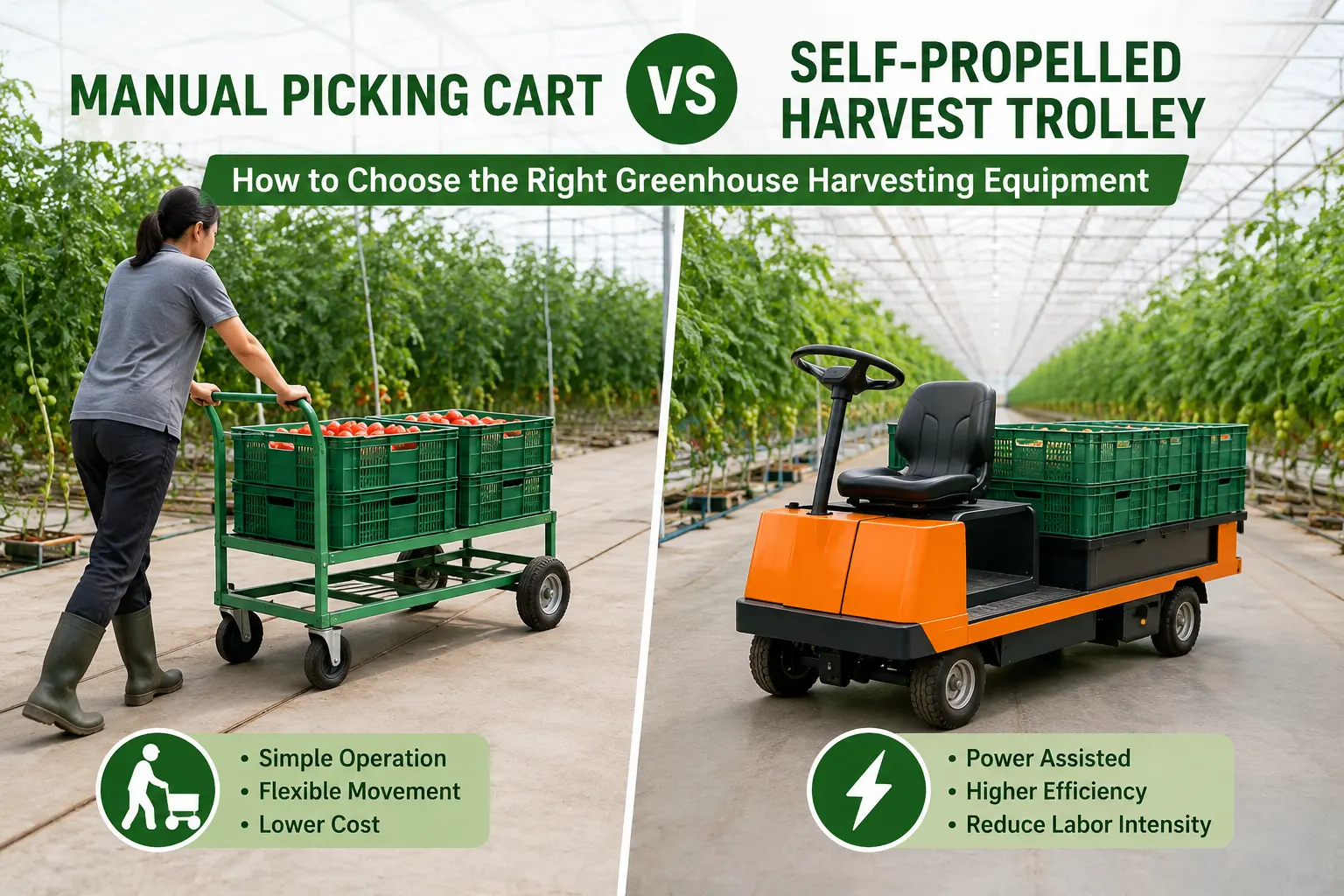
The decision of selecting a manual picking cart over a self-propelled harvest trolley is rarely about whose technology is more sophisticated. In most cases, it comes down to layout of the greenhouse, quantity of harvested produce, distance of movement, labor expenses, crop, and frequency of transferring fully-loaded carts from the growing rows into the packing zone. The correct harvesting machines for B2B clients, greenhouse administrators, equipment sellers and agricultural transportation staff must minimize additional walking and avoid congestion of aisles.
Manual picking cart is applicable in small-scale production. Self-propelled or electric harvest trolley can be an optimal solution in case of moving large, long-distance and bigger quantities of produce by the same staff.
Quick Answer: Which Greenhouse Harvesting Equipment Should You Choose?
Select manual picking cart if the size of greenhouse is small, distance for transportation is short, the daily harvest is moderate, and employees can transport harvest containers without slowing down the overall harvesting process. This type of equipment is a good choice when the client requires easy operation, less complicated maintenance, and mobility in tight spaces.
Select a self-propelled harvest trolley if the workers have to put much effort into transporting heavy crates, the distance from the place where harvesting takes place to the place where containers should be taken is large, or if containers should be transported continuously throughout the harvesting process. Electric harvest trolley will be useful in larger vegetable greenhouses.
A picking dump truck should be considered when bulk transfer and unloading are the main problems, rather than row-level picking. Buyers comparing carts, trolleys, and dump trucks can also review how different equipment types improve greenhouse harvesting efficiency in crop collection and transport.
Why Manual Picking Carts May Not Be Enough for Larger Greenhouses
Manual picking carts work well when the crop volume and travel distance are manageable. The problem appears when the cart becomes a bottleneck instead of a support tool.
In a long greenhouse, workers may spend a large part of the day walking between rows, collection points, and the packing line. Every full crate increases pushing effort. If the aisle is narrow, a loaded greenhouse picking cart can also block other workers or slow down the next harvesting cycle. These delays are not always obvious in a purchasing spreadsheet, but they are easy to see during peak harvest periods.
Manual carts may also create hidden labor pressure. A worker may still pick efficiently, but the full container must be moved before the next container can be placed. If several rows are harvested at the same time, delayed cart movement can cause temporary storage problems, aisle congestion, and uneven supply to the sorting or packing area.
This does not mean manual carts are the wrong choice. It means buyers should match the cart to the scale of the greenhouse, the crop weight, the harvest route, and the number of workers using the equipment.
Manual Picking Cart vs Self-Propelled Harvest Trolley: Key Differences
The main difference is not only power source. It is how each equipment type affects labor movement, crop handling, and daily workflow.
| Selection Factor | Manual Picking Cart | Self-Propelled / Electric Harvest Trolley |
| Best-fit greenhouse | Small to medium greenhouse | Medium to large greenhouse |
| Transport distance | Short routes | Longer internal routes |
| Operator effort | Manual pushing or pulling | Powered movement, depending on configuration |
| Harvest volume | Light to moderate | Moderate to high |
| Maintenance focus | Wheels, frame, handles, basic wear parts | Battery, drive system, controls, wheels, wear parts |
| Purchasing focus | Size, load, wheels, aisle fit | Power system, battery life, controls, turning radius, load, service support |
A manual picking cart is often selected for cost-sensitive projects or farms where equipment is moved only short distances. It can also be easier to deploy when the greenhouse layout changes frequently or when operators need a simple harvest cart without powered systems.
A self-propelled harvest trolley is more suitable when a buyer needs to reduce heavy manual pushing. It may also be useful when the greenhouse has long aisles, heavier crops, or a repeated route from crop rows to the packing area. However, the exact battery life, load capacity, platform height, and operating method should be verified against the product specification before purchase.
How to Choose by Greenhouse Layout and Aisle Conditions
Greenhouse layout is one of the most important selection factors. A greenhouse harvest trolley that looks suitable on a product page may not work well if the aisle width, turning space, floor condition, or rail system is not considered.
Before requesting a quotation, buyers should measure the working aisle width, main transport aisle, turning points, door clearance, and distance from growing rows to collection or packing areas. A narrow aisle may favor a compact manual picking cart. A larger greenhouse with clear transport routes may justify a self-propelled harvest trolley.
Floor condition also matters. Some greenhouses use concrete paths, while others have uneven ground, compacted soil, or pipe rail systems. Wheel type, braking method, turning radius, frame size, and platform structure should be matched to the actual operating environment. If the trolley will pass near crops, irrigation pipes, greenhouse posts, or workers, stability and maneuverability become purchasing priorities.
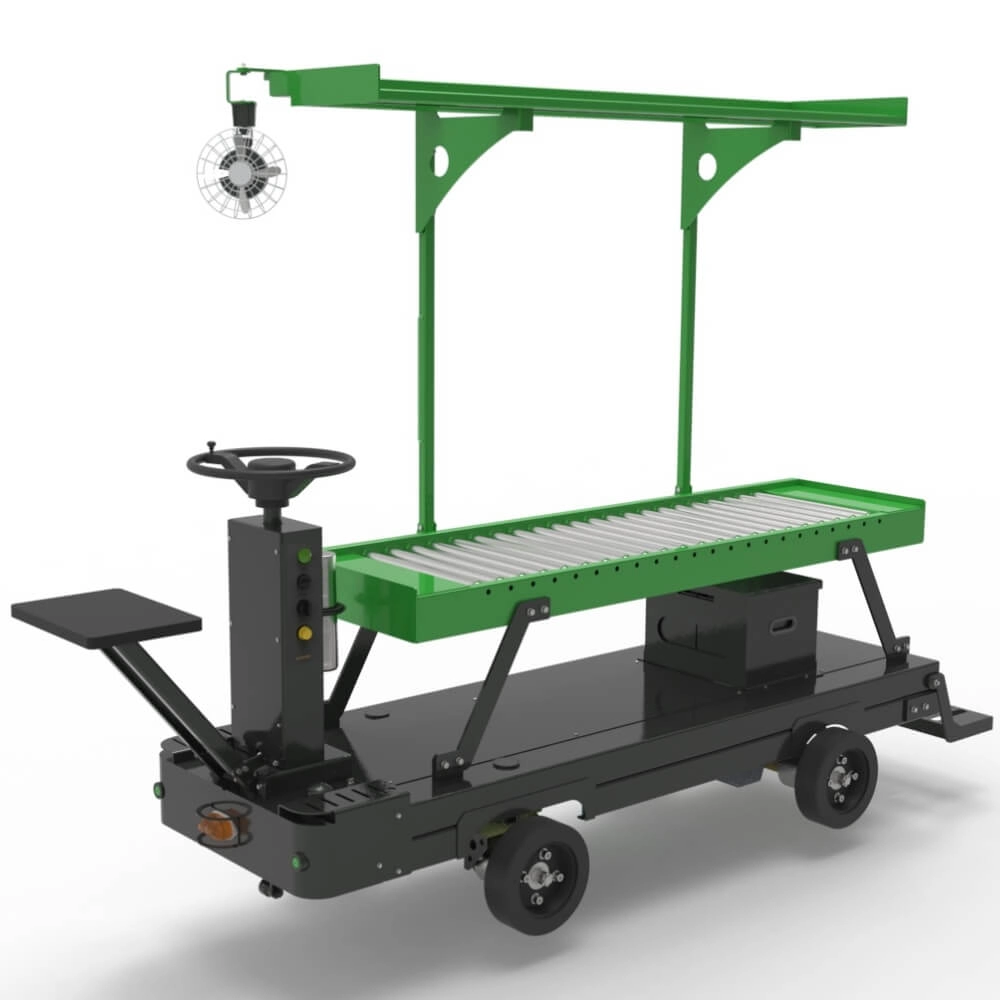
For buyers comparing options under the vegetable pickers category, WSH-GGL Driving Picking Vehicle can be evaluated as a driving-type picking solution, while manual carts and picking cars may be better for simpler movement needs.
How to Choose by Crop Type and Harvest Workflow
Different crops create different handling requirements. A vegetable harvesting trolley for tomatoes may not be selected in the same way as a greenhouse harvest cart for leafy greens.
Tomatoes and cucumbers often require repeated harvesting along long rows. The containers may become heavy, and workers may need a steady way to move produce without interrupting picking. In this case, a self-propelled harvest trolley or electric harvest trolley may reduce repeated manual movement, especially when the packing area is far from the crop rows.
Peppers, eggplants, and similar crops may also require careful handling and stable container placement. Buyers should confirm the container size, expected load, working height, and whether the trolley needs a platform or only a transport surface.
Leafy greens and lighter crops may not require powered movement in smaller greenhouses. A greenhouse picking cart can be enough when the load is lighter, the route is short, and the equipment must move easily between different areas.
The key question is not simply “Which harvest trolley is better?” The better question is: “Which equipment type keeps the harvest moving without adding unnecessary cost or complexity?”
When Should Buyers Upgrade from a Manual Picking Cart to an Electric Harvest Trolley?
An upgrade becomes worth considering when the cost of manual movement becomes higher than the cost of using powered equipment. This may happen when workers spend more time moving crops than picking, when full crates are difficult to push safely, or when longer greenhouse routes make manual transport inefficient.
Another sign is repeated workflow interruption. If harvested containers often wait in the aisle, if workers stop picking to move loads, or if the packing area receives crops unevenly, the harvesting system may need a different transport method.
A self-propelled harvest trolley can also be considered when labor availability is limited. Instead of adding more workers only to move produce, a farm may use powered internal transport to support the existing crew. The correct choice still depends on load, route length, crop type, operator training, maintenance capacity, and budget.
RFQ Checklist: What to Tell a Greenhouse Harvest Trolley Supplier
A useful quotation depends on accurate application details. Before contacting a greenhouse harvest trolley supplier, buyers should prepare the following information:
- Greenhouse size, row spacing, aisle width, and turning area
- Floor condition, pipe rail use, door clearance, and transport route
- Crop type, container size, expected load, and harvest frequency
- Required movement type: manual, electric, self-propelled, or driving-type
- Working height, platform needs, braking requirements, and operator conditions
- Target quantity, destination market, service expectations, and any customization needs
This information helps the supplier recommend a manual picking cart, greenhouse harvest cart, electric harvest trolley, or another vegetable harvesting equipment option that better fits the project. It also reduces the risk of buying equipment that is too large, too small, too complex, or unsuitable for the greenhouse layout.
Choosing a Supplier for Greenhouse Picking Carts and Harvest Trolleys
For B2B buyers, supplier selection should not depend only on a product name. A qualified supplier should help confirm whether the application requires a manual picking cart, a self-propelled harvest trolley, a picking car, or a crop transport solution. The supplier should also be able to discuss application details such as aisle width, load, working height, crop type, and operating environment.
JQLIFT provides vegetable picker products for greenhouse and agricultural handling applications. The product range includes picking dump trucks, picking cars, driving picking vehicles, and manual picking carts, allowing buyers to compare different equipment directions based on actual harvesting needs.
The company behind the brand, Hangzhou Jiequ Machinery Manufacturing Co., Ltd., is a machinery manufacturer based in Hangzhou, China. For procurement teams, this background is useful when evaluating whether the supplier has a real manufacturing base and product categories that match agricultural handling requirements.
When preparing an inquiry, buyers should avoid sending only a product name. A clearer RFQ should include greenhouse layout, crop type, aisle width, container size, expected load, route length, and whether the equipment needs manual, electric, or driving-type movement. This makes the discussion more practical and helps the supplier recommend a more suitable configuration.
Conclusion
A manual picking cart is a practical choice for smaller greenhouses, short transport routes, lighter crops, and buyers who prefer simple operation. A self-propelled or electric harvest trolley is more suitable when the greenhouse is larger, the route is longer, harvest volume is higher, or workers spend too much time moving loaded containers.
The best decision should be based on greenhouse layout, crop type, aisle conditions, load requirements, labor pressure, maintenance capacity, and purchasing budget. For a more accurate recommendation, buyers can send application details such as greenhouse dimensions, aisle width, crop type, container size, target load, operating route, and required movement type to JQLIFT for review.
FAQs
Q1: How do I determine if I need a manual picking cart for my greenhouse?
A1: A manual picking cart will suffice when the greenhouse is not very big or long, the transportation distance is short, harvested containers are light, and it is easy to push the cart without hampering the process of harvesting. When manual transportation slows the process of harvesting, fatigue, or aisles become overcrowded with manual carts, you may want to consider electric harvesting trolley.
Q2: How does a manual picking cart differ from a self-propelled harvest trolley?
A2: Manual picking carts rely on manual labor to move, whereas self-propelled harvest trolleys depend on power-driven movement based on their type. It is recommended that you go for self-propelled greenhouse harvesting trolleys if your greenhouse requires longer routes, heavier load, higher harvesting volume, or labor pressure.
Q3: Can the same greenhouse harvesting trolley be used for tomatoes, cucumbers, and peppers?
A3: There is a possibility, but it will depend on factors such as crop weight, size of containers, spacing of rows, working height, and harvesting procedure. You should verify these details from the supplier before buying any harvesting trolleys.
Q4: How wide should the aisle be for greenhouse harvesting machinery?
A4: The required aisle width will vary depending on the size of the equipment, turning radius, load position, and design of the greenhouse. Customers should measure the working aisle, main aisle, door width, and turning aisle before choosing between manual picking cart, greenhouse picking cart, or electric harvest trolley.
Q5: What should one consider when submitting an RFQ for greenhouse harvesting equipment?
A5: An effective RFQ should contain the type of crops, size of the greenhouse, aisle width, floor surface, size of containers, expected load, transportation distance, daily output, required type of movement, targeted quantity, and any customization requirements. This will enable the supplier to recommend a suitable harvest trolley.


