
When to Choose a Vertical Mast Lift for Data Center Maintenance
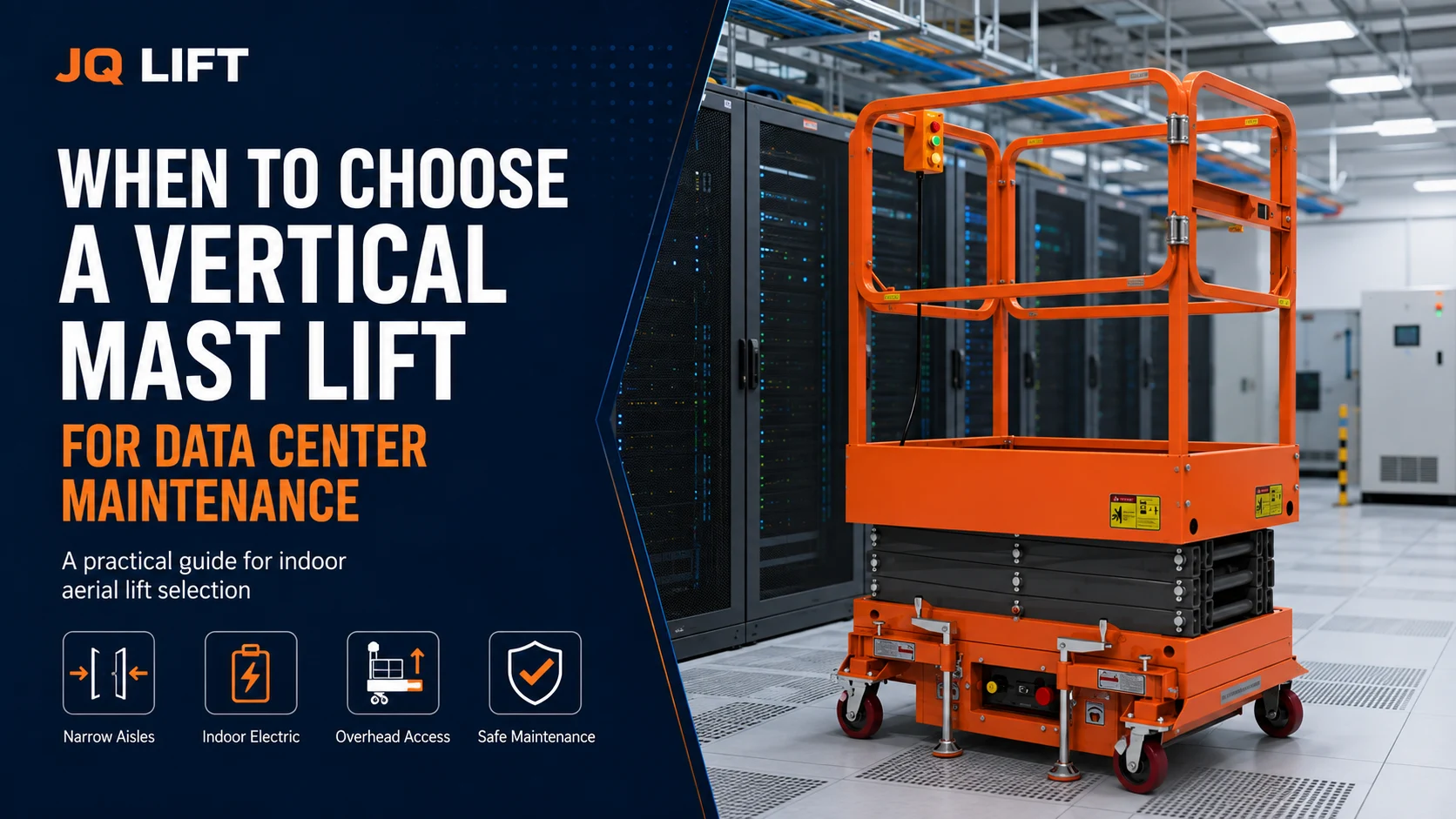
A vertical mast lift can be a practical option for data center maintenance when work is mainly vertical, access routes are narrow, and the platform must reach overhead cable trays, lighting, sensors, or electrical components. It is not automatically the right choice for every facility. Doorway width, turning space, platform load, floor conditions, and working height must be checked before a model is selected.
This guide explains when to choose a vertical mast lift, when a small scissor lift may be more suitable, and what maintenance teams should confirm before requesting a quotation.
Why Vertical Mast Lift Selection Matters in Data Centers
Data center maintenance often takes place between rack rows, inside equipment rooms, or near fixed infrastructure. These spaces can include narrow doors, raised floors, thresholds, containment systems, and overhead obstructions. A lift that reaches the required height may still be difficult to position or remove from the work area.
The Work Area, Not Maximum Height, Determines the First Choice
The first step is to define the work route and the task. A machine may have sufficient platform height but still fail to pass through the smallest doorway or turn near a rack row. Measurements should include the clear doorway opening, narrowest aisle, threshold height, turning points, and final positioning area.
The lift’s overall width, overall length, and turning radius should be reviewed together. Straight-line access does not confirm that a machine can make a 90-degree turn or align with an overhead cable tray. A supplier should provide an external dimension drawing and model-specific turning information before the equipment is approved.
For general product information and application references, the Jiequ lift manufacturer website can be used as an initial source. Final suitability still depends on the site survey and the product specification for the selected configuration.
Separate Personnel Access From Server Handling
A personnel aerial lift raises workers, tools, and installation materials to an elevated work position. A server or rack lift is designed to move equipment. These are different categories with different load, platform, and operating requirements.
The purchase request should state whether the task involves people working at height, equipment handling, or both. Cable tray installation, lighting replacement, and overhead electrical inspection usually require a personnel access platform. Moving a server cabinet to rack level may require a separate handling device.
Keeping these requirements separate helps prevent a “data center lift” search from producing an unsuitable recommendation.
When a Vertical Mast Lift Is the Better Option
A vertical mast lift is worth considering when the job requires compact vertical access and the route limits the use of larger equipment. The decision should be based on measurable conditions rather than on the lift category alone.
Narrow Aisles and Limited Turning Space
A vertical mast lift may fit projects where the access route is narrow and the work point is reached mainly by moving straight ahead and raising the platform. This arrangement can suit maintenance between equipment rows, overhead lighting checks, and localized cable tray work.
Before selecting a model, measure the smallest clear width rather than the nominal aisle width. Rack guards, doors, fire protection equipment, temporary barriers, and cable covers can reduce the usable route. Turning areas deserve separate attention because a machine that passes through the entrance may not have enough space to change direction.
The RFQ should include the narrowest route, turning points, and a marked floor plan. This gives the supplier enough information to compare the actual machine footprint with the site.
Single-Operator Inspection and Overhead Maintenance
A vertical mast lift can be considered for single-operator inspection, lighting maintenance, sensor checks, and other tasks that need vertical movement without a large platform footprint. The platform load must include the operator, hand tools, test equipment, and any small parts carried during the task.
This option becomes less suitable when two workers must handle long components, when bulky materials must be staged on the platform, or when a larger standing area is needed. In those situations, a small scissor lift may provide a more practical work surface, subject to its own width, load, and floor checks.
The task description should specify the number of workers, the heaviest tool or component, and whether materials will remain on the platform during movement.
Indoor Electric Operation
Electric vertical mast lifts may be considered for indoor maintenance where exhaust emissions are restricted and charging access is available. However, operating conditions should be confirmed rather than assumed. Important questions include:
- Where will the machine be charged?
- Is the available power supply suitable for the quoted configuration?
- Are there restrictions on noise, wheel materials, surface marking, or operating hours?
- Are floor gradients, thresholds, and raised-floor sections documented?
Noise, ESD, clean-room suitability, and specific certification should only be stated when supported by the supplier’s technical documents or customer requirements.
When a Scissor Lift May Be More Practical
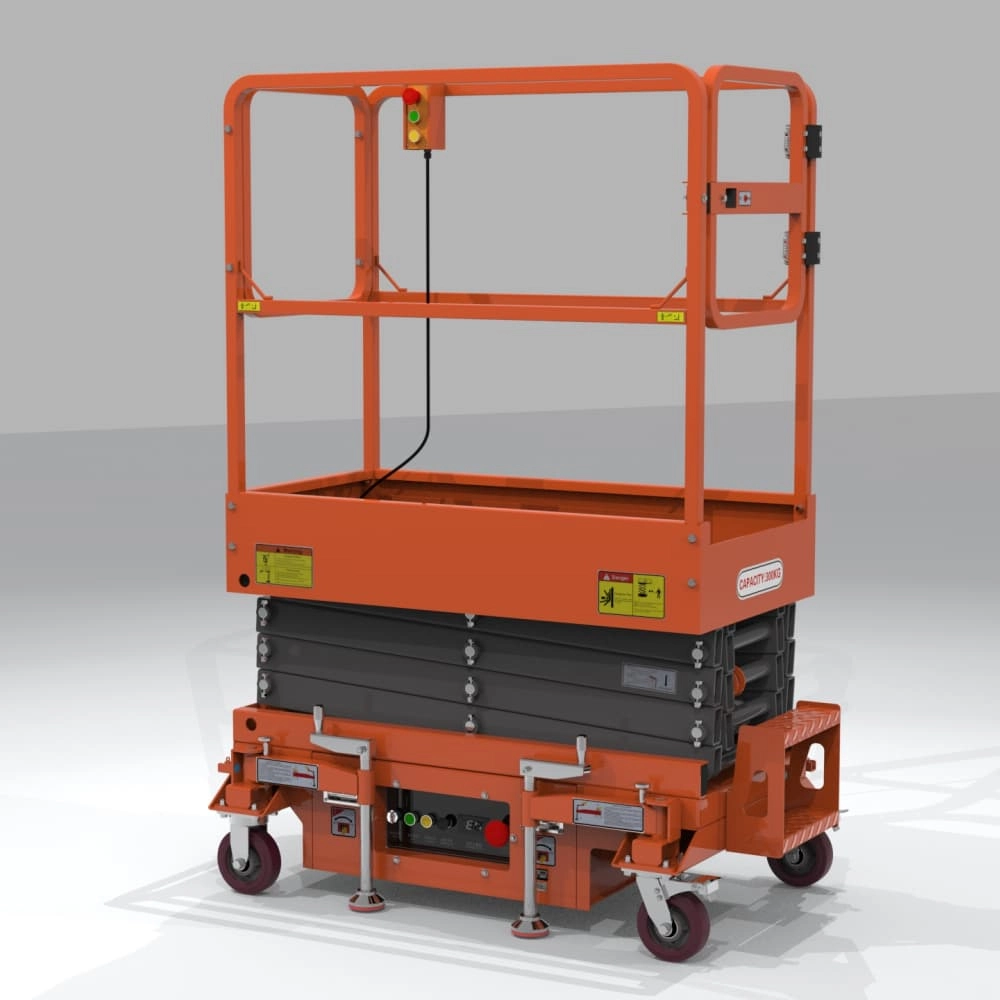
A vertical mast lift is not the only solution for indoor data center work. A small scissor lift may be more practical when the job requires a larger platform or more than one person.
| Requirement | Vertical Mast Lift | Small Scissor Lift |
|---|---|---|
| Main movement | Primarily vertical access | Vertical access with a larger standing platform |
| Narrow route | Often considered for compact routes | Depends on total width and platform dimensions |
| Typical crew | Often suitable for one operator | May suit two-person tasks, subject to rated load |
| Platform need | Compact work area | More room for tools and installation materials |
| Main checks | Width, length, turning radius, height, load | Width, platform size, working height, load |
Two-Person Work and Larger Platform Requirements
Two-person electrical, lighting, or cable tray work changes the selection criteria. The platform must accommodate both workers without exceeding the rated load. Tools, fixtures, cable sections, and temporary hardware must be included in the calculation.
A wider platform can reduce repositioning during installation, but it may also make the lift harder to move through a narrow aisle. The procurement team should compare platform length and width with the actual work area, not with a general equipment category.
Jiequ’s SF semi-electric small scissor lift page lists a 760 mm overall width, a 4.8 m maximum working height, a platform measuring 1,155 mm by 600 mm, and model-dependent loads of 200 kg or 300 kg. The page also states that the platform can accommodate two workers. These published figures support an initial comparison; the exact model and site conditions require confirmation before purchase.
Tasks That Need More Than Vertical Access
Some jobs require a larger working area, repeated repositioning, or a different platform arrangement. Examples may include installing several fixtures along a long section of cable tray, handling larger components, or coordinating two workers with separate tools.
When the task needs more than compact vertical access, compare a small scissor lift or another configuration. The decision should account for route width, platform load, overhead clearance, and the space needed to position the machine. A larger platform is not useful if it cannot reach the work area safely.
Check These Specifications Before Requesting a Quote
A clear specification sheet helps maintenance teams and suppliers evaluate the same requirements.
Overall Width, Length, and Turning Radius
Overall width determines whether the machine can pass through the narrowest route. Overall length affects positioning and maneuvering. Turning radius indicates how much space is needed to change direction.
All three values should be checked against the floor plan. Ask for dimensions of the exact quoted configuration, including guardrails, platform extensions, and other features that may affect clearance.
Platform Height, Working Height, and Overhead Clearance
Platform height identifies how high the platform itself rises. Working height may be described differently by suppliers, so the quoted definition should be confirmed. The measurement must then be compared with the actual height of the cable tray, light fixture, or electrical component.
Overhead clearance is equally important. Containment, pipes, sprinkler lines, and structural elements can interfere with guardrails or the raised platform. Selecting the highest available model without checking these obstructions can create access problems.
Machine Weight and Platform Load
Machine weight affects floor loading, transportation, and movement over thresholds. Platform load covers the occupants, tools, equipment, and materials carried at height. These checks are separate.
The quotation should identify the exact rated load for the selected model and configuration. If requirements exceed the published figure, request an alternative configuration or a technical review instead of assuming that a larger load is available.
Floor, Threshold, Wheel, and Charging Conditions
Record floor type, raised-floor areas, thresholds, gradients, surface protection requirements, wheel-material requirements, and charging locations. The acceptable solution may vary by material, size, load, operating environment, or configuration.
Any requirement related to floor loading, ESD, clean-room operation, or non-marking wheels should be confirmed by the site team and supplier in writing.
Use Published Specifications as a Conditional Shortlist
Jiequ publishes specifications that can support an initial comparison of compact indoor lift options. The vertical mast lifts for indoor maintenance category can be used to review available configurations before narrowing the selection to a specific model.
AL All-Electric Aluminum Alloy Vertical Mast Lift
The published AL information includes 820 mm overall width, 1,400 mm overall length, and a 1,600 mm turning radius. Platform-height options are listed at 6.0 m and 7.5 m, with a rated load of 125 kg. The lift uses electric travel and electric lifting.
These figures can be compared with a data center route and a single-operator maintenance task. The 125 kg rated load still needs to be checked against the operator, tools, equipment, and materials. The AL all-electric aluminum alloy vertical mast lift page should be reviewed together with the site measurements and the final technical specification.
When to Compare a Different Configuration
A different configuration should be considered when the required platform height, load, platform area, turning space, or floor conditions fall outside the published information. The supplier may need to review drawings, samples, or a proposed layout before recommending a model.
For procurement, request the model number, complete dimensions, load chart, power details, platform data, and any configuration limitations in the quotation.
Build a Vertical Mast Lift RFQ
A useful RFQ should include:
- Narrowest doorway and aisle width
- Turning points and positioning areas
- Required platform height and working height
- Overhead clearance
- Machine-weight restrictions
- Number of workers
- Tool and material weight
- Floor, threshold, and raised-floor information
- Wheel and surface-protection requirements
- Charging and power conditions
- Drawings, photos, target quantity, and delivery location
- Existing equipment model and replacement reason
Before purchase, ask whether the supplier can provide a model-specific specification sheet, external dimension drawing, load information, sample arrangement, drawing-based production, and available customization. Jiequ’s published service information includes sample orders and production based on samples or technical drawings, but delivery timing, local inventory, and local after-sales coverage should be confirmed separately.
Conclusion: Choose the Work Pattern Before the Lift Model
A vertical mast lift is most relevant when data center maintenance requires compact vertical access, narrow-route maneuvering, and a moderate platform load. A small scissor lift may be more practical for two-person work or tasks requiring a larger standing platform.
Before selecting a model, confirm the route, turning space, floor conditions, platform height, working height, overhead clearance, people, tools, materials, and charging requirements. To begin a technical review, submit these details together with drawings, photos, an existing model number, target quantity, and application description through request a technical quotation.
FAQs
When is a vertical mast lift better than a scissor lift?
A vertical mast lift may be better when the route is narrow, the task is mainly vertical, and one operator needs a compact platform. A scissor lift may be more practical when two workers need a larger standing area.
Can a vertical mast lift fit through a data center aisle?
Fit should be confirmed using the machine’s overall width, length, turning radius, doorway clearance, thresholds, and final positioning space. A doorway measurement alone is not sufficient.
What working height is needed for overhead cable tray maintenance?
The required height depends on the actual cable tray elevation, platform position, operator reach, and overhead obstructions. Platform height and working height should be checked against the exact model specification.
How much load should a vertical mast lift carry?
The rated platform load should cover all workers, tools, test equipment, and materials carried at height. The total should be compared with the specific model and configuration quoted.
What should be included in a vertical mast lift RFQ?
Include route dimensions, turning points, platform and working height, overhead clearance, machine weight, platform load, floor conditions, power requirements, drawings, quantity, delivery location, and the intended maintenance task.


