
Order Picker Measurement Checklist for Small Warehouses: 7 Specs Before Buying
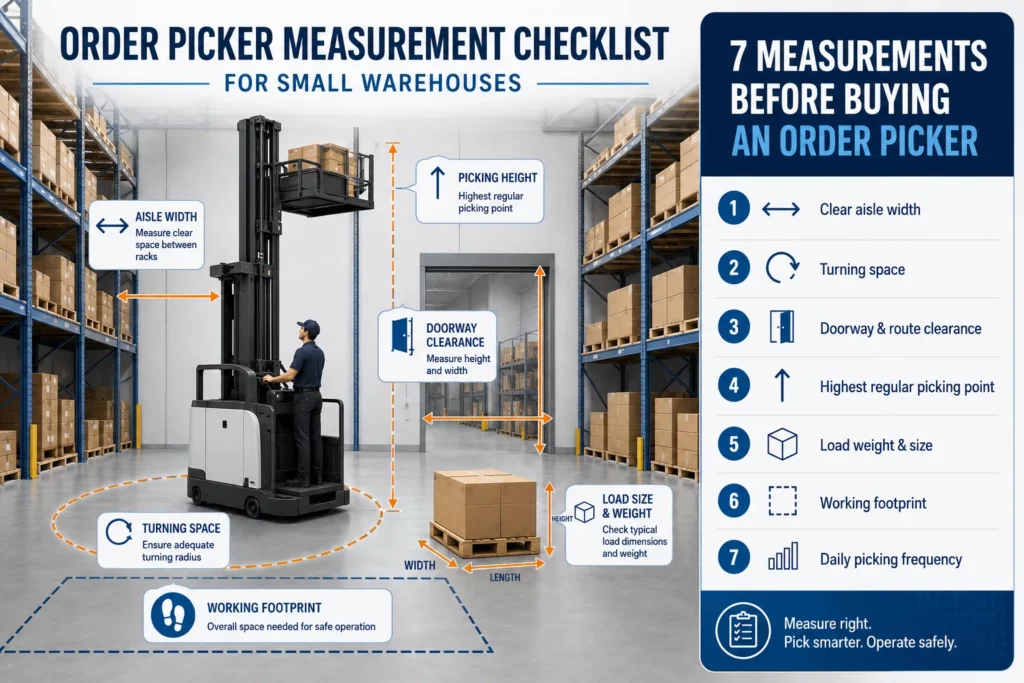
Buying an order picker for a small warehouse is not only a height decision. A small warehouse order picker must fit the aisle, turn safely, reach the regular picking height, carry the expected load, and match the daily picking route. Before requesting a quote, buyers should collect practical site measurements instead of choosing only by product photos, maximum platform height, or rated capacity.
Why Small Warehouses Need a Measurement Checklist Before Buying
Small warehouses often use narrow aisles, mixed shelf heights, doorway transitions, elevators, and compact storage zones. That makes the purchase more sensitive to layout errors. OSHA describes narrow aisle storage as a way to gain storage space, but it also notes that reach trucks and order pickers are used in much narrower aisle widths than conventional layouts.
Machine Width Alone Does Not Tell You Whether an Order Picker Will Fit
The overall width of the machine is only one part of the fit check. A compact order picker may travel straight through an aisle but still lack space for turning, repositioning, entering a cross-aisle, or operating with support feet deployed. Buyers should measure the narrowest clear aisle, not just the rack drawing width. Rack guards, pallet overhang, columns, cartons, floor marks, and temporary stock can reduce usable clearance.
The next step is to compare those measurements with the exact model specification. Aisle width should be checked together with machine length, turning radius, side clearance, load size, and any deployed stabilizing structure.
A Small Warehouse Order Picker Should Match the Job, Not Just the Shelf Height
An order picker is suitable when workers regularly retrieve cartons, parts, tools, or small goods from elevated shelves. It may not be the right choice for heavy pallet handling, rough outdoor floors, long-distance material transport, or applications where a forklift, lift table, or different access platform is more appropriate.
The main buying question is: what task needs to become safer, faster, or more repeatable? If the task is high-shelf picking inside a compact warehouse, an order picker may reduce ladder movement and repeated manual reaching. If the task is mainly moving loaded pallets, a different material handling solution should be evaluated.
The 7 Measurements to Take Before Requesting a Quote
A useful order picker measurement checklist should turn site conditions into supplier-ready data. The goal is to help the supplier judge fit, not simply quote the closest-looking model.
| Measurement | What to Confirm Before Buying |
| Clear aisle width | Narrowest usable aisle after rack guards, pallets, and obstacles |
| Turning space | Cross-aisle, aisle entry, exit, and repositioning area |
| Travel route clearance | Doorways, elevators, dock routes, thresholds, and slopes |
| Highest regular picking point | Shelf height used in daily work, not only the top rack |
| Load weight and size | Goods, tools, boxes, trays, and load distribution |
| Working footprint | Support feet, side clearance, and elevated operation space |
| Picking frequency | Daily cycles, travel distance, and power type requirements |
Measure Aisle Width, Turning Space, and Travel Route Clearance Together
“How wide should an aisle be for an order picker?” is usually the first question, but the answer depends on the machine, load, and maneuvering pattern. Toyota’s aisle width guide defines aisle width as the minimum straight aisle where a truck carrying a load can make a 90-degree turn.
For a small warehouse, measure the full route: receiving area, storage aisle, picking zone, door openings, elevator entrance, and charging location. A unit that fits the rack aisle but cannot pass through the doorway or turn at the aisle end may still create a purchasing problem. Photos and layout sketches help suppliers verify whether the order picker dimensions match the site.
Measure Picking Height by the Highest Regular Picking Point
Platform height and working height are not the same. The platform height describes how high the operator platform rises, while working height depends on the operator’s reach and the actual shelf position. Buyers should measure the highest regular picking point, not a shelf used once a year.
This avoids two risks. A machine with insufficient height can leave workers climbing or stretching. A machine selected only for extreme height may be larger or more costly than needed for daily use. Ceiling beams, lights, sprinkler pipes, and overhead doors should also be checked before confirming a model.
Measure Load Weight, Load Size, and Picking Frequency Before Choosing Power Type
Rated load matters, but it should be read with the application. A light part in a bulky carton, a small but dense component, and a tool kit placed on the platform create different handling conditions. Buyers should confirm the typical load weight, maximum expected load, carton dimensions, tray needs, and whether the operator carries tools or packaging.
Picking frequency also affects the choice between semi-electric and fully electric equipment. Short, occasional routes may suit a compact or semi-electric order picker. Frequent picking routes, longer travel distance, and repeated daily cycles may justify fully electric travel, depending on budget and workflow.
How to Turn Your Measurements Into an Order Picker Type
A compact electric order picker is useful when space is limited and high-shelf access is part of daily operations. JQLIFT lists aerial order pickers as a product category with models including T3 Semi-electric Reclaimer, OPC Picker, DAT Fully Electric Reclaimer, and AT Fully Electric Reclaimer.
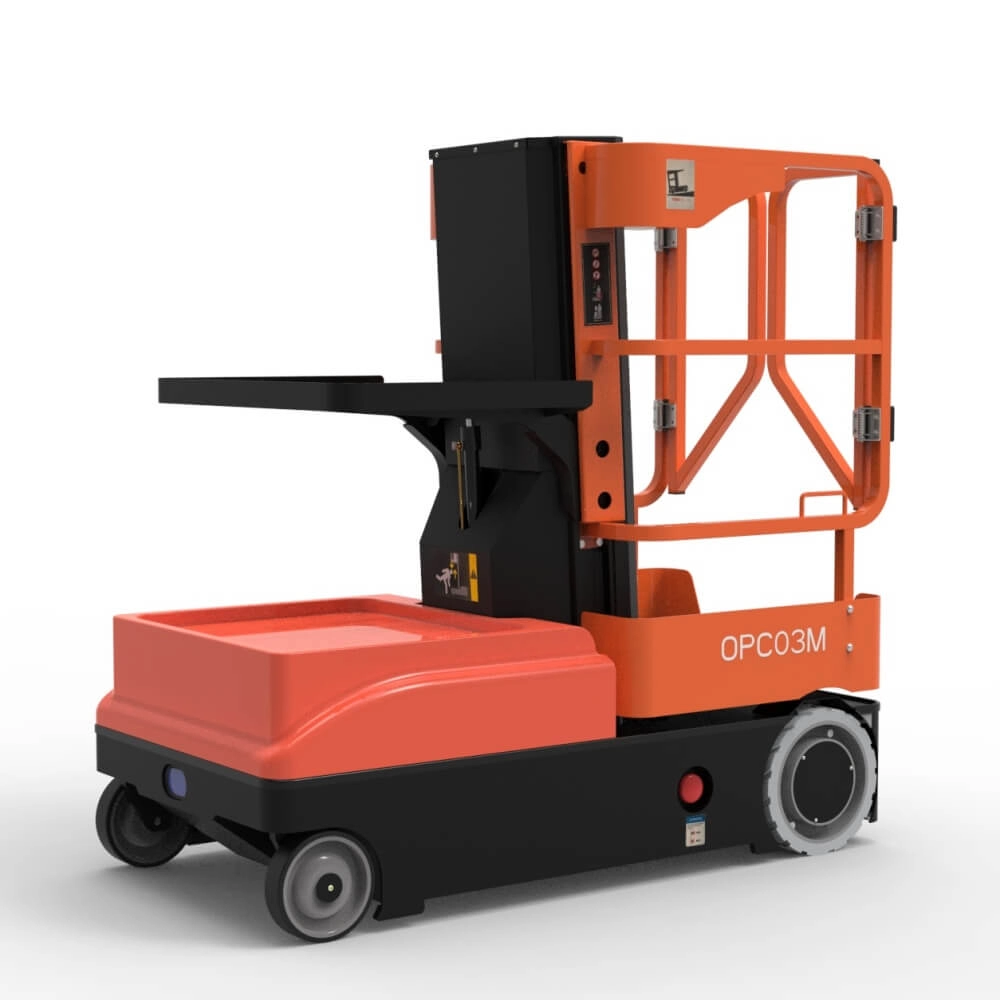
For occasional picking in tight spaces, a semi-electric type may be practical when the main need is electric lifting and the travel distance is short. For frequent routes, higher daily throughput, or repeated movement between aisles, a fully electric option may reduce pushing effort. The final choice should be verified against platform height, load capacity, turning radius, overall width, route clearance, and power configuration.
Common Buying Mistakes to Prevent Before Ordering
A frequent mistake is buying by maximum height or rated capacity alone. Bigger numbers do not automatically mean a better warehouse fit. If the platform height exceeds the real picking need, the buyer may pay for unused capability while losing compactness. If the rated capacity is selected without checking load size and distribution, the platform or tray may still be unsuitable.
Another mistake is ignoring floor and access conditions. Door thresholds, ramps, elevator size, floor levelness, and charging location can affect whether the equipment is practical after delivery. These details should be confirmed before purchase, especially when the order picker must move between rooms, mezzanine access points, or narrow storage lanes.
What to Send to an Order Picker Supplier for a Faster RFQ
A clear RFQ should include aisle width, cross-aisle space, highest regular picking point, load weight, load size, doorway width and height, floor condition, picking frequency, and photos of the route. Sending only a product screenshot usually slows down the selection process because the supplier still needs the application data.
A qualified supplier should help confirm whether the equipment fits the site, not only provide a price. Buyers comparing JQLIFT equipment can review the product range, then use the RFQ data to ask which model is suitable for the warehouse layout, power preference, and load condition. The company’s About JQLIFT page describes Hangzhou Jiequ Machinery Manufacturing Co., Ltd. as a manufacturer rooted in Hangzhou with pre-sales consultation and tailored aerial work solutions.
Conclusion
A small warehouse order picker should be selected from real measurements: aisle width, turning space, route clearance, picking height, load data, working footprint, and daily frequency. These details help reduce the risk of buying a machine that reaches high enough but cannot work smoothly in the actual warehouse.
Before requesting a quote, prepare the site measurements, layout photos, load details, and expected picking frequency. For model selection or specification confirmation, buyers can contact JQLIFT with the measured data and application requirements.
FAQs
Q1: What is the most important measurement before buying an order picker?
A: The most important measurement is usually the narrowest usable aisle combined with turning space. Height matters, but the machine must first travel, enter the aisle, turn, and operate safely in the available warehouse space.
Q2: How wide should an aisle be for an order picker?
A: It depends on the exact model, load size, turning radius, and whether the unit uses support feet or guidance systems. Buyers should measure the clear aisle width and ask the supplier to verify it against the product specification.
Q3: Is platform height the same as working height?
A: No. Platform height is the height of the operator platform. Working height depends on the operator’s reach and the shelf position. For purchasing, measure the highest regular picking point and check it against the product specification.
Q4: What size order picker do I need for a small warehouse?
A: The right size depends on aisle width, doorway clearance, shelf height, load size, daily picking frequency, and floor condition. A compact order picker may be suitable when space is tight and loads are light to moderate.
Q5: Should I choose a semi-electric or fully electric order picker?
A: A semi-electric order picker may suit occasional picking and short routes. A fully electric order picker may be better for frequent routes, longer travel distance, or higher daily picking volume. The decision should be based on actual workflow and site measurements.


