
AC vs DC Power for Push-Around Vertical Mast Lifts: Which Option Fits Your Jobsite?
Choosing between AC and DC power for push-around vertical mast lifts is usually not an electrical theory question. However, the main concern for most business-to-business buyers is whether the machine will operate safely, effectively, and reliably at the real jobsite location. A maintenance crew in the factory, hotel facilities workers, a warehouse manager, and a rental firm might all require the very same compact access device, but their choice of energy source could vary.
Push-around vertical mast lifts are often chosen when a compact design is required for indoor maintenance tasks, installations, inspection, cleaning, and warehouse access. It depends on the application at hand whether the jobsite would require AC power, DC power, or an AC/DC combination.
Quick Answer: Choose AC, DC, or Dual Power Based on the Jobsite
For stable indoor work near reliable power outlets, an AC powered vertical mast lift is often a practical choice. It fits workshops, factory maintenance areas, and fixed indoor service points where operators do not need to move far between tasks. The main advantage is continuous power when the site has the correct voltage and safe cable routing.
For jobs that require frequent movement, a DC powered vertical mast lift is usually easier to manage. A battery powered vertical mast lift avoids trailing cables and is better suited to hotels, shopping malls, hospitals, retail stores, warehouses, and office buildings where staff, customers, shelves, or equipment may be nearby.
For mixed applications, dual power is often the more flexible option. Rental companies, maintenance contractors, and distributors may prefer a dual-power vertical mast lift because the final jobsite conditions are not always known before the machine is delivered.
| Power Option | Better Fit | Less Suitable For | Key Purchasing Check |
| AC plug-in | Fixed indoor maintenance, workshops, factories | Long-distance movement, public areas with cable risks | Site voltage, plug type, cable safety |
| DC battery | Multi-point indoor maintenance, warehouses, hotels, malls | Long shifts without charging time | Battery capacity, charger input, daily use time |
| AC/DC dual power | Rental fleets, mixed jobsites, uncertain applications | Buyers with only one fixed use case | Switching method, charger, spare parts support |
What AC and DC Mean on a Push-Around Vertical Mast Lift
AC and DC refer to the way the machine receives power for lifting operation. In this buying context, AC usually means plug-in operation from a site power supply, while DC means battery-powered operation. It should not be confused with a broad AC motor vs DC motor discussion, which may involve other lift types or drive systems.
AC Plug-In Power: Best for Stable Indoor Power and Long Tasks
An AC plug-in vertical mast lift is useful when the operator works near a stable power source for extended periods. Typical examples include factory ceiling maintenance, workshop repairs, indoor installation work, and fixed equipment servicing. If the lift only needs to be positioned once or moved a short distance, AC power can reduce charging concerns.
It is not the right fit when the operator must move through busy corridors, across sales floors, or around warehouse traffic. Cable management becomes a real safety and productivity issue. Before buying, confirm the local voltage, plug type, grounding conditions, distance from power outlets, and whether the lift will be used in areas where a cable could become a trip hazard.
DC Battery Power: Best for Cordless Movement and Multi-Point Work
A DC battery vertical mast lift is better when the lift must move between many work points. This applies to lighting repair in hotels, ceiling inspection in offices, signage work in retail stores, warehouse shelf maintenance, and facility service in hospitals or airports. Cordless movement helps reduce cable interference and gives the operator more freedom to reposition the lift.
The main risk is downtime caused by insufficient battery capacity, slow charging, or poor charging discipline. Buyers should confirm battery voltage and capacity, charger input, charging time, expected daily working hours, and whether replacement batteries or charger parts can be supplied. For compact indoor models, push-around vertical mast lift models from JQLIFT provide a useful starting point for comparing mast structure, platform height, load capacity, and power configuration.
Dual AC/DC Power: Best for Mixed Jobsites and Rental Fleets
Dual AC/DC power is useful when one machine may be used across several sites. A rental company may send the same lift to a warehouse one week and a hotel maintenance job the next. A facility contractor may work in a fixed workshop in the morning and a public building in the afternoon. In these cases, the ability to use AC power when available and DC battery power when mobility matters can reduce configuration risk.
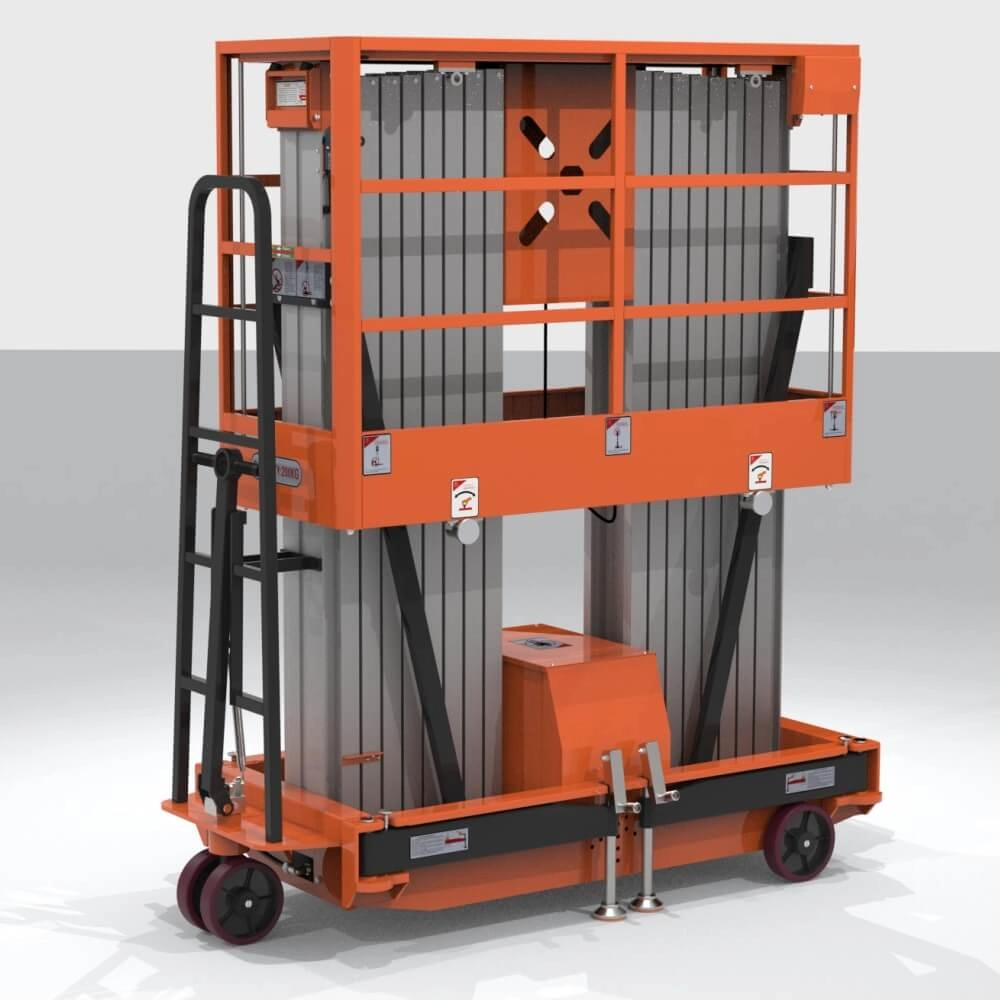
This option may not be necessary for a buyer with one fixed indoor location and predictable power access. However, when site conditions vary, a dual-power double mast vertical lift can be a strong reference model because it supports AC operation for stationary continuous use and DC battery power for mobile tasks, depending on the selected configuration and job requirements.
Match the Power Option to Real Facility Applications
Warehouses, retail stores, hotels, and hospitals often favor DC or dual power because maintenance points are spread across a building. Operators may need to pass through doorways, aisles, elevators, or customer-facing areas. In these environments, the ability to move without a cable can be more valuable than the simplicity of AC power.
Factories and workshops may lean toward AC power when outlets are reliable and the work area is controlled. If the lift is used near production equipment, maintenance benches, or fixed installation zones, AC can make sense. The purchasing team should still check whether the machine will cross traffic lanes, whether cables can be protected, and whether a DC option would reduce setup time.
For buyers comparing compact access equipment, the decision should not be made on power type alone. Working height, platform load, machine width, support leg footprint, floor condition, doorway access, elevator clearance, and operating frequency all affect the final choice.
Common AC/DC Selection Mistakes That Cause Downtime
The most common AC mistake is assuming that any indoor site can safely use a plug-in mast lift. Wrong voltage, incompatible plugs, poor grounding, long extension cables, and busy walkways can all create problems. These issues should be checked before purchase, not after delivery.
The most common DC mistake is underestimating daily use. A battery powered vertical mast lift may be suitable for short maintenance tasks but less suitable for continuous high-frequency work without charging windows. If the lift is used by multiple teams in one day, the buyer should confirm battery capacity, charger specifications, battery indicator visibility, and parts availability.
A practical prevention step is to create a jobsite profile before requesting a quote: indoor or outdoor use, available power supply, working height, load, daily operating time, floor type, doorway width, and whether the machine must move between multiple zones.
B2B Buying Checklist Before Requesting a Quote
Before choosing AC or DC power for a push-around mast lift, buyers should prepare the following information:
- Required platform height and working height
- Maximum operator and tool load
- Indoor or outdoor use conditions
- Floor condition and space restrictions
- Doorway, aisle, and elevator dimensions
- Available site voltage and plug standard
- Expected daily use time
- Preferred AC, DC, or dual power configuration
- Destination country or region for electrical compatibility
- Any customization needs, such as platform changes or attachment brackets
Supplier selection also matters. A reliable vertical mast lift supplier should be able to explain the trade-off between AC plug-in, DC battery, and dual-power configurations without pushing the same option for every application. Buyers should also check whether product information, spare parts support, customization options, and clear communication channels are available.
JQLIFT provides vertical mast lift products for compact access applications, including single mast, double mast, and all-electric aluminum alloy models. For buyers reviewing supplier background and product scope, JQLIFT aerial work platform manufacturer can help connect the power selection discussion with the broader equipment range. For company information, about JQLIFT lifting equipment is the appropriate reference point.
Conclusion
AC vs DC power for push-around vertical mast lifts should be decided by jobsite conditions, not by preference alone. AC plug-in power fits stable indoor locations with reliable outlets and limited movement. DC battery power fits multi-point maintenance where cable-free movement reduces setup time and safety concerns. Dual AC/DC power is often the safer purchasing choice when the lift will serve different buildings, rental customers, or maintenance tasks.
To request a suitable recommendation, send the required working height, platform load, site voltage, daily use frequency, indoor space limits, and preferred power configuration. For project discussions or model selection, use contact JQLIFT for vertical mast lift quote with the jobsite details needed for a practical AC/DC recommendation.
FAQs
Q1: Is AC or DC better for an indoor vertical mast lift?
A: AC is better for fixed indoor work near a stable outlet. DC is better when the lift must move between several indoor locations. If the same machine will be used in different buildings or rental applications, dual AC/DC power may be more practical.
Q2: Should I choose a battery powered vertical mast lift for warehouse maintenance?
A: A battery powered vertical mast lift is often suitable for warehouse maintenance when the operator needs to move between aisles, shelves, lighting points, or inspection areas. Buyers should confirm battery capacity, charger input, daily use time, and whether the machine width fits the warehouse layout.
Q3: Can a DC vertical mast lift work while charging?
A: This depends on the specific model and electrical design. It should be verified against the product specification or supplier guidance. Buyers should not assume that every DC mast lift can be operated safely while charging.
Q4: What information is needed to get an AC/DC mast lift quote?
A: A useful RFQ should include working height, platform load, site voltage, plug standard, indoor or outdoor use, daily operating time, doorway or elevator limits, floor condition, and whether AC, DC, or dual power is preferred.
Q5: Which power option is better for rental companies?
A: Dual AC/DC power is often more flexible for rental fleets because the final jobsite may vary by customer. It can support fixed indoor tasks when AC power is available and battery operation when cordless movement is needed.


