
Order Picker for Supermarket Shelf Replenishment: Key Specifications and Selection Guide
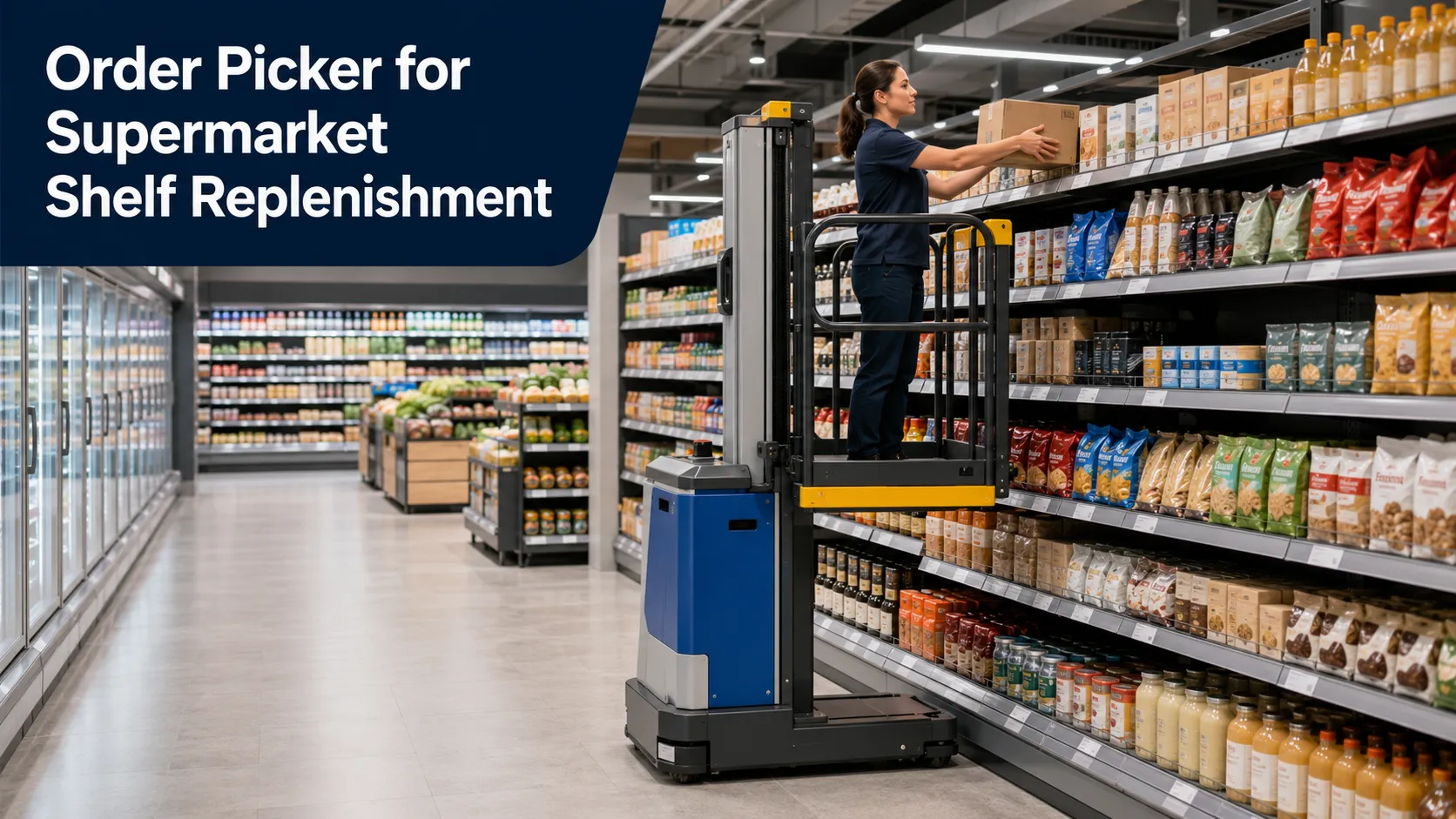
Choosing an order picker for supermarket shelf replenishment requires more than comparing platform height and rated capacity. A machine may reach the highest shelf yet remain unsuitable because it cannot turn in the aisle, pass through a doorway, operate safely around customers, or complete a full shift on one charge.
The correct choice depends on shelf height, carton dimensions, aisle geometry, replenishment frequency, floor conditions, access routes, and whether powered travel is necessary. Buyers should evaluate the complete replenishment cycle—not an isolated specification—before selecting supermarket shelf restocking equipment.
When Is an Order Picker the Right Equipment for Supermarket Replenishment?
An order picker is appropriate when an operator must access elevated shelves while handling individual cartons, trays, or packaged goods. Typical applications include restocking upper retail shelves, retrieving products from a stockroom, changing promotional displays, and performing inventory checks at height.
Unlike equipment designed primarily for pallet handling, a retail order picker lift raises the operator to the picking position. This can reduce repeated ladder use and make elevated stock accessible from a guarded platform. Buyers comparing possible configurations can begin with an aerial order picker range, then narrow the selection according to the actual store layout and workflow.
Suitable Replenishment Tasks—and When to Choose Different Equipment
A compact order picker for a retail store is most relevant when products are handled individually and the operator needs frequent access to multiple shelf levels. It may also suit backroom storage where cartons must be retrieved from shelving rather than moved as complete pallets.
It is not automatically the right equipment for every replenishment task. A pallet-handling machine may be more appropriate when full pallets must be lifted, placed, or removed. A different access platform may be required when the task involves maintenance rather than picking stock. Buyers should identify the handled unit—individual item, carton, tote, or pallet—before comparing models.
The operating environment also matters. A standard indoor order picker should not be assumed suitable for wet areas, uneven outdoor surfaces, cold rooms, ramps, or customer-filled aisles. These conditions must be checked against the product specification, operating manual, and site risk assessment.
Which Order Picker Specifications Determine Supermarket Fit?
The most important supermarket order picker specifications are usable platform height, load capacity, machine dimensions, turning radius, operating footprint, drive system, battery configuration, platform size, and floor compatibility. Each specification should be connected to a real measurement or operating requirement.
Match Platform Height and Combined Capacity to the Real Shelf Task
Platform height is not the same as working height. The required platform height should be calculated from the highest picking point, the operator’s practical reach, and the need to handle a carton without stretching or leaning outside the platform.
Measuring only the top of the shelf can result in unnecessary height, additional machine weight, or access problems. Conversely, selecting a platform that is too low encourages unsafe reaching. Buyers should record the height of the highest item to be handled and verify whether the supplier’s published figure refers to platform height, working height, or total machine height.
Capacity must be evaluated as a complete load case. Confirm whether the rating includes the operator, tools, containers, and picked products. Carton dimensions also matter: a load may be within the weight limit but too large for the platform or material tray.
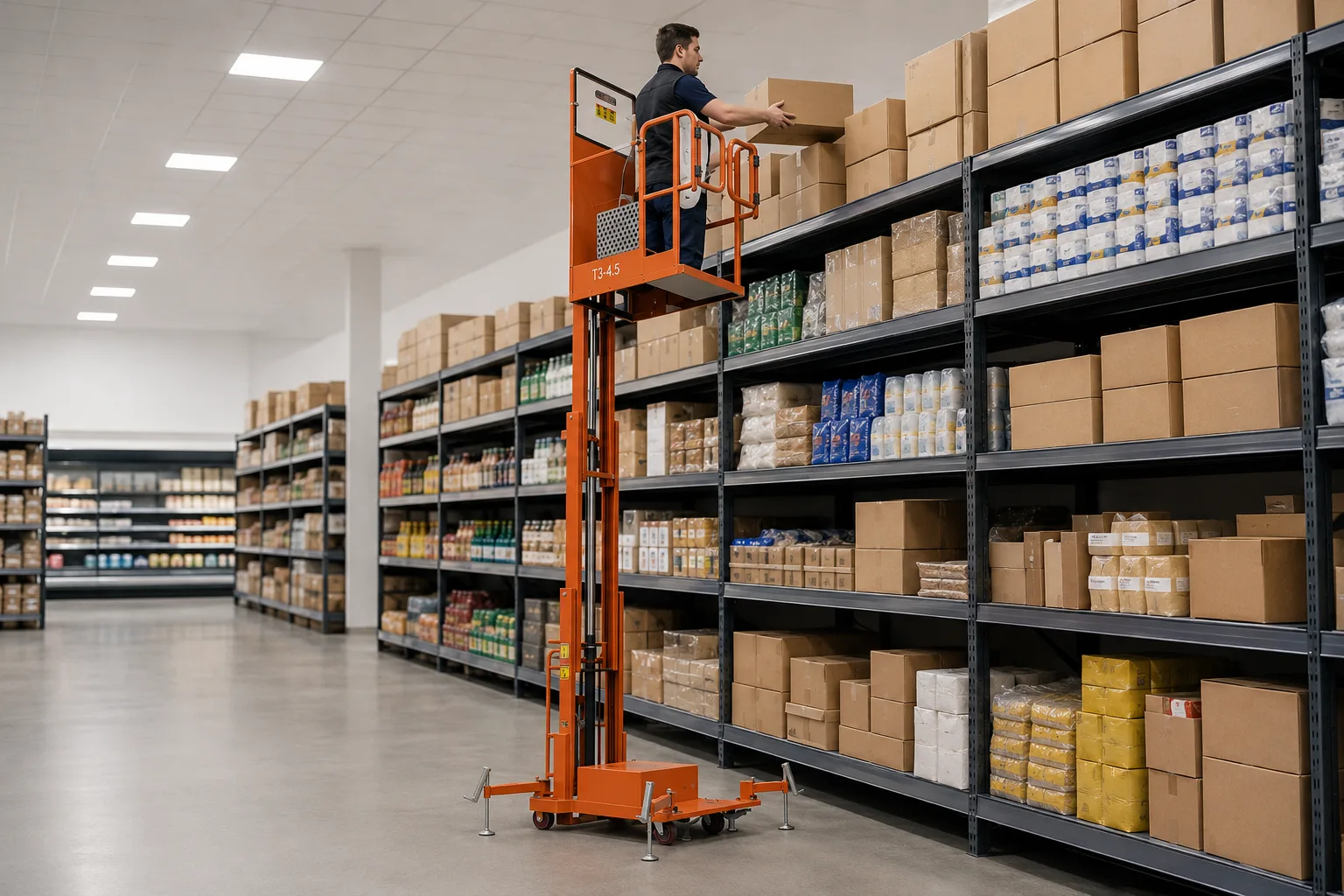
For example, the T3 semi-electric order picker is presented for warehouse and supermarket applications with a published 200 kg load and several platform-height configurations. Its 630 × 645 mm platform and selected height options should still be checked against the operator, carton size, shelf position, and the manufacturer’s definition of rated load.
Check Overall Width, Turning Radius, and the Full Operating Footprint
A supermarket order picker can fit between two shelves and still be unable to work there. Straight-line machine width does not show whether the unit can turn at an aisle end, align with a shelf, open its access gate, or deploy required stabilizing components.
Measure the narrowest doorway, aisle width, cross-aisle space, elevator opening, stockroom entrance, and any fixed obstructions. Allow clearance for shelf edges, displays, protective barriers, and people. The turning radius should be checked using the machine’s full length and the manufacturer’s recommended operating clearance.
The operating footprint may be larger than the transport footprint. The T3, for instance, has a published overall width of 840 mm, while selected configurations list a 1,230 × 1,310 mm support-foot footprint. The exact configuration and deployment requirements should therefore be confirmed before purchase.
Floor loading and total machine weight also affect access. A compact electric order picker may pass through an elevator door but still require verification of elevator capacity, threshold clearance, and floor suitability.
Choose Semi-Electric or Fully Electric by Route Length and Picking Frequency
A semi-electric order picker commonly combines powered lifting with manual movement. It may be suitable for occasional replenishment, short routes, compact stockrooms, and applications where the unit is repositioned only a few times during a task. The simpler travel arrangement can be practical, but manual movement becomes less attractive when routes are long, floors are sloped, or picking is continuous.
A fully electric order picker adds powered travel and is generally more appropriate for frequent multi-aisle replenishment. However, it introduces additional purchasing questions concerning battery duty, charging access, travel controls, braking, turning space, and operator training.
The decision should be based on a typical shift. Record the number of stops, distance between picking locations, lifting cycles, floor transitions, and available charging time. If employees must repeatedly push a loaded machine across long routes, selecting solely by purchase price can create an operational burden.
Verify Battery, Floor, Access Route, and Indoor Safety Requirements
Battery voltage and capacity cannot be assessed in isolation. Runtime may vary with lifting frequency, travel distance, load, battery condition, temperature, and operating configuration. Buyers should provide the expected daily duty cycle and ask whether the proposed battery and charger match it.
The entire access route should also be inspected. Look for slopes, expansion joints, damaged floors, thresholds, mats, drainage channels, low overhead structures, and areas where pedestrians or shopping carts may enter the work zone.
For indoor retail use, confirm the machine’s emergency-stop arrangement, braking method, platform enclosure, access gate or guardrail, operating controls, and any required stabilizers. JQLIFT’s T3 information identifies features including an emergency stop, foot brake, guardrail locking, anti-slip platform, and outriggers that must be deployed before lifting. Operators must still follow the applicable manual, training requirements, and site procedures.
Why Apparently Suitable Order Pickers Fail in Retail Operations
Specification mismatches often appear only after delivery because the buying process focused on maximum height or headline capacity. Supermarket environments expose practical constraints that a basic quotation may not reveal.
Common Causes of an Order Picker–Store Mismatch
Common problems include measuring the aisle but not the turning area, confusing working height with platform height, overlooking stabilizer deployment, and failing to account for the operator in the capacity calculation. Buyers may also ignore carton dimensions, doorway thresholds, elevator limits, charging locations, or the distance between the stockroom and sales floor.
Another frequent mistake is choosing manual travel for a demanding route. The machine may technically perform the lift but slow the replenishment cycle or require excessive pushing. The opposite problem also occurs: a powered-travel model may add cost and complexity where the equipment moves only a few meters between occasional lifts.
These risks can be reduced by matching every quoted specification to a measured site condition. Any unexplained term—such as load, gradeability, working height, or operating footprint—should be clarified in writing.
Prevent a Bad Purchase by Testing the Worst-Case Replenishment Cycle
A useful assessment follows the hardest realistic task, not an empty-aisle demonstration. Start at the storage location, load the largest expected carton, pass through the narrowest access point, travel to the most restricted aisle, turn into position, deploy required supports, reach the highest shelf, and return to the charging location.
The review should also consider customer traffic, temporary displays, emergency routes, and the time available for replenishment. Where practical, provide the supplier with a layout drawing, marked photographs, aisle measurements, shelf heights, and load information. A dimensional review or application check before ordering is less costly than modifying store layouts after delivery.
How to Match the Order Picker to the Replenishment Workflow
The following matrix helps connect equipment direction with the real operating pattern.
| Replenishment scenario | Likely equipment direction | Specifications to prioritize | Main purchasing risk |
|---|---|---|---|
| Occasional high-shelf work in a backroom | Compact semi-electric model | Platform height, combined load, deployed footprint | Supports or platform do not fit |
| Frequent movement across several aisles | Fully electric order picker | Battery duty, turning radius, travel controls, brakes | Insufficient runtime or maneuvering space |
| Narrow doors and restricted cross-aisles | Compact retail configuration | Width, length, turning radius, machine weight | Machine fits straight but cannot turn |
| Large or awkward cartons | Configuration with verified handling space | Platform dimensions, carton size, load definition | Weight is acceptable but the carton is not |
| Full-pallet replenishment | Separate pallet-handling assessment | Pallet size, lift method, required capacity | Selecting the wrong equipment category |
This workflow-based approach is reflected in the equipment categories available from JQLIFT. A product should be shortlisted only after its configuration has been compared with the store’s measurements, duty cycle, and handled goods.
What Should Buyers Confirm Before Requesting a Quote?
Build an Application-Based RFQ and Compare More Than Price
A useful RFQ should state the highest shelf or picking point, required platform height, operator weight, maximum product weight, carton dimensions, aisle width, doorway dimensions, turning area, floor condition, route length, daily operating hours, and estimated number of lift cycles.
It should also identify whether work occurs on the sales floor, in a stockroom, inside a cold room, or near customers. Include charging voltage, desired travel type, delivery destination, target quantity, and any requested platform or accessory changes.
When comparing supermarket order picker quotations, check whether the same configuration is being priced. Confirm included batteries, chargers, safety components, documents, spare parts, warranty terms, packaging, and after-sales arrangements. A lower quotation may represent a different platform height, battery, drive system, or accessory package.
How to Choose a Reliable Supermarket Order Picker Supplier
Require Application-Specific Technical Verification
A qualified supplier should ask questions before recommending a model. At minimum, the supplier should verify the required height, combined load, carton size, aisle geometry, turning area, floor condition, route length, and operating frequency.
The recommendation should identify any assumptions and distinguish machine width from operating footprint. Buyers should also request the correct specification sheet and operating requirements for the quoted configuration. Information about JQLIFT’s manufacturing focus and development can be reviewed through its order picker manufacturer profile.
Evaluate Production, Parts, Documentation, and After-Sales Support
Supplier evaluation should extend beyond the initial product price. Confirm who manufactures the equipment, how configuration changes are reviewed, what operating and maintenance documents are supplied, and how replacement parts are identified and ordered.
Ask whether technical support is available for installation questions, routine maintenance, troubleshooting, and part replacement. Where customization is needed, such as a platform enclosure change or selected connection accessory, obtain written confirmation that the modification is suitable for the application and included in the quotation.
JQLIFT presents both semi-electric and fully electric order picker configurations. Its published T3 options include multiple platform heights and selected customization possibilities, but final suitability depends on the ordered configuration and the supermarket’s measured conditions.
Conclusion
The right order picker for supermarket shelf replenishment is the machine that completes the entire task safely and efficiently—not simply the model with the greatest height or capacity. Buyers should verify platform height, combined load, carton fit, aisle geometry, turning space, deployed footprint, travel type, battery duty, floor conditions, and access restrictions before comparing prices.
For an application review, buyers can request an order picker recommendation and submit shelf heights, aisle and doorway dimensions, carton size, maximum load, route length, operating frequency, site photographs, target quantity, and any configuration requirements.
FAQs
Can an order picker be used while a supermarket is open?
It may be possible only when the product instructions, local requirements, and site risk assessment permit it. The work area may need to be isolated from customers and carts. Many stores schedule elevated replenishment during lower-traffic or closed periods to reduce pedestrian interaction.
What platform height is needed for supermarket shelves?
Measure the highest picking point and account for the operator’s practical reach while remaining inside the guarded platform. Do not select a model from shelf height alone. Confirm whether the supplier’s stated figure is platform height or working height.
Does order picker capacity include the operator?
Capacity definitions vary by manufacturer and configuration. Ask whether the rating covers the operator, picked goods, tools, and containers together. Provide the supplier with the maximum combined load rather than only the carton weight.
Is a semi-electric or fully electric model better for shelf replenishment?
A semi-electric model may suit occasional lifting and short repositioning distances. A fully electric model is generally more appropriate for frequent picking across longer routes. Compare travel distance, daily cycles, floor conditions, battery duty, and available maneuvering space.
Can a standard indoor order picker be used in a cold room?
Not without verification. Low temperatures can affect batteries, components, traction, and runtime, while condensation may introduce additional risks. The required temperature range and environment should be disclosed to the supplier before a model is selected.


