
Ladders vs. Small Scissor Lifts: Safer Indoor Maintenance | JQLIFT
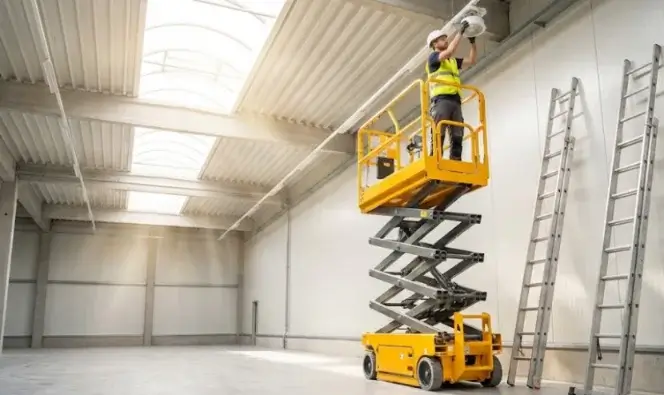
Doing routine indoor maintenance on high ceilings is always a big challenge for building managers. Think about changing out heavy air conditioning filters 20 feet in the air. You put a tall extension ladder on a slick concrete floor. The worker climbs up to the top. The thin metal wobbles with every single step. It is a very scary thing to watch. Someone always drops a screwdriver from up there, and it immediately rolls completely under a heavy shipping pallet where you cannot reach it. Upgrading to a small scissor lift changes how the whole maintenance team works. You get the job done much faster without sending people to the local hospital.
The Hidden Dangers of Using Ladders for Ceiling Work
Basic safety rules say you must keep three points of contact on a ladder at all times. That means two feet and one hand touching the rungs. But how do you hold a heavy power drill and a new metal pipe fitting with just one hand? You simply cannot do it.
Workers always let go of the ladder to use both hands to work. Then they lean way too far out to the side. They do this because they do not want to climb all the way down just to move the ladder two inches to the left. That dangerous sideways reach is exactly how the whole thing tips over and crashes straight to the ground. A bad fall ruins lives and costs businesses a fortune.
4 Reasons to Choose a Small Scissor Lift Over a Ladder
The construction and facility management world is moving away from traditional ladders very quickly. Safety inspectors really hate seeing tall, shaky A-frames on modern job sites today. Choosing powered driving machines brings huge benefits that go way beyond just keeping people safely off the floor.
Unmatched Stability and Fall Prevention
A wide metal base gives absolute fall prevention that a wobbly ladder simply cannot offer. The heavy electric battery sits very low to the ground. This creates a deeply low center of gravity. You also get solid metal rails all around your waist. You can lean against the strong rail to get a good angle on a ceiling vent without any fear of tipping backward.
Larger Workspace for Tools and Materials
Carrying heavy parts up a ladder is dangerous and annoying. You try to stuff heavy wrenches into your pockets and hold screws in your mouth. With a powered platform, you just put your entire toolbox, your water bottle, and all the replacement light bulbs right on the steel deck. It is the perfect piece of warehouse maintenance equipment for doing big lighting swaps. Everything goes up with you in one single safe trip.
Massively Reduced Worker Fatigue
Climbing up and down thirty steps all day completely destroys your knees. By two in the afternoon, workers are very tired and sweaty. Tired people make bad mistakes. Pressing a simple joystick button to go up and down saves so much human energy. The crew stays sharp and awake for the whole entire shift.
Faster Job Completion Times
Think about the physical time wasted just setting up a tall extension ladder. You have to carry it from the closet, unfold it, check the rubber feet, and ask another guy to hold the bottom. A powered platform just drives right over to the exact spot. You push the stick up. You fix the broken pipe. You drive over to the next pipe. A job that takes three hours with a ladder takes about forty five minutes with a driving platform.
Overcoming Space Limits With Compact Aerial Platforms
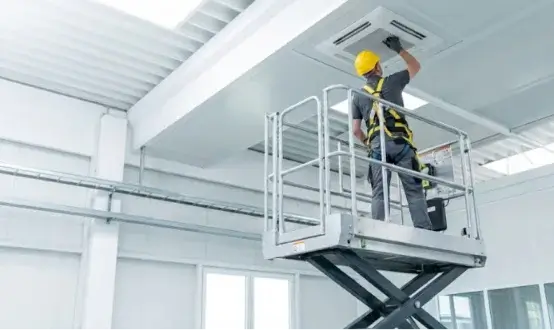
People always worry that their building is just too crowded for heavy machinery. Maybe the narrow hallways are constantly packed with boxes. You really need a compact aerial work platform to fit through a standard office door.
Good machines are built very narrow for this exact reason. They drive straight through normal single doors without forcing you to take the metal safety rails off. They also weigh a lot less than giant outdoor construction lifts. This means you can drive them straight into a normal passenger elevator to go up to the fourth floor. You do not need a special freight elevator at all.
Total Cost of Ownership: Does Safety Really Pay Off?
Money is always the biggest question for any business manager. A basic metal ladder costs maybe two hundred dollars. A driving lift costs a few thousand. But you really have to look at the real numbers over time.
One single bad fall from a ladder ruins a business financially. The hospital bills, the government safety fines, and the massive jump in insurance prices cost way more than ten brand new machines. Plus, you save so much money on hourly pay because the team finishes the work much faster. The machine actually pays for itself in less than a year just in saved labor hours alone.
Work Smarter With the JQLIFT ASF Series
When looking for heavy duty lifting gear, JQLIFT stands out as a true expert in the field. They build very tough machines meant for everyday industrial abuse. Their engineering team focuses deeply on making smart, battery powered platforms that actually fit in tight indoor spaces without constantly breaking down. They really listen to what building managers hate about old equipment and fix those exact problems with better metal and better electronics.
A great example of this smart design is the JQLIFT ASF series. These machines give you a super tight turning circle for crowded warehouse aisles. They run on quiet electric batteries, so there is zero bad exhaust gas poisoning the air inside the building. They also use special smooth tires that do not leave ugly black marks on expensive hospital or shopping mall floors. You can check out their full line of scissor lifts to see how a driving platform safely replaces dangerous old ladders for good.
FAQ
Q1: How high can a mini scissor lift actually reach?
A: Most small indoor models easily reach working heights between twelve and nineteen feet. This is perfect for standard commercial ceilings, light fixtures, and low warehouse racks.
Q2: Do you need a special license to drive one indoors?
A: Yes. Safety rules require operators to take a basic training class. They must learn how to drive it, inspect it, and wear a safety harness before using the machine on a job site.
Q3: How long does the battery last on a single charge?
A: A fully charged electric battery usually lasts through a standard eight hour work shift. You simply plug it into a normal wall outlet overnight to charge it back up for the next day.
Q4: Can these machines drive outside on dirt or grass?
A: No. Small indoor models have small solid tires designed only for flat, hard surfaces like concrete or tile. Taking them on soft dirt will cause them to get stuck or tip over very fast.
Q5: Are they too heavy for normal raised office floors?
A: You always need to check the floor weight limit first. However, lightweight compact models are specially designed to spread their weight out so they do not crush standard commercial floors or crack tiles.