
Can a Mini Scissor Lift Replace a Ladder in Small Warehouses?
If you run a small warehouse, ladders probably feel “good enough” most days. They are cheap, they fit anywhere, and everyone knows how to use one. Then reality hits: a top shelf pick with a carton in one hand, a light fixture that takes longer than expected, or a weekly cycle count that turns into hours of up and down climbing. That is when the ladder starts to feel less like a tool and more like a daily tax on time and bodies.
A mini scissor lift can replace ladders for a large share of warehouse tasks, especially when work at height is frequent and the floor is flat. The better question is not “Is a lift nicer?” It is “Where is the break point where a lift becomes the smarter way to work?”
Why Ladders Are Still Common in Small Warehouses
Ladders stay popular because they solve the space problem. You can carry one through narrow aisles, lean it against racking, and get the job done without planning. For small teams, that convenience matters. You do not need charging routines, daily checks, or a dedicated parking spot.
But ladders also tend to become a default choice, even when the workload changes. As soon as your warehouse adds higher racking, more SKUs, or more frequent maintenance tasks, ladder use quietly increases. At that point, it makes sense to look at a safer step up like a mini scissor lift for small warehouses instead of accepting constant climbing as “normal.”
The Limits of Ladders in Daily Warehouse Work
Ladders are not automatically unsafe. The problem is how warehouses use them in real life: repetitive tasks, awkward loads, and time pressure. Those conditions expose the limits quickly.
The real question in many facilities is no longer cost, but whether a mini scissor lift vs ladder makes more sense for repeated indoor tasks.
Stability Issues When Carrying Stock or Tools
A ladder works best when you can keep three points of contact and carry very little. Warehouses rarely cooperate. Stock picking often means handling boxes, scanners, labels, or tools. Even “light” items get awkward when you are stretched toward a bin location. The ladder is also only as stable as the floor beneath it. Dust, wrap, uneven patches, and tight spaces all increase risk.
Fatigue From Repeated Climbing
In a small warehouse, tasks come in clusters. A cycle count can mean dozens of short climbs. A light replacement round can mean moving and climbing again and again. Fatigue is not dramatic, but it changes behaviour. People rush. They skip repositioning. They try to reach “just a little further.” That is how minor slips happen.
Limited Reach and Awkward Working Angles
Ladders give you vertical access but poor working posture. If the task is above a rack beam or slightly behind a shelf edge, you end up twisting. Twisting plus reaching plus holding something is a bad combo. It also slows the job down, which matters when you have a dozen similar tasks in a row.
How Mini Scissor Lifts Change Daily Work at Height
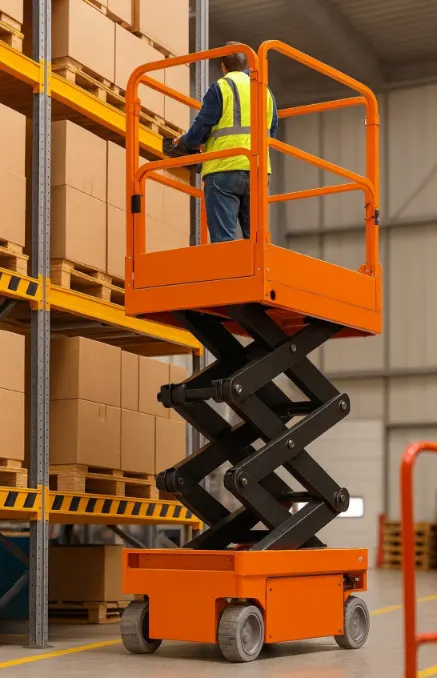
A mini scissor lift changes the work style. Instead of climbing to the job, you drive or push a platform to the job, raise it, and work from a stable deck with rails. That means both hands can stay on the task, not on balancing.
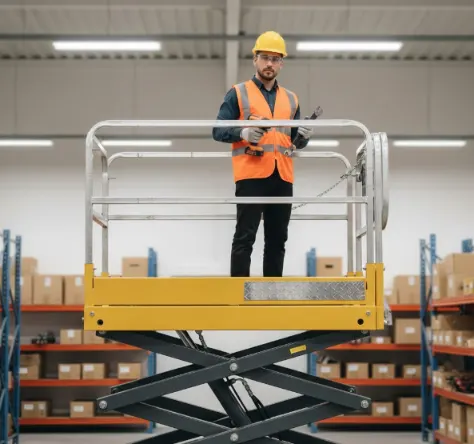
Unlike ladders, a compact indoor scissor lift gives operators a stable platform with guardrails and room to work with both hands. You can bring tools up with you, place boxes on the platform, and position yourself directly in front of the work area. For repetitive work, that “set up once, work comfortably” feeling is the biggest difference.
Key Reasons Mini Scissor Lifts Can Replace Ladders
It helps to be blunt here. In small warehouses, mini scissor lifts do not win because they are fancy. They win because they remove friction from tasks you already do every week.
Better Stability on Flat Warehouse Floors
Most indoor warehouses have flat concrete floors. That is a perfect environment for a compact scissor base. Once positioned, the platform feels steady and predictable. For tasks at height, that stability is worth more than people expect until they try it.
Safer Two-Person and Load-Carrying Tasks
Ladders are a one-person tool in practice. Two people cannot safely share a ladder task, and handing up items adds risk. A scissor lift platform can support two people in many cases, plus the tools or parts they need. That makes tasks like fixture replacement, cable routing, or rack accessory installs smoother and more controlled.
Faster Repetitive Jobs Like Stock Checks
Cycle counts, label updates, and top bin checks are repetitive. A lift lets you move along the aisle and stop at the right positions with less climbing and less set up. Small time savings stack up fast across a full inventory routine.
Reduced Physical Strain Over a Full Shift
Warehouses are already physical. A ladder adds stress in ankles, knees, and lower back. A platform reduces that load. It does not make the job effortless, but it removes the constant climb-and-balance pattern that wears people down by the end of the shift.
More Control in Tight Layouts
Tight aisles are where warehouses lose time. Repositioning a ladder around pallets, wrapping stations, or staging areas is slow. In tight layouts, a mini electric scissor lift for narrow aisles allows safe movement and positioning without blocking the entire aisle. That matters when your warehouse has to keep traffic moving.
When a Mini Scissor Lift Makes More Sense Than a Ladder
You do not need a lift for every warehouse. The decision becomes obvious when a few conditions show up.
For warehouses with frequent overhead tasks, a small electric scissor lift often delivers better efficiency than repeated ladder use. If you have weekly top-level picks, regular lighting checks, frequent rack label work, or maintenance above head height, the lift pays back in time and reduced strain.
It also makes sense when tasks involve tools, parts, or cartons that are awkward to carry while climbing. If staff regularly hold items while stepping up a ladder, that is a sign you have outgrown the ladder-only approach.
When a Ladder Is Still Enough
A ladder still makes sense when the task is quick, low, and rare. If you only need to reach a spot once a month, and it is a simple visual check with no tools or lifting, a ladder is fine. Ladders also work well for very tight corners where even a compact lift cannot fit.
The point is not to ban ladders. It is to stop using them as the default solution for tasks that happen all the time.
Choosing the Right Mini Scissor Lift for Warehouse Use
Once you decide a lift is useful, choosing the right one is mostly about fit. You want the lift that matches your aisle width, your common working heights, and your typical loads, without oversizing.
If space is limited around racks or equipment, an indoor mini scissor lift for tight spaces is usually easier to manage than ladders. Look at machine width, turning space, and how the platform positions in front of racking. Consider whether you need self-propelled movement for frequent aisle-to-aisle tasks, or whether a push-around style is enough for occasional use.
Also be honest about how your team works. If you know tasks come in batches across the building, self-propelled models often feel more natural. If tasks are localized, simpler models can still do the job well.
Conclusion
Yes, a mini scissor lift can replace ladders for a big portion of small warehouse work, especially repetitive tasks at height on flat indoor floors. The biggest gains show up in comfort, stability, and speed for routine jobs like top-level picking, label work, and maintenance. Ladders still have a place for quick, low, rare tasks, but they should not be the only option once your warehouse work at height becomes frequent. If you choose a lift that actually fits your aisles and your workload, it becomes one of those tools everyone uses without thinking twice.
Why Many Small Warehouses Rely on JQLIFT Indoor Lifting Equipment
In small warehouses, lifting equipment is not judged by how impressive it looks on paper, but by how well it fits into daily routines. JQLIFT focuses on building scissor lifts that match real indoor constraints such as narrow aisles, limited ceiling height, and frequent short-duration tasks. Instead of oversizing machines, the design approach centers on compact dimensions, stable lifting structures, and platforms suited for one- or two-person work with tools or cartons.
Attention is placed on practical details that matter over time: consistent hydraulic performance, solid welding quality, clear controls, and safety features that support everyday use rather than rare extreme conditions. Many of these lifts are optimized for flat indoor floors, quiet operation, and simple maintenance, which makes them easier to integrate into active warehouse environments.
For teams moving beyond ladders and temporary access solutions, JQLIFT scissor lifts are often selected as long-term tools that improve safety, reduce fatigue, and keep work at height efficient without disrupting tight warehouse layouts.
FAQ
Q1: Can a mini scissor lift fully replace ladders in a warehouse?
A: Not fully. Ladders still help for quick, low, occasional tasks or very tight corners. But for repeated work at height, a mini scissor lift can replace ladders for a large share of jobs.
Q2: Is a mini scissor lift safer than a ladder?
A: For frequent tasks at height, usually yes. A stable platform with guardrails reduces balance issues and awkward reaching, especially when tools or boxes are involved.
Q3: Will a mini scissor lift work in narrow aisles?
A: It can, but only if the machine width and turning space match your layout. Measure your tightest aisle and the turning area at the aisle end before you choose.
Q4: Do operators need training for a mini scissor lift?
A: Basic training is a good idea. People need to know daily checks, load limits, safe positioning, and what to do in simple emergencies. It is not complicated, but it matters.
Q5: What is the biggest sign a warehouse should move beyond ladders?
A: When overhead tasks become routine and people carry boxes or tools while climbing. If staff are on ladders daily, the upgrade usually pays back in time and reduced strain.